All species › Passerines › New World sparrows › Rufous-crowned Sparrow
Rufous-crowned Sparrow | Aimophila ruficeps
Roestkruingors | Chingolo coronirrufo
The Rufous-crowned Sparrow is a large, long-tailed sparrow of steep, stony slopes with scattered shrubs and tufts of grass, from California and the southwestern United States far into Mexico. It has a plain rufous crown, a white eye-ring and a black moustachial stripe, and holds the same territory all year.

Voice
The song is a short, fast, bubbling series of chipping notes that accelerates and then falls away, with a quality recalling a wren; the male sings from a projecting twig or stone, mainly in early spring. The call is distinctive: a nasal, plaintive dear-dear-dear in two or three notes, used by pairs to keep contact and also when alarmed. Besides that, a dry chip.
Recording: Manuel Grosselet — CC BY-NC-SA 4.0 · Benito Juarez National Park (near Oaxaca de Juárez), Oaxaca, Oaxaca, Mexico · xeno-canto
Identification
Fairly large and round-headed, with a long, rounded tail and a thick, pointed, yellowish bill. The crown is plain rufous, the supercilium and face grey, with a white eye-ring and a short rufous line behind the eye. From the base of the bill a black moustachial stripe runs across a white throat side — the most constant mark. The upperparts are rufous-brown with faint dark streaking, the underparts plain grey and unstreaked. Pacific coast birds are smaller and redder, desert birds browner.
Confusion species
Chipping Sparrow is smaller, with a white supercilium and black eyeline, a notched tail and no black moustachial stripe. Rufous-winged Sparrow, which shares part of the range, has a greyer crown with rufous stripes, a rufous shoulder and a different, accelerating song. Rufous-crowned is separated from Fox Sparrow and from Mexico's Rusty Sparrow by size and by their streaked breasts. The combination of plain rufous crown, black moustachial stripe and unstreaked grey underparts is decisive.
Habitat
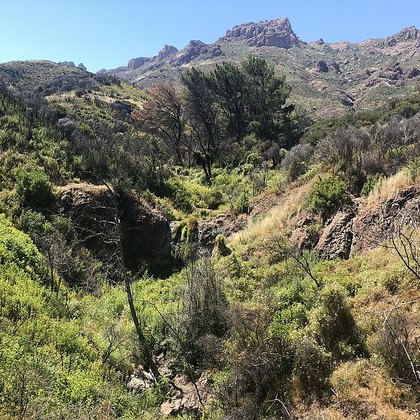
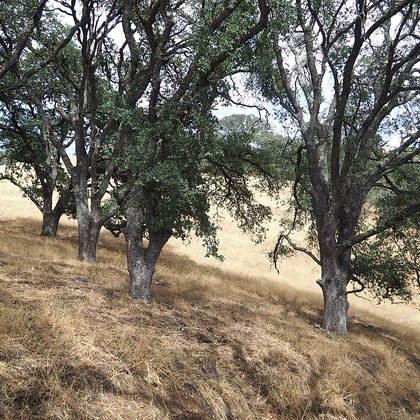
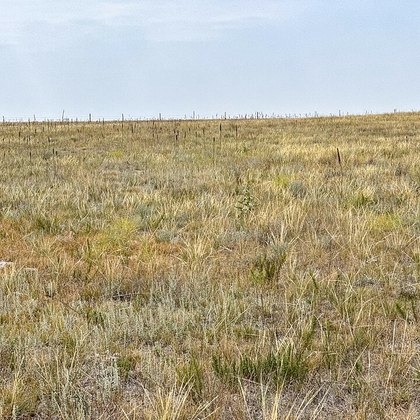
Steep, dry, stony slopes and canyon walls with scattered low shrubs and intervening patches of grass, forbs and bare ground; also chaparral (dense, hard-leaved scrub of California's Mediterranean climate) in the coastal ranges, open oak woodland, juniper and pinyon slopes and the edges of rock outcrops. It avoids closed forest and flat, densely vegetated grassland. Elevation runs from sea level in California to over 2000 metres in the mountains of Mexico.
Where the bird is most often found, arranged by the USNVC — the vegetation classification of the United States and Canada — and CMECS for sea and coast.



Range and movements
Resident in California, Arizona, New Mexico, western and central Texas, extreme southeastern Colorado and western Oklahoma, and in Mexico from northwestern Baja California and from eastern Sonora, western Chihuahua and northern Coahuila south along the mountain slopes to central Oaxaca, with an isolated population in southern Tamaulipas. It does not migrate; only mountain birds drop to lower ground in severe winters. The subspecies sanctorum of Todos Santos Island is considered extinct.
- Resident
- Breeding (summer)
- Winter
- Passage
- dark = core range, pale = thinly spread
Where and when to look
Walk halfway up a steep slope of sage or chaparral in March or April and listen for the nasal dear-dear; the bird often responds by coming up on top of a shrub. Later in the day it works along the ground beneath the shrubs and rarely flies — follow the sound rather than the movement.
Conservation
The species is listed as Least Concern (LC), with a population put at about 2.4 million birds and a stable overall trend. There is regional loss: in southern California coastal chaparral is going under housing and what remains is fragmenting, while more frequent fires turn shrub slopes into stands of non-native annual grass. The island subspecies sanctorum disappeared after cats and goats were introduced.
Scientific name
Aimophila ruficeps | (Cassin, 1852)
John Cassin described the species in 1852 as Ammodromus ruficeps; because it was later moved to another genus, author and year stand in parentheses. The specimen came from the Calaveras River east of Stockton in California. The species name is Latin: rufus 'reddish' and -ceps from caput 'head', hence 'red-headed'. The genus Aimophila goes back to Greek haimos 'thicket' and philos 'loving', after the habitat.