All species › Waterfowl › Ducks, swans and geese › Mallard
Mallard | Anas platyrhynchos
Wilde eend | Ánade azulón
The Mallard is the duck everyone knows: the male with his glossy green head and yellow bill, the female plain brown, both found on almost any body of water in North America. No other duck species in the world is so widely distributed, and none has been so thoroughly reshaped by people — as game, as a park bird, and as the ancestor of nearly every breed of domestic duck.
Voice
The familiar loud quack-quack-quack-quack, descending in pitch, comes only from the female and is the sound most people associate with 'duck'. The male is far quieter, giving mainly a soft, raspy rehb, often within the courting groups that form in late summer and winter. On flushing, both sexes give a series of short, harsh quacks.
Recording: Esperanza Poveda — CC BY-NC-SA 4.0 · Aljarafe (near Choza de Huerta Tejada), Sevilla, Andalucía, Spain · xeno-canto
Identification
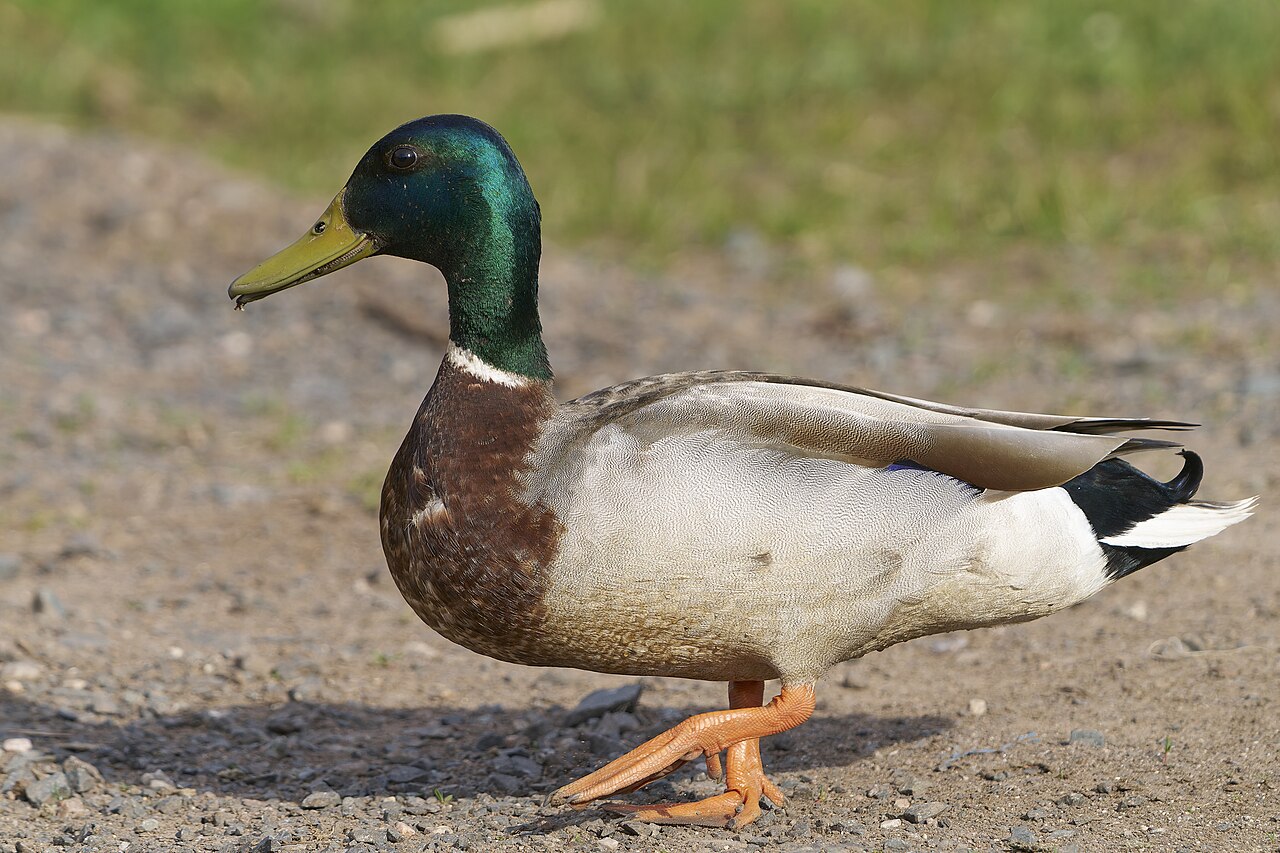
The male in breeding plumage has a glossy green head, a narrow white neck ring, a chestnut breast and a grey body, with a distinctive curled tail feather above the black rump. The female is streaky light brown with an orange-and-black bill, hard to tell from other brown ducks at a distance. Both sexes show a blue-purple wing speculum bordered with white on both sides in flight. After moulting, the male spends several months in a female-like 'eclipse' plumage, told apart by its yellow rather than orange bill.
Confusion species
American Black Duck (Anas rubripes) of the northeast is darker and more evenly brown than a female Mallard, with a plain dark head and a speculum lacking the white border; the two species interbreed where their ranges overlap, and the offspring can often not be confidently identified. In the southwest and Mexico, the closely related Mexican Duck (Anas diazi) takes over the Mallard's role — both sexes then resemble a female Mallard — and hybrids occur there too. Feral and domestic ducks on city ponds add a further layer of confusion, in every conceivable combination of white, brown and green.
Habitat
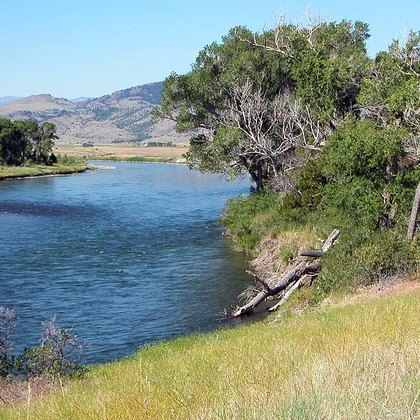
Almost any freshwater habitat, from prairie potholes and marshes to rivers, lakes, ornamental ponds and city parks, and outside the breeding season also brackish coastal waters. For nesting it needs no more than dense ground cover close to water; for food it is far from fussy, dabbling and grubbing for aquatic plants, seeds and water insects. It is one of the few ducks that thrives well in entirely artificial waters.
Where the bird is most often found, arranged by the USNVC — the vegetation classification of the United States and Canada — and CMECS for sea and coast.




Range and movements
Breeds across nearly all of Canada, Alaska and the United States, with the core of the breeding population in the prairie potholes of the northern Great Plains and the Canadian prairie provinces. Across most of the United States it is resident, helped by the year-round open water of cities and ornamental ponds; birds from the north and Canada move south in winter as far as Mexico. Escaped and released park birds have also established the species in nearly every city, independent of its natural migratory pattern.
- Resident
- Breeding (summer)
- Winter
- Passage
- dark = core range, pale = thinly spread
Where and when to look
Almost any city park with water is virtually guaranteed to hold Mallards, but for pure birds behaving naturally a marsh or prairie pothole away from town is the better spot — look there for the absence of white patches or odd bill colours, signs of domestic ancestry. In autumn, thousands of birds concentrate on shallow marshes along the migration routes; late afternoon, as they drop in to roost, is the best time to watch them arrive.
Conservation
By far the most numerous duck in North America, listed as Least Concern (LC) and with a population in the many millions, and for that reason also the most important species for waterfowl hunting. The greater concern is not its numbers but the genetic purity of its relatives: through ongoing hybridization the Mallard threatens to gradually absorb both American Black Duck and Mexican Duck, a problem locally regarded as a bigger risk than habitat loss.
Scientific name
Anas platyrhynchos | Linnaeus, 1758
Linnaeus described the species in 1758 as Anas platyrhynchos, in the same genus it still stands in today, hence no parentheses around author and year. Anas is Latin for 'duck'; platyrhynchos is Greek for 'flat-billed', after the broad, flattened bill typical of most ducks in this genus. The type locality lies in Europe, restricted by Linnaeus himself to Sweden in 1761.