All species › Waterfowl › Ducks, swans and geese › Mexican Duck
Mexican Duck | Anas diazi
Mexicaanse eend | Pato Mexicano
The Mexican Duck is the duck of the dry Mexican highlands: a stocky, plain brown duck that resembles a female Mallard in everything but distribution, with the same blue, white-bordered speculum. Almost the entire world population lives in Mexico, with a small extension into the southwestern United States; from 1973 to 2020 it was treated as a subspecies of the Mallard, until genetic research restored it to full species status.
Voice
The female gives the classic loud quack of a duck, in a descending series that falls in strength and pitch as it continues — much like the Mallard, to which the species is also closely related in voice. The male is softer and raspier, with a nasal quack that rarely carries far. During courtship the male, like the Mallard, rubs his bill along his flight feathers, producing a short rattling sound alongside his voice. In the dry season, when hundreds of birds gather on the same pool, this becomes a sustained chorus of overlapping calls.
Recording: Manuel Grosselet — CC BY-NC-SA 4.0 · Santa María Acuitlapilco, Tlaxcala, Tlaxcala, Mexico · xeno-canto
Identification
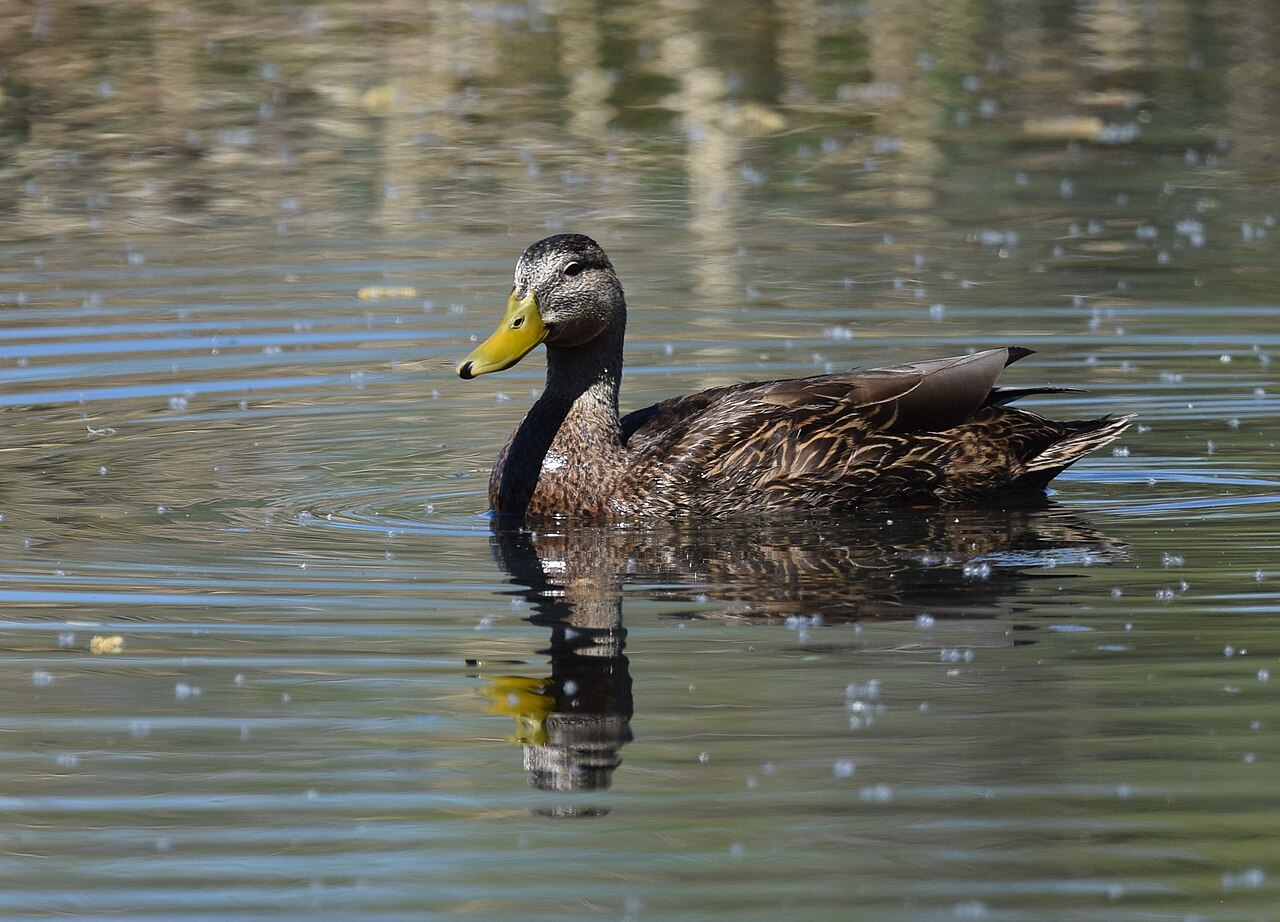
The male is warm cinnamon-brown with a yellow-orange bill; the female is duller brown with an orange bill mottled black, barely distinguishable from a female Mallard at a distance. Both sexes show a blue speculum bordered white on both sides, the same pattern as the Mallard and unlike American Black Duck or Mottled Duck. The crown and the line through the eye are darker and more sharply defined than in Mottled Duck, with which the species overlaps only in extreme southeastern Texas. The tail and undertail coverts are more uniform and darker than a female Mallard's, which are white and patterned there. Juveniles are duller still and harder to tell from a Mallard hybrid.
Confusion species
The female Mallard is paler and less evenly patterned, with a white tail and white undertail coverts that Mexican Duck lacks; where their ranges overlap — especially at the edge of towns and along irrigation canals — the two interbreed freely, exactly the problem already noted under the Mallard itself. Mottled Duck (Anas fulvigula), with which Mexican Duck overlaps only in extreme southeastern Texas, has a paler cheek, a more uniform bill colour and a less sharply defined eyestripe, and lacks the dark crown. Feral and domestic ducks around settlements add the same layer of confusion in Mexico as the Mallard does elsewhere.
Habitat
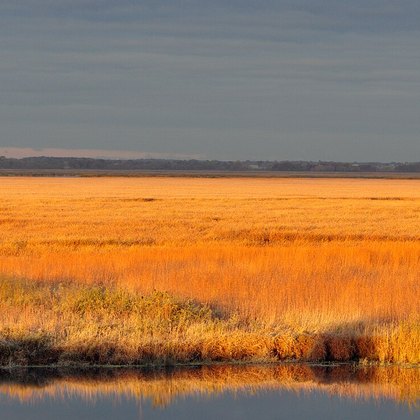
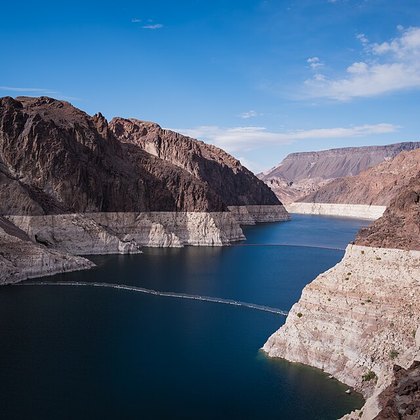
Breeds on temporary pools that form after the rains, on the savanna and farmland of the Mexican highlands; in the dry season it moves to permanent water — reservoirs, rivers and irrigation canals — where it spends the rainless months. Outside the breeding season it depends heavily on farmland for food, especially fields of garbanzo beans, wheat and barley, which have earned it the nickname 'pato garbancero' in Mexico. Marsh vegetation is enough for a nest site; for food the species is far from fussy. It uses both natural and human-made water, and is therefore less tied to untouched habitat than its rarity might suggest.
Where the bird is most often found, arranged by the USNVC — the vegetation classification of the United States and Canada — and CMECS for sea and coast.



Range and movements
Well over eight in ten Mexican Ducks live in the interior of Mexico, centred on the Central Highlands — chiefly Jalisco, Guanajuato, Michoacán and Aguascalientes — with a smaller population in the northern highlands of Chihuahua and Durango. From there the range runs north into extreme southeastern Arizona, southern New Mexico, western Texas and western Colorado, where the species is present year-round; it strays occasionally further north into Utah, Wyoming, Nebraska and Montana. The species does not migrate in the usual sense, but gathers in the dry season on the water that remains, which can look like a seasonal movement on sighting maps. Since the 2020 re-split its range is being mapped more precisely than when it still counted as a subspecies of the Mallard.
- Resident
- Breeding (summer)
- Winter
- dark = core range, pale = thinly spread
Where and when to look
Look for it on the Central Highlands of Mexico around a reservoir or irrigation canal in the dry season, when hundreds of birds crowd onto the same stretch of water. In the southwestern United States a quiet irrigation ditch or a farm marsh is more reliable than a city park, where hybrids with the Mallard lower the odds of a pure bird. Watch for the plain dark tail against the white tail of a female Mallard — the quickest distinction at a distance.
Conservation
Mexican Duck was listed as endangered from 1967 to 1978, until numbers recovered; the species is now listed as Least Concern (LC), and the Mexican population is regarded as secure, though no recent count exists since the 2020 re-split. The main concern is no longer hunting but ongoing hybridization with the Mallard, which keeps establishing itself further into Mexican farmland and cities; in places a substantial share of the population already carries Mallard genes. Loss of the temporary rain pools the species breeds in, drained for agriculture, remains a further concern.
Scientific name
Anas diazi | Ridgway, 1886
Ridgway described the species in 1886 directly as Anas diazi, in the same genus it still stands in today, so author and year do not stand in parentheses — not even during the years it was treated as a Mallard subspecies from 1973 to 2020, since that changed only its rank, not its genus. The species name honours the Mexican engineer and geographer Agustín Díaz, who was carrying out fieldwork in Mexico at the time. The type locality is San Ysidro, in the state of Puebla.