All species › Waterfowl › Ducks, swans and geese › American Black Duck
American Black Duck | Anas rubripes
Amerikaanse zwarte eend | Pato negro americano
The American Black Duck is the dark duck of the marshes and coastal waters of the northeast: unlike most of its relatives, male and female are coloured almost alike. It was once the most numerous duck on the Atlantic coast and has declined sharply over the past century — through hunting and habitat loss, but increasingly also through hybridization with the Mallard (Anas platyrhynchos).
Voice
The female quacks loudly, in a six-note series that falls in pitch with the accent on the second note — similar to the Mallard but somewhat coarser. The male is quieter, giving mainly a hoarse, reedy rehb, with a thin rising-and-falling whistle added during courtship. While displaying, the male also rubs the tip of his bill along the underside of his wing, producing a short rattling sound unrelated to his voice. In mixed flocks with Mallards, the female's call is a clue to the species.
Recording: Stanislas Wroza — CC BY-NC-SA 4.0 · Charlevoix (near Saint-Joseph-de-la-Rive), Capitale-Nationale, Québec, Canada · xeno-canto
Identification
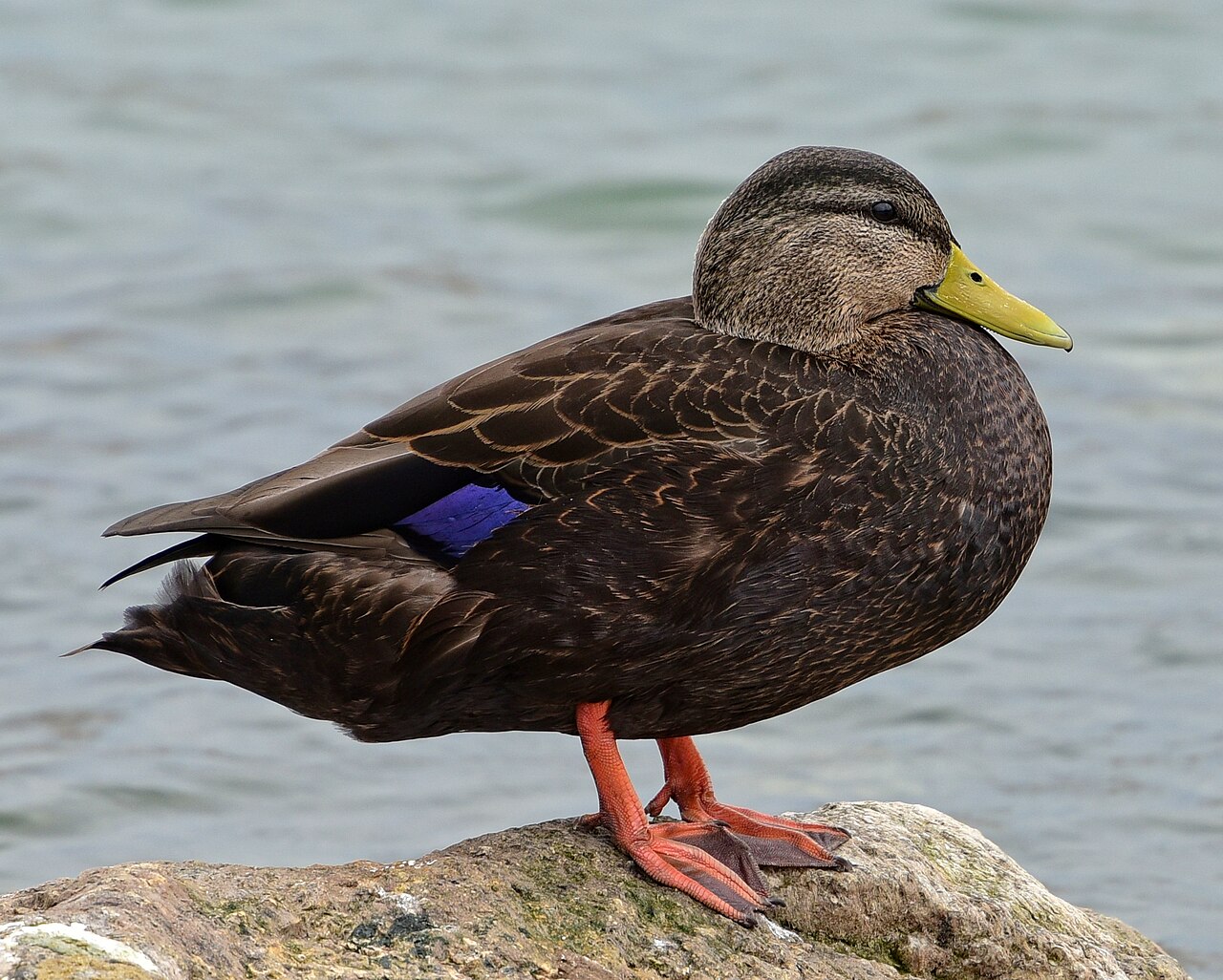
Male and female differ little: both are dark chocolate-brown on the body, with a paler, finely streaked greyish-brown face and a dark crown. The male has a plain olive-yellow bill, the female a duller one mottled greenish-black. In flight the sharp contrast between the dark body and the white underwing stands out, brighter white than on a Mallard. The speculum is purple, without the white border a Mallard shows. The legs are coral-red, brighter than in any relative. Juveniles resemble the adult but are more vaguely marked on the face.
Confusion species
The female Mallard is paler-bodied, with an orange-and-black bill and a blue speculum bordered white instead of the American Black Duck's unbordered purple one; where their ranges overlap the two interbreed freely, and the offspring can often not be told apart with confidence — the same problem already noted under the Mallard itself. Mottled Duck (Anas fulvigula) is paler, with a plainer, unstreaked face and a black spot at the base of the bill that American Black Duck lacks; the two species barely overlap. The female Gadwall is likewise light brown but slimmer-built, with a thin orange-and-black bill and a small white wing patch the American Black Duck lacks. Female Surf and Black Scoters can look like a dark duck from a distance, but sit lower in the water and lack the pale face and white underwing shown in flight.
Habitat
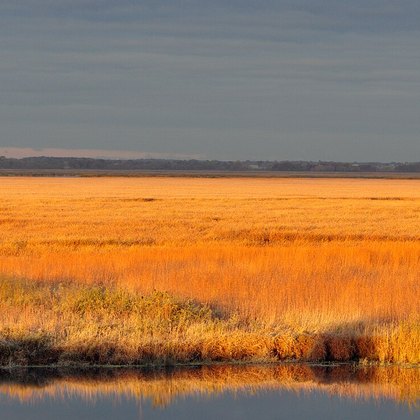
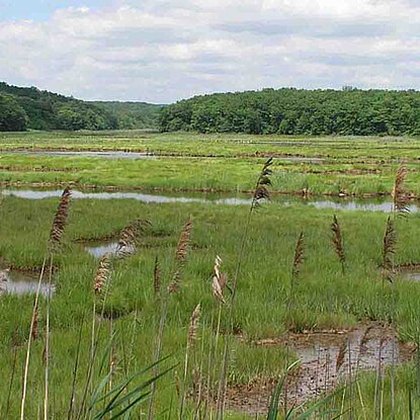
Breeds on cold, wooded water: beaver ponds, streams lined with speckled alder, shallow lakes with reeds and sedges, and acid bogs — shyer of open, human-made water than the Mallard. Outside the breeding season it shifts to the coast: brackish marshes along bays, flooded farmland marshes, estuaries and river deltas. It avoids heavily polluted water and open water with no shoreline cover. In winter coastal marshes it often mixes with Mallards and sea ducks on the same mudflats.
Where the bird is most often found, arranged by the USNVC — the vegetation classification of the United States and Canada — and CMECS for sea and coast.



Range and movements
Breeds from northeastern Saskatchewan through Manitoba, Ontario and Quebec to Newfoundland and Labrador, and south through the Great Lakes and the Appalachians to the Atlantic coast of North Carolina. It winters mainly along the Atlantic coast, with the core of the wintering population between New England and South Carolina; in the Great Lakes and the northeast some birds stay year-round. Around the mid-twentieth century it was still the most numerous duck of the east; since then the US population has fallen by more than eighty per cent, while the Canadian population has stayed comparatively stable. The Mallard's spread into formerly wooded country is seen as one of the causes, alongside hunting and the loss of forested wetland.
- Resident
- Breeding (summer)
- Winter
- Passage
- dark = core range, pale = thinly spread
Where and when to look
Look for it in winter in a coastal marsh or estuary at low tide, when birds feed on the exposed mudflats; at high tide they gather instead on open water nearby. In mixed flocks with Mallards, watch for the dark, unstreaked body and the lack of a white tail border — the white underwing in flight is the quickest clue at a distance. Early in the morning, before the rest of the marsh wakes, the female's falling call carries furthest.
Conservation
The American Black Duck has declined sharply in the United States since the mid-twentieth century — roughly three-quarters fewer breeding birds — while the Canadian population has stayed more stable; the world breeding population is now estimated at around seven hundred thousand. Tighter hunting regulations have slowed the decline since the 1980s but not reversed it. The greatest threat is no longer hunting but ongoing hybridization with the Mallard, which thrives better in disturbed and urban habitat and gradually displaces and genetically absorbs the Black Duck. Loss of forested wetland on the breeding grounds remains a further concern.
Scientific name
Anas rubripes | Brewster, 1902
Brewster described the bird in 1902 as a subspecies, Anas obscura rubripes, within the genus of the now-abandoned 'dusky duck' Anas obscura; later authors raised it to a full species, Anas rubripes, without changing the genus, so author and year do not stand in parentheses. rubripes is Latin for 'red-footed', from ruber, 'red', and pes, 'foot' — after the coral-red legs that set the species apart from its relatives. The type locality lies on the shore of Lake Umbagog in New Hampshire, where Brewster first described the bird.