All species › Cuckoos › Cuckoos › Mangrove Cuckoo
Mangrove Cuckoo | Coccyzus minor
Mangrovekoekoek | Cuclillo de Manglar
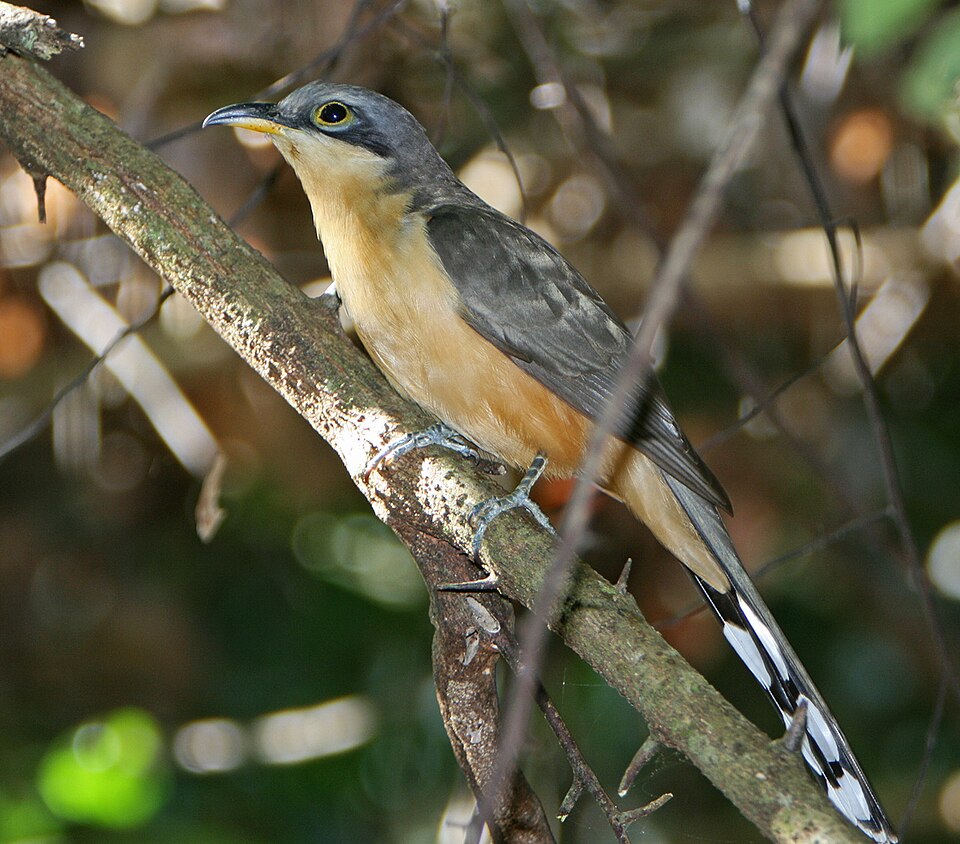
The Mangrove Cuckoo is the only cuckoo in North America to stay in the mangroves all year, and in the United States it occurs only in southern Florida. A black mask through the eye and a warm buff belly set it apart from its relatives. Observers rarely get to see it: it sits still inside the canopy and moves without a sound.
Voice
The call is a slow series of hard, nasal gaw-gaw-gaw-gaw notes that drop in pitch and slow towards the end, as though the air were running out. It sounds heavier and more throaty than the knocking of Yellow-billed Cuckoo and lacks that wooden attack. Calling is concentrated in early spring, when males mark out their ground, and comes almost always from dense foliage; outside that season a bird may be silent for weeks. A soft rattling krrr is heard only close to the nest.
Recording: GABRIEL LEITE — CC BY-NC-SA 4.0 · Mayagüez, Isla de Mona e Islote Monito, Mayagüez, Puerto Rico · xeno-canto
Identification
Slim and long-tailed, brown above and creamy white below, turning distinctly buff or tawny towards the rear on belly and undertail coverts. A black stripe runs through the eye and continues as a mask behind the ear coverts; the eye-ring is yellow to greyish. The bill is mostly black with a yellow base to the lower mandible. The undertail is boldly blocked black and white, with broad white ends to the feathers. There is no rufous in the wing, and the flight is low, straight and short, usually from one bush to the next.
Confusion species
Yellow-billed Cuckoo is the main confusion: it has clean white underparts without buff, no black mask, and shows a rufous panel in the wing that Mangrove Cuckoo lacks. Black-billed Cuckoo has an all-dark bill, a red eye-ring and only narrow white tips beneath the tail. In Florida all three overlap on migration, so face pattern and belly colour have to be taken together and not one of them alone.
Habitat
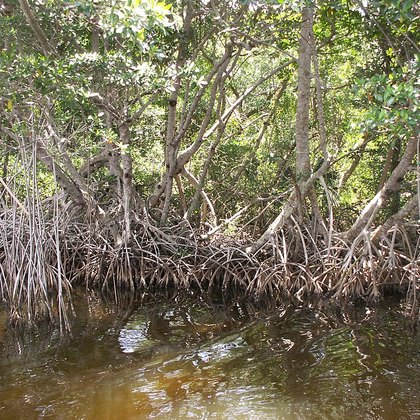
Mangrove of red and black mangrove is its core habitat, with beach scrub and the tropical hardwood hammocks of the Keys and the southern mainland alongside it. Farther south it also uses dry forest, second growth, orchards and gardens, including well away from water; it is less tied to salt water than its name suggests. What it needs is a closed, opaque canopy at modest height in which it can forage unseen. It avoids open ground and tall closed rainforest.
Where the bird is most often found, arranged by the USNVC — the vegetation classification of the United States and Canada — and CMECS for sea and coast.



Range and movements
Resident from southern Florida through the whole Caribbean island chain, along both coasts of Mexico and Central America, and on to the Atlantic coast of South America as far as the mouth of the Amazon. It is not a long-distance migrant; in Florida it is present all year but far more obvious in spring and early summer, because that is when it calls. Beyond Florida it appears only very rarely along the Gulf Coast and in Texas. Its Florida range has contracted through the twentieth century with the loss of mangrove, although it is spreading north again locally along the coast.
- Resident
- Breeding (summer)
- Winter
- Passage
- dark = core range, pale = thinly spread
Where and when to look
Work the mangrove channels of the Everglades or the roadsides of the Florida Keys by boat or on foot in March, April or May, and stop to listen; outside that calling season the odds are poor. If a bird answers, do not look for movement but for a long horizontal line in the gloom of the canopy, usually two to four metres up. Patience works better here than walking.
Conservation
The species is listed as Least Concern (LC); the world population is estimated at about two hundred thousand birds, few for so widespread a species, and its restricted range places it on the watch list. In Florida it is declining through loss and fragmentation of mangrove and coastal hardwood along the built-up shore. Against that, it has proved able to reoccupy regrown woodland and even small urban parcels.
Scientific name
Coccyzus minor | (Gmelin, 1788)
Gmelin described the species in 1788 as Cuculus minor; because it was later placed in another genus, author and year stand in parentheses. The genus Coccyzus was introduced by Vieillot in 1816, from Greek kokkuzo ('to call like a cuckoo'). The species name is Latin for 'smaller', given because the bird is smaller than the cuckoos Gmelin compared it with. The specimen described came from Cayenne, after a plate by Daubenton.