All species › Cuckoos › Cuckoos › Black-billed Cuckoo
Black-billed Cuckoo | Coccyzus erythropthalmus
Zwartsnavelkoekoek | Cuclillo Piquinegro
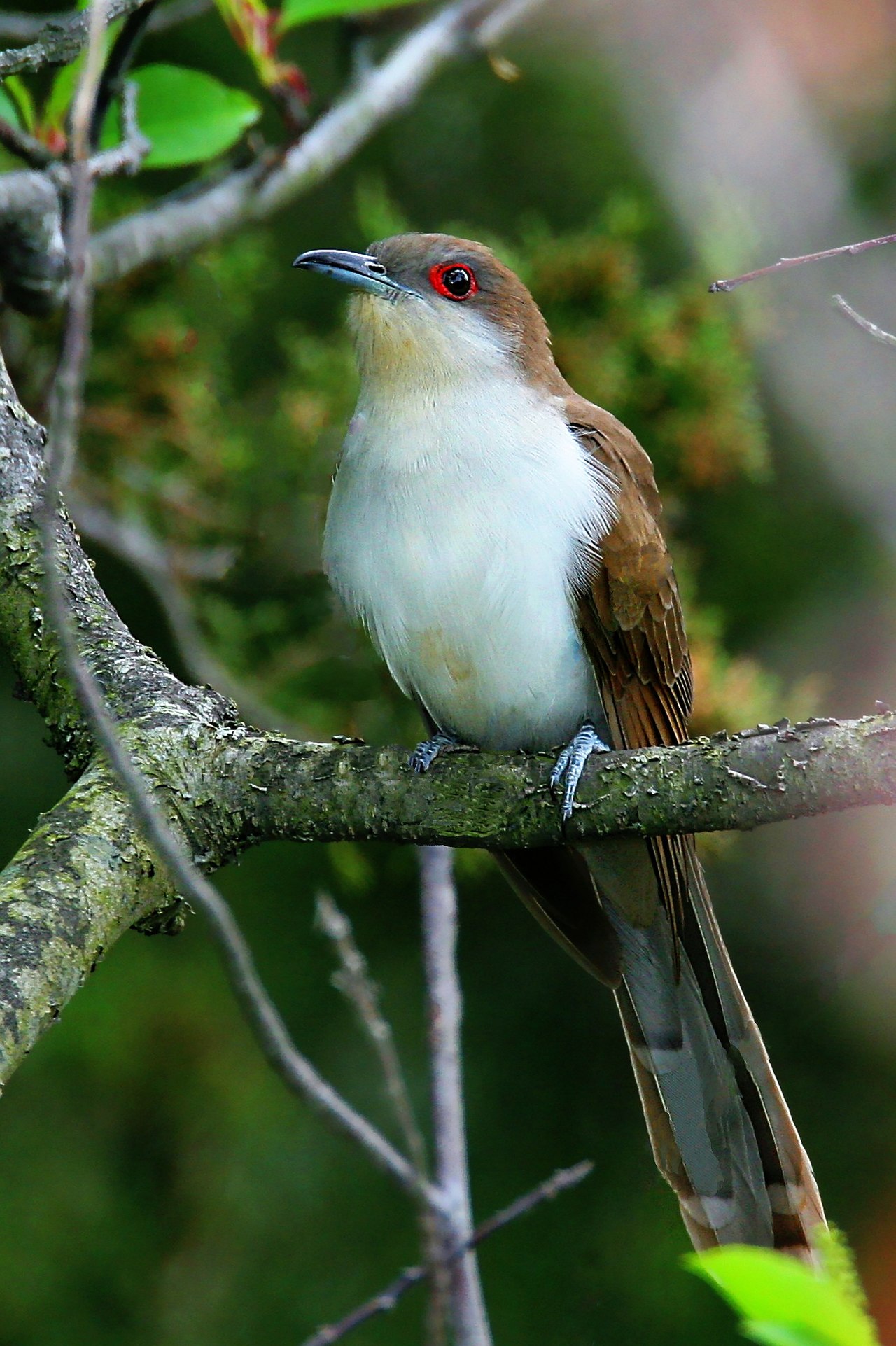
The Black-billed Cuckoo is the most retiring of the three North American cuckoos: plain brown above, white below, with an all-black bill and a red ring around the eye. It eats caterpillars by the hundred and follows outbreaks of webworm and tent caterpillar with its nesting. Of all the birds of the East it is among the most steeply declining.
Voice
The call is a soft, hollow coo-coo-coo in groups of two to four notes, low and even in pitch, without the slowing with which Yellow-billed Cuckoo ends. It sounds more like a distant dove than like a cuckoo and carries well through dense foliage. In the breeding season it calls at night as well, for hours on end, and that is often the only way to know it is there. When disturbed it gives a short muffled knocking that stops after a few notes.
Recording: Jeff Stewart — CC BY-NC-SA 4.0 · Cavan-Monaghan (near Millbrook), Peterborough County, Ontario, Canada · xeno-canto
Identification
Slim and long-tailed, evenly grey-brown above without any warm tone, white to dingy white below. The bill is dark throughout, lower mandible included, and the eye is ringed in red, most obviously in old birds. The undertail is grey with only narrow white tips to the feathers, not the broad white blocks of its relative. There is no rufous in the wing, though a faint warm cast can show in flight. Perched it holds a bowed, slightly hunched posture; young birds have a yellowish rather than red eye-ring and a paler face.
Confusion species
Yellow-billed Cuckoo is the main confusion: it has a yellow lower mandible, a yellow eye-ring, a rufous panel in the wing and broad white blocks beneath the tail. Mangrove Cuckoo has a black mask through the eye and a buff belly, and keeps to southern Florida and the Caribbean. Young Yellow-billed Cuckoos in autumn have a duller bill and a less blocked tail and resemble this species most closely; then look at the underside of the tail, where the narrow white tips settle it.
Habitat
Deciduous and mixed woodland with a dense shrub layer, abandoned farmland grown up with aspen, birch and hawthorn, and willow thickets along water. On average it sits in larger and more closed woodland than Yellow-billed Cuckoo and more often at the edge of boggy ground. It uses overgrown orchards and thick hedgerows too, but avoids open farmland and bare pasture. In winter it lives in forest and scrub in tropical South America.
Where the bird is most often found, arranged by the USNVC — the vegetation classification of the United States and Canada — and CMECS for sea and coast.




Range and movements
Breeds from central and southern Alberta east to Quebec and the Maritimes, and in the United States from Montana to southeastern Virginia, with outliers south along the Appalachians. It is a long-distance nocturnal migrant wintering in Colombia, western Venezuela and central Peru, far beyond this map; on the way it crosses the Gulf and the Caribbean and turns up on the islands in autumn. Numbers of breeding pairs swing widely from year to year with the supply of caterpillars, so a district may be occupied one season and empty the next.
- Breeding (summer)
- Passage
- dark = core range, pale = thinly spread
Where and when to look
Listen after dark in June: on a still night beside a thickly grown woodlot the soft coo-coo-coo is often the only evidence that the species is breeding. By day it pays to return to the same spot during a caterpillar outbreak, when the birds feed low and sit still longer than usual. Look for the red eye-ring, which shows well at short range in good light.
Conservation
The species is listed as Least Concern (LC). The world population is estimated at about 880,000 birds and fell by more than two per cent a year between 1970 and 2019, close to two thirds of the stock in all. Pesticides reduce the supply of caterpillars the species depends on, and collisions with tall structures take a toll on migration. To that is added loss and fragmentation of scrub and young woodland, on the breeding grounds and in the wintering range alike.
Scientific name
Coccyzus erythropthalmus | (Wilson, 1811)
Wilson described the species in 1811 as Cuculus erythropthalma, in the fourth volume of his American Ornithology; because it was later moved to another genus, author and year stand in parentheses. The genus Coccyzus was introduced by Vieillot in 1816, from Greek kokkuzo ('to call like a cuckoo'). The species name means 'red-eyed', from eruthros ('red') and ophthalmos ('eye'); Wilson dropped a letter, and that spelling has been kept as the original. The specimen described came from near Philadelphia in Pennsylvania.