All species › Cuckoos › Cuckoos › Common Cuckoo
Common Cuckoo | Cuculus canorus
Koekoek | Cuco común
In North America the Common Cuckoo is a rare visitor from Asia: it does not breed on this continent, but reaches the islands off western Alaska regularly in late spring. It is the bird that lays its egg in another species' nest and leaves the rearing entirely to the foster parents. In flight it has something of a small hawk about it: pointed wings, a long tail and quick shallow beats that never rise above the level of the back.
Voice
The call it is named for is the two-syllable cuck-oo of the male, a soft hollow whistle with a falling second part that carries for kilometres across open country. The female sounds entirely different: a fast, bubbling, watery kwik-wik-wik-wik that suggests liquid poured from a bottle. In Alaska the visitors are usually silent, so they are rarely found by ear; a calling bird there is exceptional. When agitated it also gives a hoarse barking gowk.
Recording: Tanguy Loïs — CC BY-SA 4.0 · Arrondissement de Mont-de-Marsan (near Onesse-Laharie), Landes, Nouvelle-Aquitaine, France · xeno-canto
Identification
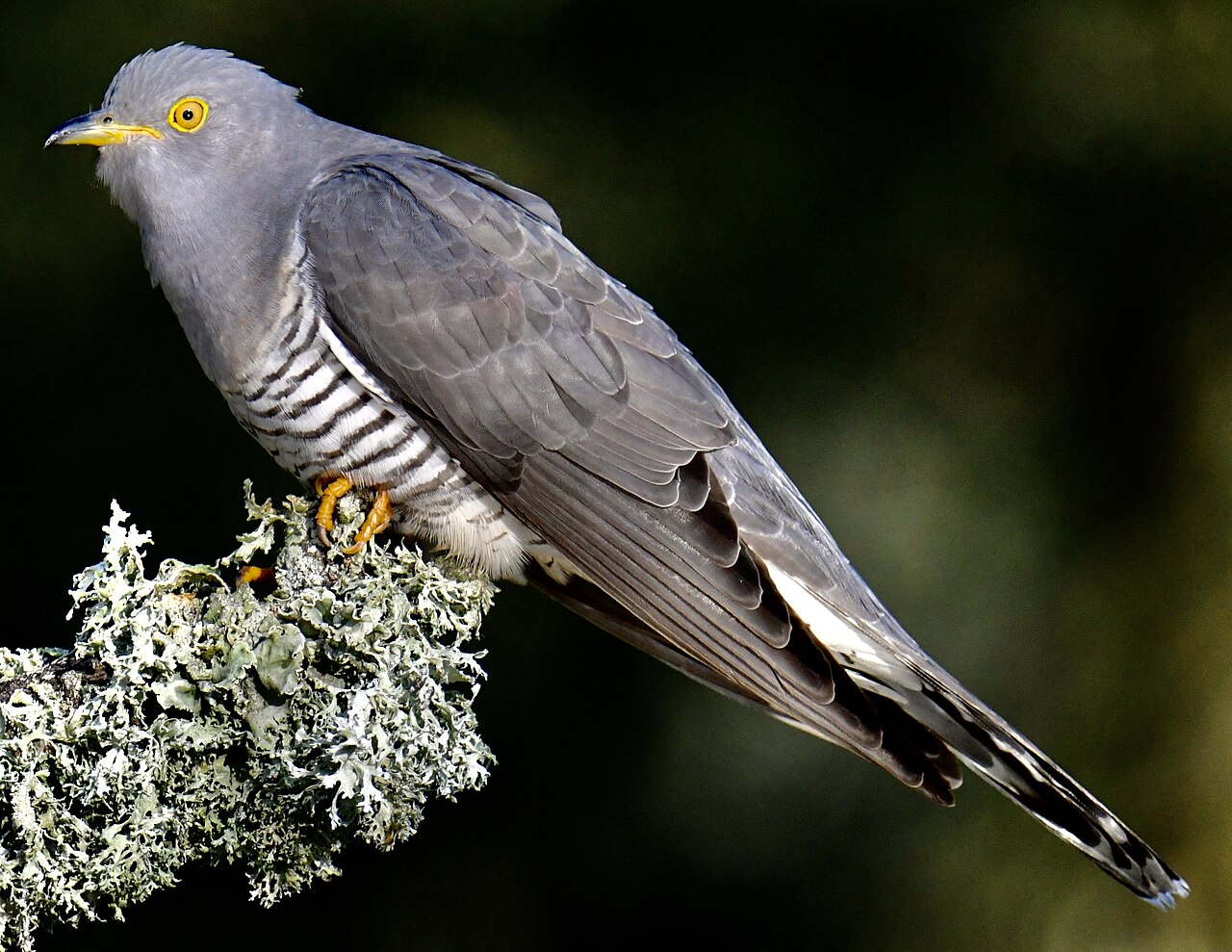
A slim, long-tailed bird with slate-grey head, breast and upperparts and a white belly finely barred with black. Eye, eye-ring and feet are bright yellow, and the tail is dark with small white spots along the edges and at the tip. Females are usually coloured like males but often show a rusty wash across the breast; a proportion of females wear an entirely rufous, heavily barred plumage. Young birds are brown or grey with dark bars and have a white patch on the nape. Perched it droops its wings and holds the tail slightly raised, a posture recognisable at a distance.
Confusion species
The chief difficulty is Oriental Cuckoo (Cuculus optatus), which appears in western Alaska in the same weeks and looks almost identical; it averages broader and more widely spaced belly bars and a buff cast to the undertail coverts, but many birds cannot be named with certainty in the field. In flight a cuckoo is taken for a Sharp-shinned Hawk or a small falcon; it lacks the hooked bill and the spread primaries, though, and the wingbeat stays below the horizontal. The American cuckoos of the genus Coccyzus are brown above and white below without barring and have a much heavier, pale bill.
Habitat
In Alaska it turns up on treeless ground: tundra with dwarf willow, old beach ridges, village edges and the low scrub of the river valleys on the Bering Sea islands. Nothing there resembles its usual habitat, and the birds sit out in the open on posts, roofs and wires. On its Eurasian breeding grounds it uses open woodland, hedgerows, heath, marsh and reedbed — anywhere songbirds build nests it can use. It avoids dense closed forest and wholly bare, plantless ground.
Where the bird is most often found, arranged by the USNVC — the vegetation classification of the United States and Canada — and CMECS for sea and coast.



Range and movements
It breeds throughout Europe and Asia as far as the east coast of Siberia and winters in Africa and tropical Asia. Birds that overshoot too far east reach the western Aleutians, the Pribilofs and St. Lawrence Island, where small numbers are seen regularly in late spring and early summer. There are far fewer records from mainland Alaska, and beyond Alaska it has been recorded only a handful of times. Nothing indicates that it breeds in North America; these are overshooting migrants, not an established population.
- Breeding (summer)
- Passage
- dark = core range, pale = thinly spread
Where and when to look
Anyone wanting to see it in North America must be on one of the Bering Sea islands in the last week of May or in June and scan the open ground for a long grey shape on a lookout perch or flying low across the tundra. On every bird check the undertail coverts and the width of the belly bars at once, and take photographs: the separation from Oriental Cuckoo is settled afterwards, not through the binoculars. A calling bird is a stroke of luck.
Conservation
Worldwide the species is numerous and not threatened; in parts of western and northern Europe numbers have fallen for decades, which is bound up with the decline of the songbirds that raise it and of the large caterpillars it lives on. For North America conservation does not arise: it comes only as a visitor and has no breeding ground here that could be protected.
Scientific name
Cuculus canorus | Linnaeus, 1758
Linnaeus described the species in 1758 as Cuculus canorus; because it still stands in its original genus, author and year carry no parentheses. The genus name is the classical Latin word for cuckoo, formed after the call itself, as the English word is. The species name means 'melodious' or 'tuneful', from canere ('to sing'). Linnaeus gave the type locality simply as Europe; it was later restricted to Sweden.