All species › Sandgrouse › Sandgrouse › Chestnut-bellied Sandgrouse
Chestnut-bellied Sandgrouse | Pterocles exustus
Roodbuikzandhoen | Ganga moruna
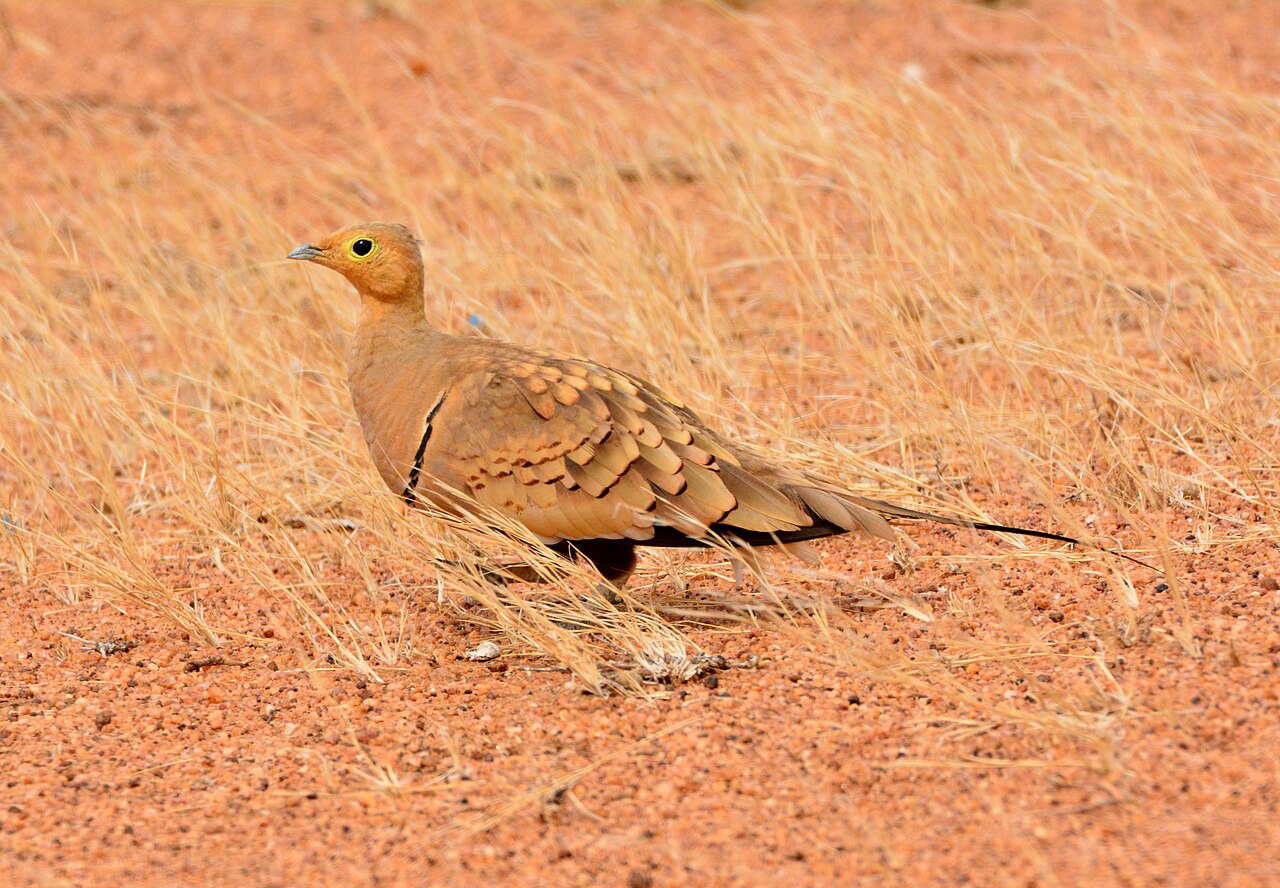
The Chestnut-bellied Sandgrouse is a desert bird of Africa and India that has lived on the dry lava plains of the island of Hawaii since 1961. It is built like a pigeon, with pointed wings and two elongated central tail feathers that trail behind it like a pin. The family is best known for the male carrying water to his chicks in his belly feathers, which hold it like a sponge.
Voice
In flight a sharp, over-slurred whistle followed by lower, guttural notes: whit-ke-tarr, repeated for as long as the flock is on the move. A party heading for water sounds like a continuous frog-like double cluck coming out of the sky from every direction. On the ground it is all but silent. Anyone looking for it therefore listens upward: the sound almost always comes before the bird.
No freely licensed recording has been found for this species yet; what to listen for is described below.
Identification
A compact sandy bird with a small head, short neck and long pointed wings; the two central tail feathers taper into fine points that give the tail a needle shape. The male has a grey-green head with an ochre-yellow throat, a pale breast cut off below by a narrow black line edged in white, and a dark brown belly that looks black in the field. The wing coverts are golden yellow with black edges, which makes a perched bird look scaled. The female lacks the breast line and is finely streaked, spotted and barred in sand, yellow and brown over the whole body — invisible on bare ground. Both sexes show a dark underwing in flight and travel fast, low and dead straight, on quick beats without gliding.
Confusion species
There is no other sandgrouse in the region, so confusion comes from birds that share the same bare ground. Gray Francolin (Francolinus pondicerianus) and Erckel's Francolin are as sandy, but round-winged and heavier bodied, and would rather run than fly. Rock Pigeon is the same size and as fast, but has a broad square-cut tail and glides with raised wings. The Pacific Golden-Plover that winters there (Pluvialis fulva) also stands out on the open lava, but is shorter-winged, with a squat head and a large eye; the needle tail and dark belly of the sandgrouse settle it.
Habitat
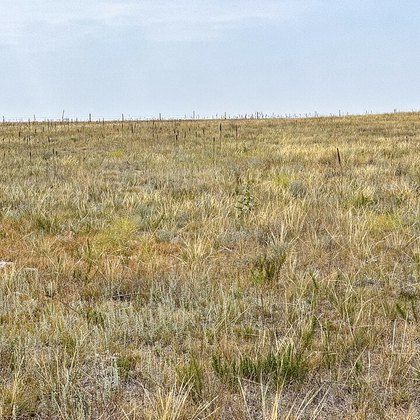
Bare dry lava plains and ranchland on the lee side of the island of Hawaii, from near sea level to high on the slopes, with scattered kiawe and dry grass holding seed-bearing weeds. It wants open country with a clear view and little tall growth; scrub and forest it avoids entirely. Its second requirement is water: it eats nothing but dry seed and so must drink daily, which means it never settles further from a drinking place than it can cover in one flight. Stock tanks, reservoirs and coastal pools serve well enough.
Where the bird is most often found, arranged by the USNVC — the vegetation classification of the United States and Canada — and CMECS for sea and coast.




Range and movements
Its original range runs from West Africa and the Sahel through Arabia to India; on this continent it occurs only in Hawaii. The birds came from India and were released by the state game division: 118 on Kauaʻi and 137 on Molokaʻi on 30 March 1961, 123 on the island of Hawaii on 25 March 1961, followed by another 370 there in the spring of 1962. Only the island of Hawaii held them; the birds on Kauaʻi and Molokaʻi were not reported again shortly after release. The present range lies in the dry country south of Waimea, near the Kohala airfield, along Kawaihae Road and Waikoloa Stream down to 400 metres, upslope towards Pōhakuloa along the Saddle Road, and north to the Hawi area.
- Resident
Where and when to look
Look for it at water rather than on the ground: stand by a stock tank or a pool on the lee side shortly after sunrise and wait. The flocks come in during the first hours after sunrise, drink for a minute or two and are gone; at other times the birds are next to impossible to find on the lava. So watch the sky and listen for the clucking, and as they come in look for the sharp point of the tail.
Conservation
Worldwide the species is numerous and not threatened, from the Sahel to India. The Hawaiian stock is small and confined to one island, but has held its ground since the 1980s: more than 200 birds stood at a single drinking place in October 1981, and 254 were counted at the Upolu airstrip on 25 December 2013. Where the species declines elsewhere, it is mainly because drinking places dry up and because it is heavily hunted.
Scientific name
Pterocles exustus | Temminck, 1825
Temminck described the species in 1825 as Pterocles exustus, in his sequel to Buffon's coloured bird plates; author and year stand without parentheses, because the species is still in the genus in which it was described. That genus Pterocles Temminck had made himself ten years earlier, in 1815, from Greek pteron, 'wing', and kleos, 'fame' — a name for a bird known for its flight. exustus is Latin for 'scorched', after the dark brown, as if burnt, belly. The locality given was the west coast of Africa with Egypt and Nubia; it was later restricted to Senegal.