All species › Nightjars › Nightjars and nighthawks › Mexican Whip-poor-will
Mexican Whip-poor-will | Antrostomus arizonae
Mexicaanse whippoorwill | Chotacabras Cuerporruín Mexicano
Mexican Whip-poor-will is the mountain dweller among the whip-poor-wills: it occupies the pine-oak forests of the southwestern United States and Mexico, at elevations its eastern counterpart never reaches. It was only recognized as a full species in 2010, separated from Eastern Whip-poor-will mainly on the strength of its song.
Voice
The song is the familiar three-syllable whip-poor-will, but lower-pitched and burrier than the Eastern's, delivered in a noticeably slower, lazier rhythm. Males sing mainly just after sunset and just before dawn, sometimes through the whole night during the breeding season, from a branch within the forest. A short quirt or grip serves as a contact call between partners, and when agitated the bird gives a sequence of low growls mixed with short clucks.
Recording: Manuel Grosselet — CC BY-NC-SA 4.0 · Tierra Colorada, Santa Catarina Ixtepeji, Oaxaca, Mexico · xeno-canto
Identification
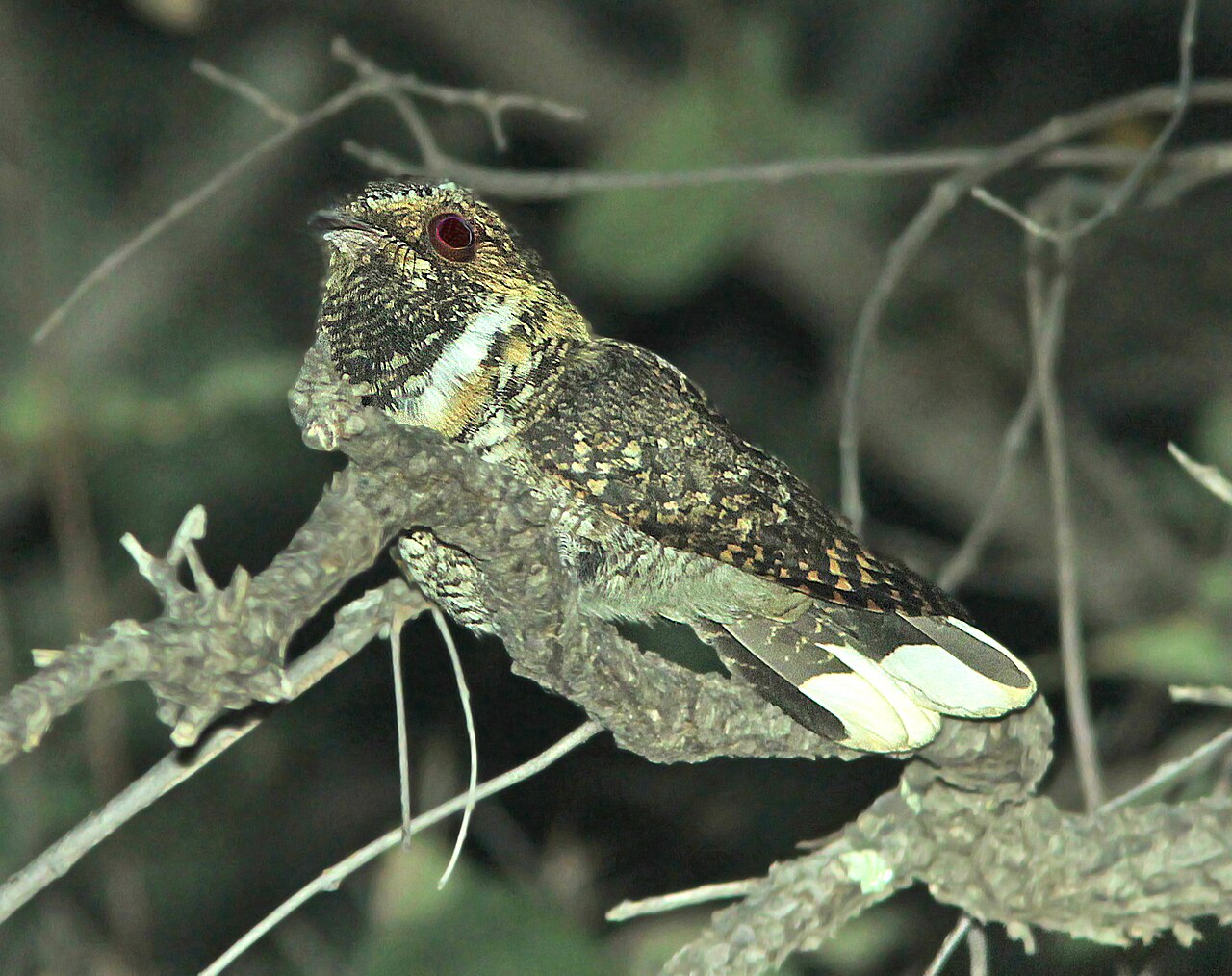
Barely distinguishable from Eastern Whip-poor-will: a medium-sized nightjar with a large round head, finely marbled grey-brown-black plumage, and, in the male, broad white corners to the outer tail feathers that are narrower and buffy in the female. The silhouette is just as front-heavy and tapering as the Eastern's; on looks alone the species cannot be safely identified in the field.
Confusion species
Eastern Whip-poor-will (Antrostomus vociferus) is essentially indistinguishable in plumage; the difference lies in the song, higher-pitched and faster in the Eastern, and in range, which lies east and north of the Mexican's with almost no overlap. Chuck-will's-widow (A. carolinensis) is clearly larger with buffy rather than white tail corners. Buff-collared Nightjar (A. ridgwayi) is smaller, lacks the broad white tail corners, and gives a short, accelerating series rather than a chanted song.
Habitat
Humid to semiarid pine-oak forest in the mountains, typically between 1,400 and 3,000 metres in Mexico and from about 1,700 metres upward in the southwestern United States: wooded canyons, pine-juniper-oak woodland in West Texas, and mixed oak-conifer forest in the mountains of California. In winter it moves down into lower-elevation forest.
Where the bird is most often found, arranged by the USNVC — the vegetation classification of the United States and Canada — and CMECS for sea and coast.




Range and movements
Breeds from southeastern California, Arizona and New Mexico to the extreme southwest of Texas, and south through the mountains of Mexico. The northernmost birds withdraw south for the winter; more southerly populations remain year-round. Little is known about the exact migration routes and wintering grounds — the species ranks among the least-studied breeding birds in North America.
- Resident
- Breeding (summer)
- Winter
- Passage
- dark = core range, pale = thinly spread
Where and when to look
In May or June, climb a wooded canyon in southern Arizona or New Mexico up into the pine-oak zone and listen just after sunset: the slower, lower song sets it apart at once from Eastern Whip-poor-will further east. By day it is, like its relatives, rarely seen.
Conservation
The species is listed as Least Concern (LC); the world population is estimated at around 190,000 birds; the trend is unknown. The species sits on the Yellow Watch List in North America, with a Continental Concern Score that points to moderate vulnerability, largely because related insect-eating nightjars elsewhere have declined sharply.
Scientific name
Antrostomus arizonae | Brewster, 1881
Brewster described the bird in 1881 as the subspecies Antrostomus vociferus arizonae, already in its current genus — hence no parentheses around author and year, even though its rank later changed from subspecies to species. The type locality lies in the Chiricahua Mountains in Arizona, the source of the species name arizonae. Only in 2010 was the bird split from Eastern Whip-poor-will as a separate species, based on differences in song, egg size and DNA.