All species › Nightjars › Nightjars and nighthawks › Lesser Nighthawk
Lesser Nighthawk | Chordeiles acutipennis
Texasnachtzwaluw | Añapero Garrapena
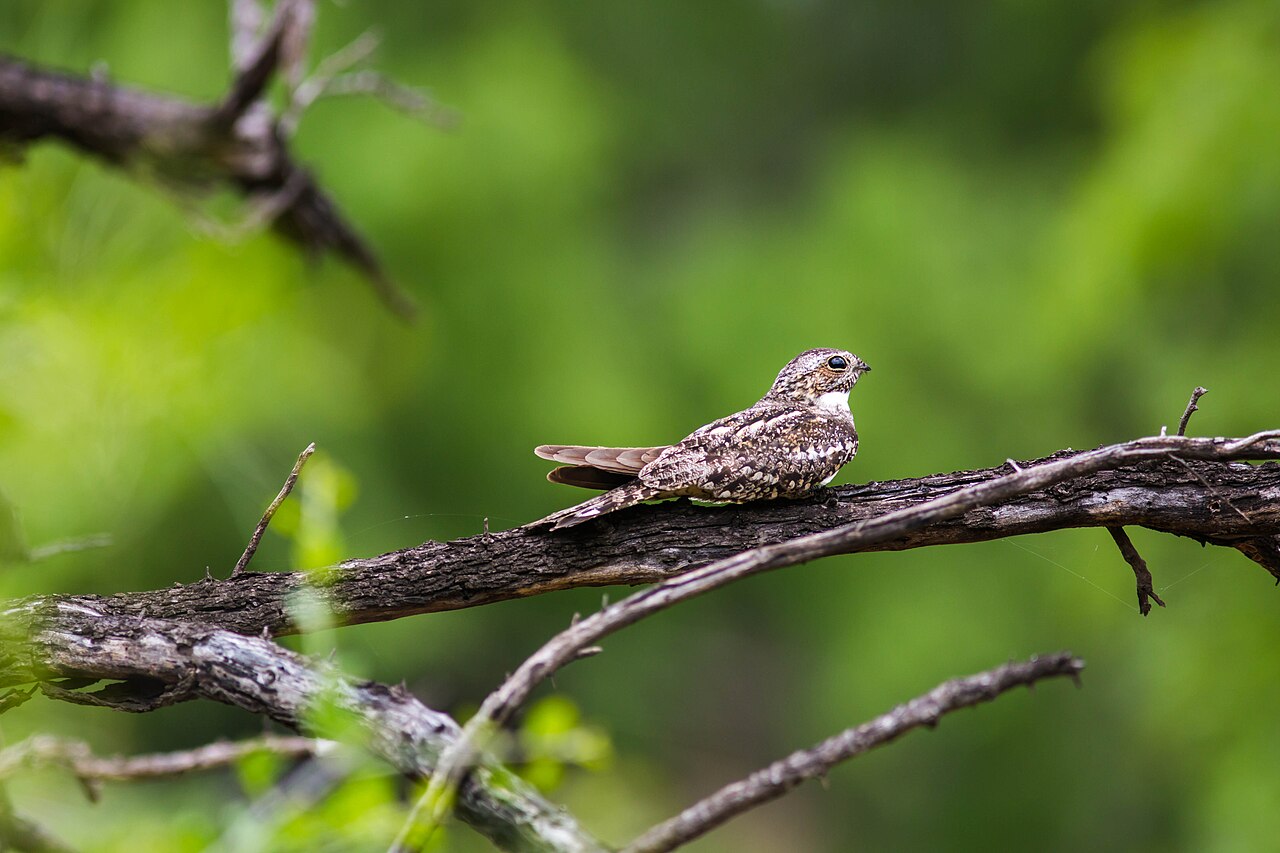
Lesser Nighthawk is the nightjar of the desert: a long, sharp-winged bird that hunts insects on the wing over bare flats and dry riverbeds, rather than sallying from the ground like its forest-dwelling relatives. Despite its Dutch name referencing Texas, that state is only a small part of a range stretching from California deep into South America.
Voice
From the ground it gives a long, sustained, toadlike trill lasting seven to thirteen seconds that carries far across the desert stillness. In flight it produces a completely different sound: a bleating, almost laughing wa-wa-wa-wa, often followed by a low, muffled trill. Both sounds are given mainly at dusk, but also under a bright moon or over lit areas where insects gather.
Recording: Richard E. Webster — CC BY-NC-SA 4.0 · Mittry Lake, Yuma County, Arizona, United States · xeno-canto
Identification
A slender nightjar with long, narrow, pointed wings and a slightly forked tail, different in shape from the compact whip-poor-wills. The plumage is a fine, blended pattern of grey-brown and black; the male shows a broad white band close to the wingtip and a white throat patch, both replaced by buffy tones in the female. By day it sits flat on the ground or a branch, but unlike the whip-poor-wills it can also be watched hunting actively at dusk, well before full darkness.
Confusion species
Common Nighthawk (Chordeiles minor) has its white wing band set further from the tip, closer to the bend of the wing, gives a nasal peent instead of the bleating call, and flies in a higher, more powerful hawking pattern over towns and open ground rather than the low, fluttering flight of Lesser Nighthawk. The whip-poor-wills and Buff-collared Nightjar (all Antrostomus) have short, rounded wings without a white band and hunt by sallying from a perch rather than on the wing.
Habitat
Bare or sparsely vegetated desert and semi-desert: dry riverbeds, creosote scrub, and sand or gravel flats, plus the edge of farmland where irrigated fields attract insects. On its wintering grounds it also uses open woodland, marsh, mangrove and beaches. It avoids dense forest and high mountains entirely.
Where the bird is most often found, arranged by the USNVC — the vegetation classification of the United States and Canada — and CMECS for sea and coast.



Range and movements
Breeds in the southwestern United States, from California and Nevada to Arizona, New Mexico and southern Texas, and further through nearly all of Mexico and Central America into South America, where it remains year-round in the southern part of its range. North American breeders withdraw in autumn to Mexico and Central America; some already winter in the extreme south of Texas and Arizona. The population has grown by roughly 15 per cent since 1970.
- Resident
- Breeding (summer)
- Winter
- Passage
- dark = core range, pale = thinly spread
Where and when to look
Drive a dirt road through desert scrub or along a dry riverbed at sunset and watch for birds fluttering low over the ground with a white band set well toward the wingtip — there are often several together over the same open patch. Streetlights on the edge of a desert town regularly draw in hunting Lesser Nighthawks after dark.
Conservation
With a world population of around twelve million birds and an increase of roughly 15 per cent since 1970, the species is listed as Least Concern (LC). It benefits from artificial lighting that attracts insects and from irrigated farmland in the desert, though as a ground-nester it remains vulnerable to disturbance and predation by free-roaming pets.
Scientific name
Chordeiles acutipennis | (Hermann, 1783)
Hermann described the species in 1783 as Caprimulgus acutipennis; it has since been moved to another genus, hence the parentheses around author and year. The genus name Chordeiles is built from Ancient Greek for 'string' or 'gut' and 'night', perhaps a reference to the whirring sound of its flight; the species name acutipennis is Latin for 'sharp-winged', after the pointed wing shape. The type locality is Cayenne, in French Guiana.