All species › Nightjars › Nightjars and nighthawks › Common Nighthawk
Common Nighthawk | Chordeiles minor
Amerikaanse nachtzwaluw | Añapero yanqui
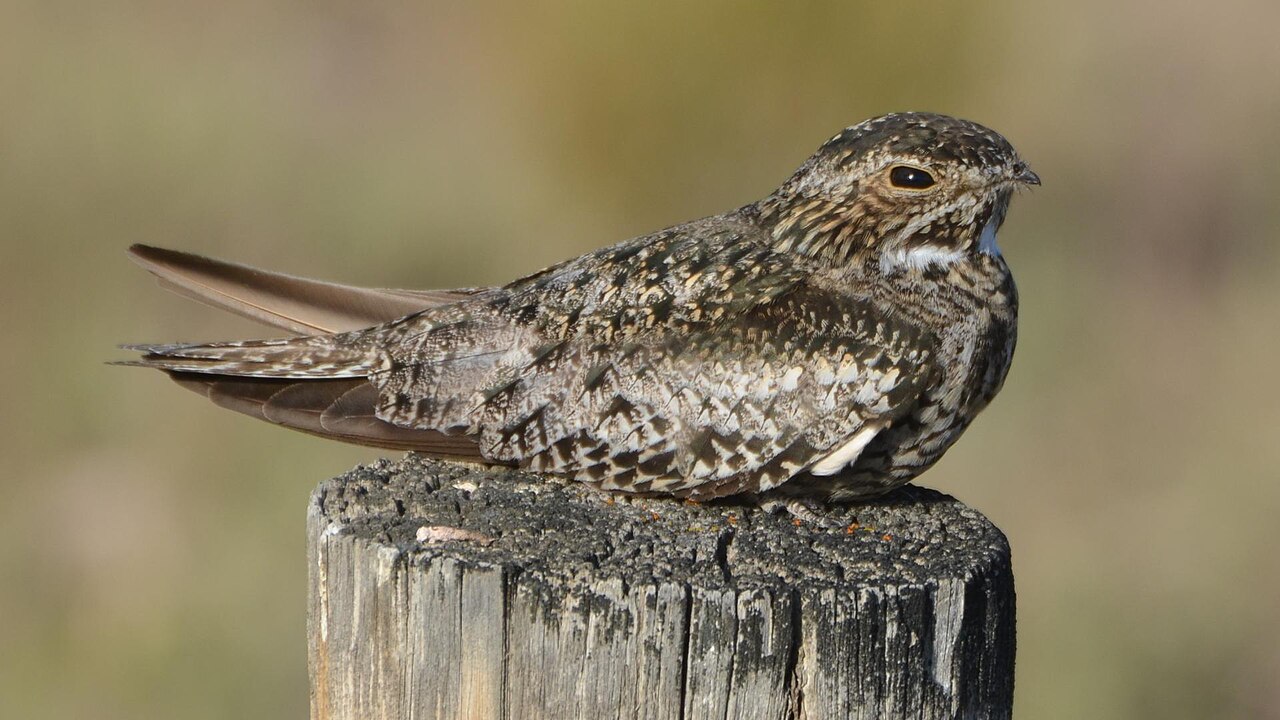
Common Nighthawk is the bird that hawks for insects over cities and open country at dusk on jerky, bat-like wingbeats, a bold white bar flashing across its long, pointed wings. Despite its name it is not a bird of prey but a nightjar, more closely related to swifts than to hawks. Its nasal call, often heard right above streets and parking lots, is for many North Americans the sound of a summer evening.
Voice
The call is a nasal, buzzy peent or beent, usually given in flight and repeated for minutes on end on summer evenings. During courtship the male plunges into a steep dive toward the ground and pulls up sharply just above it; air rushing through the spread tail and wing feathers then produces a deep, booming vroom. By day, resting on the ground or a branch, the bird is almost always silent.
Recording: Trent R. Stanley — CC BY-NC-SA 4.0 · Julian, San Diego County, California, United States · xeno-canto
Identification
A slender bird with long, narrow, sickle-shaped wings and mottled brown-grey plumage that resembles bark or gravel. A broad white band roughly halfway along the wing remains visible at great distance in flight and is the best field mark. The male has a white throat patch and a white band at the tip of the tail; the female has a buffy throat and lacks the tail band. Flight is erratic and jerky, with short glides, different from the straight, fast flight of a swift.
Confusion species
Lesser Nighthawk of the southwest is smaller and slighter, with the white wing band set closer to the wingtip, and gives a soft, trilling call instead of the Common Nighthawk's nasal peent. Nightjars such as Eastern Whip-poor-will have rounded, not pointed wings, lack the white wing band, and are almost never seen flying over open ground. At a distance in the dusk the species is sometimes mistaken for a bat, until its far larger size and straight, sickle-shaped wings become clear.
Habitat
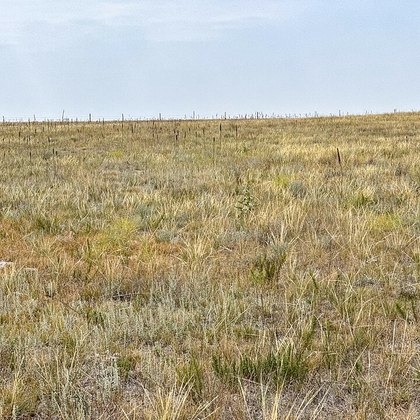
Open ground of many kinds: prairie, clear-cuts, rocky hillsides, sand flats and, increasingly, flat gravel roofs in towns and cities, where the bird scrapes a nest on the bare surface without using a single twig. It hunts in the air over almost any open landscape, from farmland to ponds to city plazas. It avoids closed forest and dense scrub; the replacement of gravel roofs with rubber membrane roofing has eliminated nesting sites in many cities.
Where the bird is most often found, arranged by the USNVC — the vegetation classification of the United States and Canada — and CMECS for sea and coast.




Range and movements
Breeds across almost the entire North American continent, from Alaska and Canada to Mexico and Central America, and withdraws entirely to South America for the winter — no bird remains in North America. Migration moves in large flocks, especially in late summer over cities and along the Gulf coast, en route to wintering grounds as far south as Argentina. In parts of the eastern range the species has declined markedly over recent decades.
- Breeding (summer)
- Passage
- dark = core range, pale = thinly spread
Where and when to look
Watch at dusk over open ground, parking lots or flat rooftops for the jerky flight and white wing bar, and listen for the nasal call. In early summer at dusk you can also see and hear the territorial male's booming diving display, often repeated over the same spot.
Conservation
As a breeding bird it has declined markedly in many parts of the eastern range, chiefly through the loss of gravel roofs as nest sites and a reduction in flying insects; elsewhere, especially in the west, the species remains commoner. Still widespread enough to be considered Least Concern (LC).
Scientific name
Chordeiles minor | (Forster, 1771)
Forster described the species in 1771 as Caprimulgus minor, in the genus of the European Nightjar; since moved to another genus, author and year stand in parentheses. The genus Chordeiles was introduced by Swainson in 1832. minor is Latin for 'smaller', in comparison with the European Nightjar against which Forster measured the species. No precise type locality was given; later authors restricted it to South Carolina, based on a description by the naturalist Catesby.