All species › Nightjars › Nightjars and nighthawks › Antillean Nighthawk
Antillean Nighthawk | Chordeiles gundlachii
Antilliaanse nachtzwaluw | Añapero Querequeté
In the far south of Florida, on the Keys alone, this Caribbean nighthawk reaches its only US foothold. Elsewhere it breeds across the Greater Antilles, the Bahamas and the Virgin Islands. It is best told, since it closely resembles the much commoner Common Nighthawk, by its call, which English-language field guides render as gimme-me-bit. By late summer the entire population leaves the region, for a wintering ground that until recently was a complete mystery.
Voice
The call is a fast, dry series of hard ticking notes, rendered as drik-rik-rik-rik, usually given in flight and the most reliable way to tell the species from Common Nighthawk. In the Bahamas and the Dominican Republic locals hear it as ki-dee-dee-dee or quera-que-que, which gave rise to the Spanish name querequeté. By day, resting on the ground or a branch, the bird is almost silent.
Recording: Noah Khanti Steinberg — CC BY-NC-SA 4.0 · Little Hamaca (near Key West), Monroe County, Florida, United States · xeno-canto
Identification
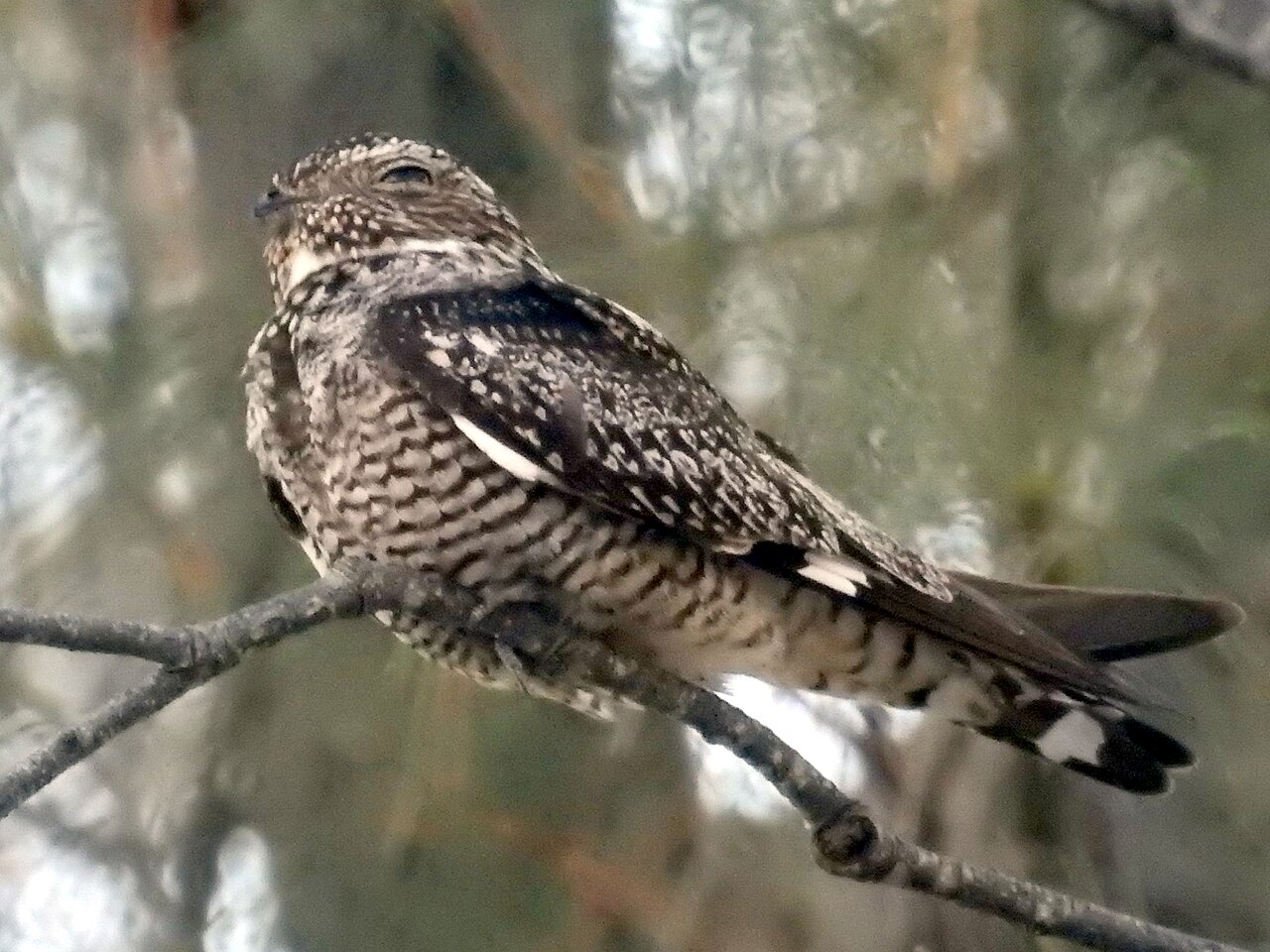
A medium-sized nighthawk with long, narrow, pointed wings, a notched tail and a fine pattern of black, grey and brown that closely matches bark or gravel. The male has a broad white wing band, a white throat patch and a white tail band; the female's throat and wing band are buffy and she lacks the tail band. In flight the species is almost impossible to tell from the closely related Common Nighthawk: it is slightly smaller and more lightly built, with a marginally narrower silhouette, but that difference rarely convinces in the field.
Confusion species
Common Nighthawk is larger and shares the same white wing band, but the two are told apart almost entirely by voice: the short, ticking drik-rik-rik-rik against Common Nighthawk's nasal, drawn-out call. Lesser Nighthawk, rare but possible in Florida, is smaller, with the wing band set closer to the wingtip, and gives a soft trilling call. Common Pauraque, in southern Texas and Florida, has rounded rather than pointed wings and is rarely seen flying high over open ground.
Habitat
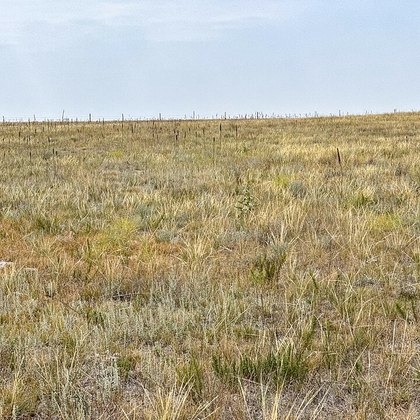
Open, warm ground with short grass or bare soil: sugarcane fields, pasture, savanna, golf courses, airfields and recently cleared land, along with beaches, salt flats and even bauxite mines as nest sites. It hunts in groups over almost any open landscape, from towns to forest edges. It avoids closed forest entirely; all it needs is a bare patch of ground for its eggs and enough open air to hunt in.
Where the bird is most often found, arranged by the USNVC — the vegetation classification of the United States and Canada — and CMECS for sea and coast.



Range and movements
Breeds in the extreme south of Florida (the Keys), and further through the Greater Antilles, the Bahamas, the Cayman Islands, the Turks and Caicos, and the Virgin Islands. By late summer the entire population leaves; only in 2013 did a geolocator establish that at least one female wintered in the deep rainforest of the Brazilian Amazon, over two thousand kilometres south of the breeding grounds — the first hard evidence for a migration that had until then been a total blank.
- Breeding (summer)
- Passage
- dark = core range, pale = thinly spread
Where and when to look
Head to an open spot on the Keys at dusk — an airfield, a golf course, open grassland — and listen rather than look: a fast, dry drik-rik-rik-rik instantly separates it from the similar Common Nighthawk. Groups sometimes hunt together over a single open patch, especially around insect swarms after sunset.
Conservation
With an estimated two hundred thousand birds worldwide and a low concern score, the species is considered Least Concern (LC). It remains nonetheless one of the least-studied birds of the Caribbean: almost nothing is known of its wintering grounds, and trends in the small, isolated island populations go largely unmonitored.
Scientific name
Chordeiles gundlachii | Lawrence, 1856
Lawrence described the species in 1856 as Chordeiles gundlachii, in the same genus it still holds; author and year therefore stand without parentheses. The genus Chordeiles was introduced by Swainson in 1832, from the Greek khordē, 'chord', and deilē, 'evening' — a reference to the humming sound the closely related Common Nighthawk produces in its display dive. The epithet gundlachii honours the German-Cuban naturalist Juan Gundlach, who spent decades describing the fauna of Cuba. The type locality is Cuba.