All species › Passerines › Cardinals and allies › Northern Cardinal
Northern Cardinal | Cardinalis cardinalis
Rode kardinaal | Cardenal norteño
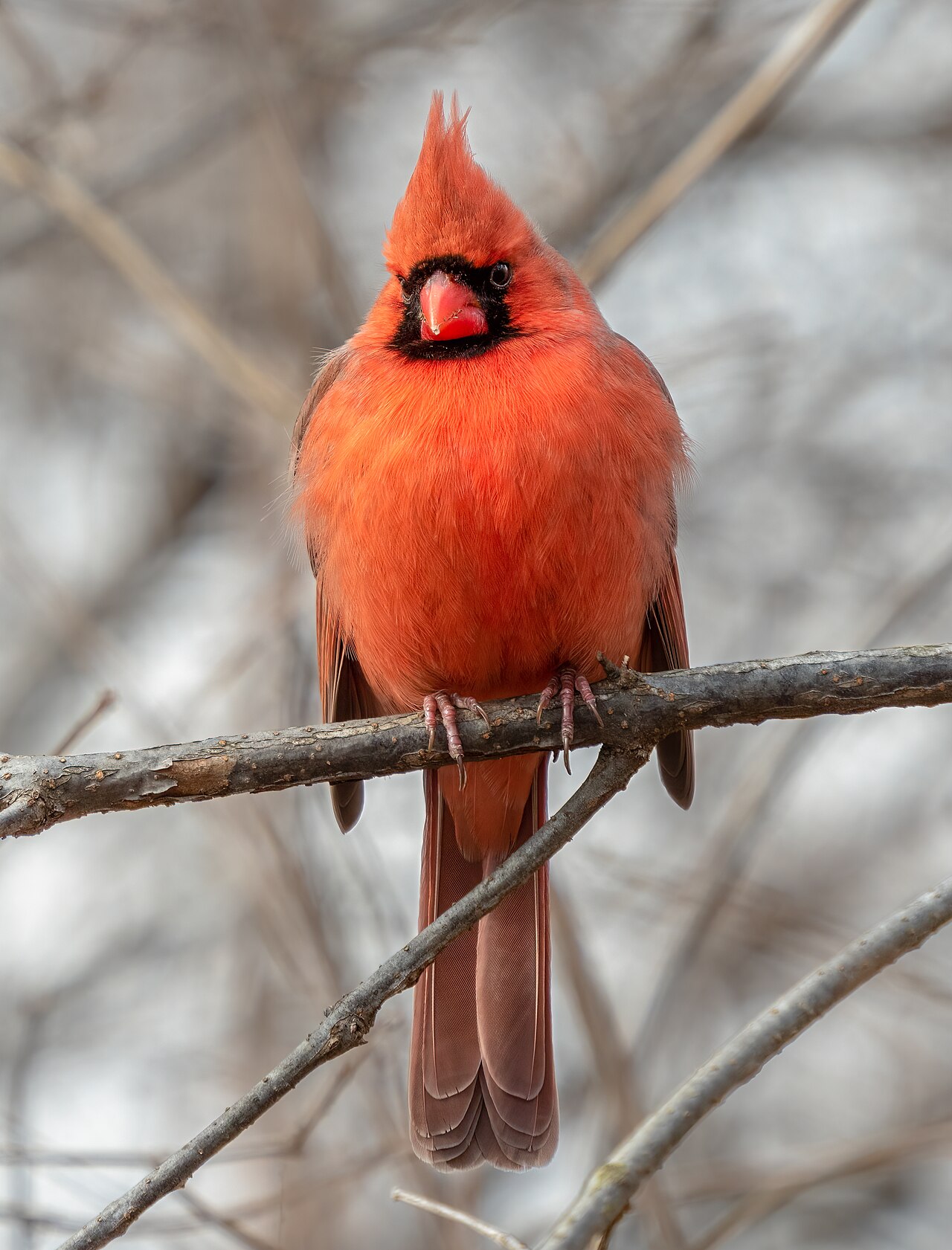
The Northern Cardinal is the bird that defines the American backyard: fire red, with a pointed crest and a heavy orange conical bill. Seven states chose it as their state bird, and over the past century it has pushed its range hundreds of kilometres north.
Voice
A clear, far-carrying whistled series of repeated motifs: what-cheer what-cheer what-cheer, or an accelerating purty-purty-purty. Unusually for a North American songbird the female sings too, often from the nest, and pairs answer each other with almost the same phrase. The call is a sharp metallic chip, usually the first sign of a cardinal in dense cover.
Recording: Rory Nefdt — CC BY-NC-SA 4.0 · Flag Ponds Nature Park Delaware, United States · xeno-canto
Identification
The male is distinctive: entirely scarlet with a black mask around the thick orange-red bill and a mobile pointed crest. The female is warm olive-brown with red washing the crest, wings and tail, and the same orange bill. Juveniles resemble the female but have a dark, dull bill, which causes confusion every autumn. The long tail and heavy bill make the silhouette distinctive as well.
Confusion species
Pyrrhuloxia (Cardinalis sinuatus) of the southwest is greyer, with red confined to face, breast and tail, and has a short, strongly curved yellow bill. Summer Tanager is as red but lacks the crest and black mask and has a far slimmer bill. Females and juveniles are confused with Brown Thrasher, which is larger, longer-tailed, yellow-eyed and long-billed.
Habitat
Thickets, woodland edges, hedgerows, riverside tangles, and above all the half-open greenery of gardens, parks and suburbs. It avoids closed high forest and open farmland; what it wants is a dense low layer to nest in and a perch to sing from. In Mexico it extends into dry thorn scrub and tropical deciduous forest.
Where the bird is most often found, arranged by the USNVC — the vegetation classification of the United States and Canada — and CMECS for sea and coast.




Range and movements
Resident across the eastern United States north to extreme southern Ontario and Quebec, west to Texas and the southwest, and south through Mexico to Yucatán and Belize. It does not migrate: ringed birds stay within a few kilometres for life. The northern limit moved sharply during the twentieth century — feeders, suburban plantings and milder winters carried it into New England and the Great Lakes, where it was absent around 1900.
- Resident
- Breeding (summer)
- Winter
- Passage
- dark = core range, pale = thinly spread
Where and when to look
Look for it at a woodland edge in the last hour before sunset, when it sings from an open branch above the scrub; its red holds colour in low light better than any other bird's. In winter cardinals are the last of all garden birds to come to food, often only at dusk — sunflower seed and a dense hedge beside the feeder is all it takes.
Conservation
Least Concern (LC); abundant and increasing, with a population well over a hundred million. It is one of the few songbirds that clearly benefits from human settlement. It is, however, a favoured host of the Brown-headed Cowbird, and as a bird of low cover near houses it is vulnerable to domestic cats.
Scientific name
Cardinalis cardinalis | (Linnaeus, 1758)
Linnaeus described the species in 1758 as Loxia cardinalis, among the crossbills; because it was later moved to another genus, author and year stand in parentheses. The genus Cardinalis was introduced by Bonaparte in 1838. cardinalis is Medieval Latin for 'cardinal', after the scarlet robes of the cardinals of Rome. The type specimen came from North America; the American Ornithologists' Union restricted the type locality to South Carolina in 1931.