All species › Passerines › Cardinals and allies › Crimson-collared Grosbeak
Crimson-collared Grosbeak | Periporphyrus celaeno
Roodkraagkardinaal | Picogrueso acollarado
The Crimson-collared Grosbeak is a heavy, thick-billed cardinal of the hill country and lowlands of northeastern Mexico. Within the guide area it reaches North America north of the Rio Grande only as a vagrant: in some winters a single bird turns up in the parks of South Texas.
Voice
The song is a slow, clear series of warbled whistled notes, the last usually slurred upward. There is also a penetrating whistle that begins with an s-like attack and slides up or down. The call is a sharp, metallic chink. Vagrants in Texas are mostly silent and give at most the call note.
No recording with a suitable Creative Commons licence has been found for this species yet; what to listen for is described below.
Identification
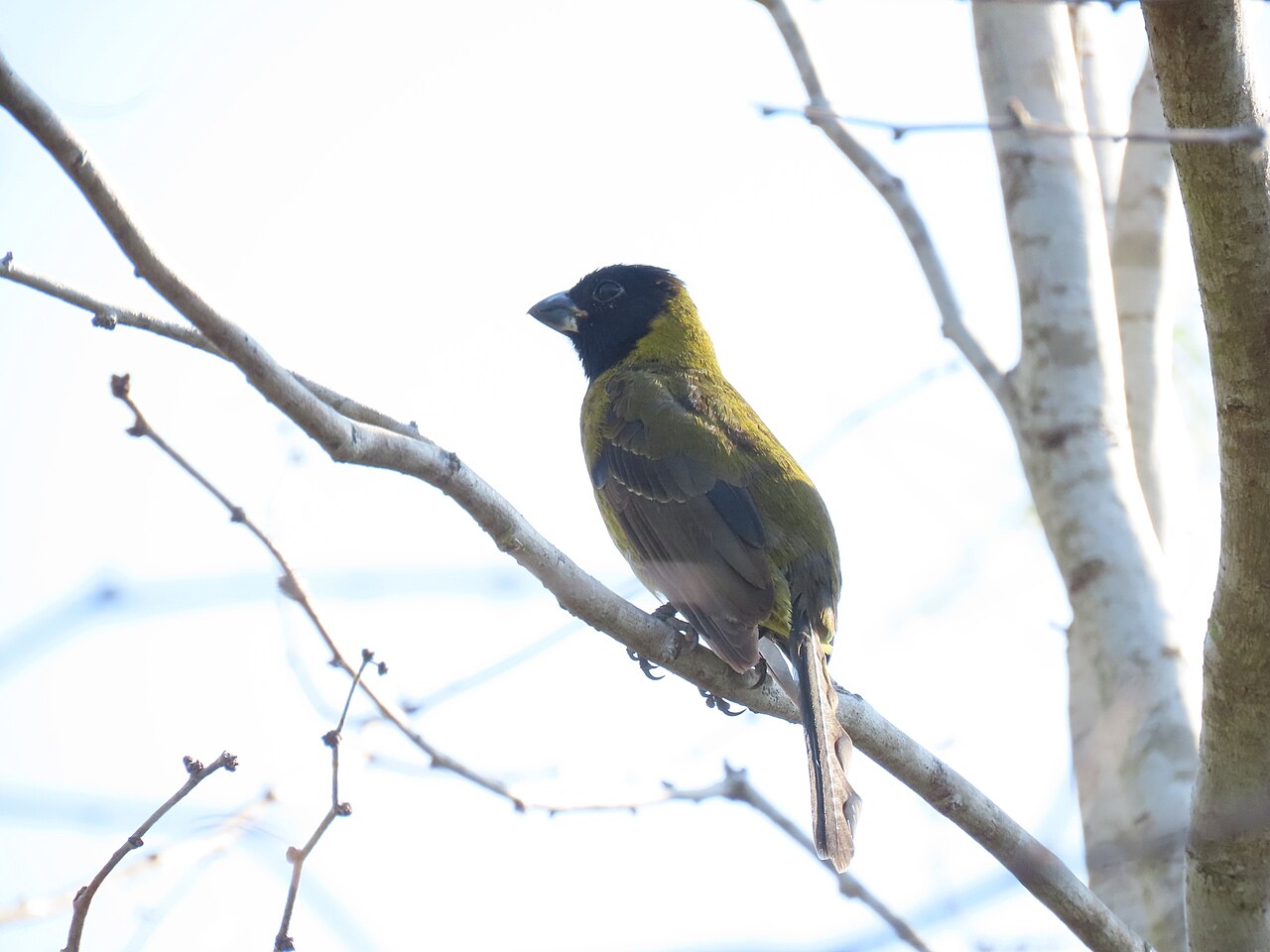
The male is black on head, throat and wings, with a dull red to pinkish-red band across the nape that continues over the shoulders and underparts; on the belly the red is mottled with black. The female has the same black head and breast but is olive-green above and yellow-green below. Young birds resemble the female with less black. The bill in both sexes is heavy, deep at the base and dark; the tail is long for a cardinal of this size. The bird moves slowly and often sits still for long periods in the shrub layer.
Confusion species
Within the guide area there is little to confuse it with. Crimson-collared Tanager (Ramphocelus sanguinolentus) has a far slimmer bill with a silver base to the lower mandible and a sharply bounded red collar with no red on the belly. Female Blue Bunting is plain brown, without a black head and without green. The female of this species is told at once by the combination of black head, green back and yellow underparts.
Habitat
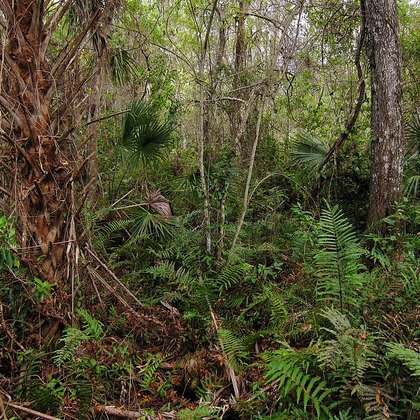
Humid and semi-arid deciduous forest, forest edge and older second growth in the foothills of the Sierra Madre Oriental, from the lowlands to about 1800 metres. It forages at all heights, including low in the shrub layer and on the ground. In South Texas the vagrants keep to the remaining patches of Tamaulipan thorn forest and to the planted parks and sanctuaries along the Rio Grande.
Where the bird is most often found, arranged by the USNVC — the vegetation classification of the United States and Canada — and CMECS for sea and coast.



Range and movements
The entire range lies in northeastern Mexico: central Nuevo León, Tamaulipas, eastern San Luis Potosí, northeastern Puebla and northern Veracruz. The species is resident but drops to lower forest in winter. In the winters with the strongest northward movement a few birds are found in the lower Rio Grande valley of Texas, usually between November and March; some stay for weeks or months in one spot.
- Resident
- Breeding (summer)
- Winter
- Passage
- dark = core range, pale = thinly spread
Where and when to look
For the Texas vagrants, follow the reports from November to March and search the known Rio Grande parks, where the bird works under the shrubs for fallen fruit. It gives itself away more often by movement in the understorey than by sound. On the breeding range the mountain roads west of Ciudad Victoria are the usual place.
Conservation
The species is listed as Least Concern (LC); the population has not been counted precisely, but the range is small and confined to one mountain chain and the adjoining lowland. Deforestation and conversion of woodland to farmland in Tamaulipas and Nuevo León reduce the area available. For the United States the species is not a management question: it involves scattered vagrants.
Scientific name
Periporphyrus celaeno | (Deppe, 1830)
Deppe described the species in 1830 as Tanagra Celaeno, from a specimen taken at Papantla in Veracruz; because it later moved to another genus, author and year stand in parentheses. It long stood as the only species in the genus Rhodothraupis; genetic work placed it in Periporphyrus, from Greek peri 'around' and porphyreos 'purple-red'. The species name celaeno refers to Celaeno of Greek mythology, from kelainos 'dark, black'. The Dutch name names the red band across the male's nape.