All species › Passerines › Cardinals and allies › Varied Bunting
Varied Bunting | Passerina versicolor
Veelkleurengors | Azulillo morado
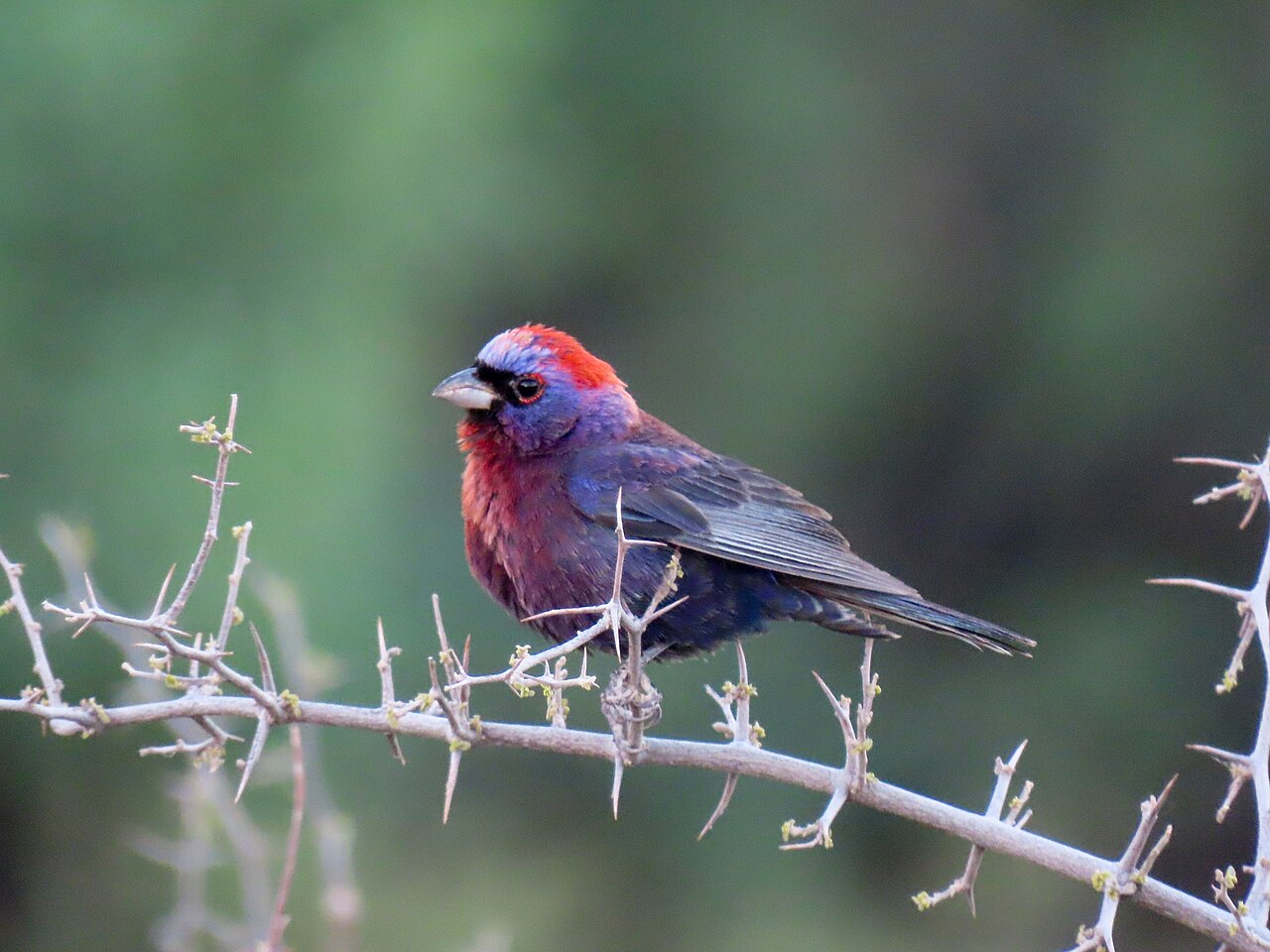
The Varied Bunting is a small bunting of thorn scrub in the dry country of Mexico that crosses the border in summer into southern Arizona, southwestern New Mexico and western and southern Texas. The male carries purple, red and blue on one body, but in shade and at distance simply looks black.
Voice
The song is a short, dry series of high paired notes, about two seconds long, thinner and scratchier in tone than that of the Indigo Bunting and without a clear repeat of the same phrase. The male sings from the top of a thorn bush or an ocotillo stem, often in the middle of the day in full heat. The call is a sharp, dry chik, repeated in flight.
Recording: Richard E. Webster — CC BY-NC-SA 4.0 · Bald Knob, Cochise County, Arizona, United States · xeno-canto
Identification
The breeding male is purple-red to wine-red over the body, with a bright red to russet nape, a blue-purple rump and a blue forehead; the eye sits in a dark area. Those colours emerge only in side light — against the light and in shade the bird looks plain black. The female is plain light brown to grey-brown, slightly paler below, without streaking and without wingbars. The bill is short, conical and curved along the upper edge; the tail is short. In autumn the red of the nape turns browner.
Confusion species
A male Indigo Bunting is evenly blue with no red on the nape. Blue Bunting (Cyanocompsa parellina) has a heavier bill and a blue face without red. Among females, a female Indigo Bunting shows faint streaking on the breast and fine pale wingbars, while a female Varied Bunting stays plain, is unstreaked and shows a clearly curved upper mandible. A female Lazuli Bunting has two pale wingbars and a blue wash on the rump.
Habitat
Dense thorny scrub: dry slopes with mesquite (a thorny pod-bearing shrub of the Southwest that forms dense thickets), acacia, ocotillo and catclaw, and above all the thickly vegetated floors of canyons and the brush along arroyos (dry, steep-sided gullies that carry water only after rain). In Mexico it also occupies thorn forest and second growth after clearing. It avoids open desert without a shrub layer and closed woodland, and reaches about 1500 metres.
Where the bird is most often found, arranged by the USNVC — the vegetation classification of the United States and Canada — and CMECS for sea and coast.





Range and movements
The range covers much of Mexico, from Sonora and Chihuahua south to Oaxaca, with a separate population in Chiapas and southeastern Guatemala. In the United States it breeds only in a narrow border strip: southeastern Arizona, the extreme southwest of New Mexico, and West Texas plus the lower Rio Grande. Almost all birds leave the United States in winter and move a limited distance south into Mexico; across most of Mexico the species is resident.
- Resident
- Breeding (summer)
- Winter
- Passage
- dark = core range, pale = thinly spread
Where and when to look
Look for it from late May into August, after the first summer rains, when males sing from bush tops; the canyons of southeastern Arizona and the Big Bend area give the best chance. Stand with the sun behind you: only then does the purple of the body separate from the red of the nape, and otherwise you are looking at a black bunting.
Conservation
The world population is put at about 360,000 birds and the species is listed as Least Concern (LC). The United States holds a small part of that, spread over a few hundred sites. The pressure is on the scrub itself: grazing, clearing of mesquite for pasture and the drawing down of water in washes all reduce the dense ground layer in which the species nests.
Scientific name
Passerina versicolor | (Bonaparte, 1838)
Bonaparte described the species in 1838 as Spiza versicolor, from a specimen taken near Temascaltepec in Mexico; because it later moved to another genus, author and year stand in parentheses. The genus Passerina was introduced in 1816 by Vieillot, from Latin passer 'sparrow'. The species name versicolor is Latin for 'of various colours', after the male, which carries purple, red and blue on one body. The Dutch name is a direct translation of that.