All species › Gannets and cormorants › Boobies and gannets › Northern Gannet
Northern Gannet | Morus bassanus
Jan-van-gent | Alcatraz atlántico
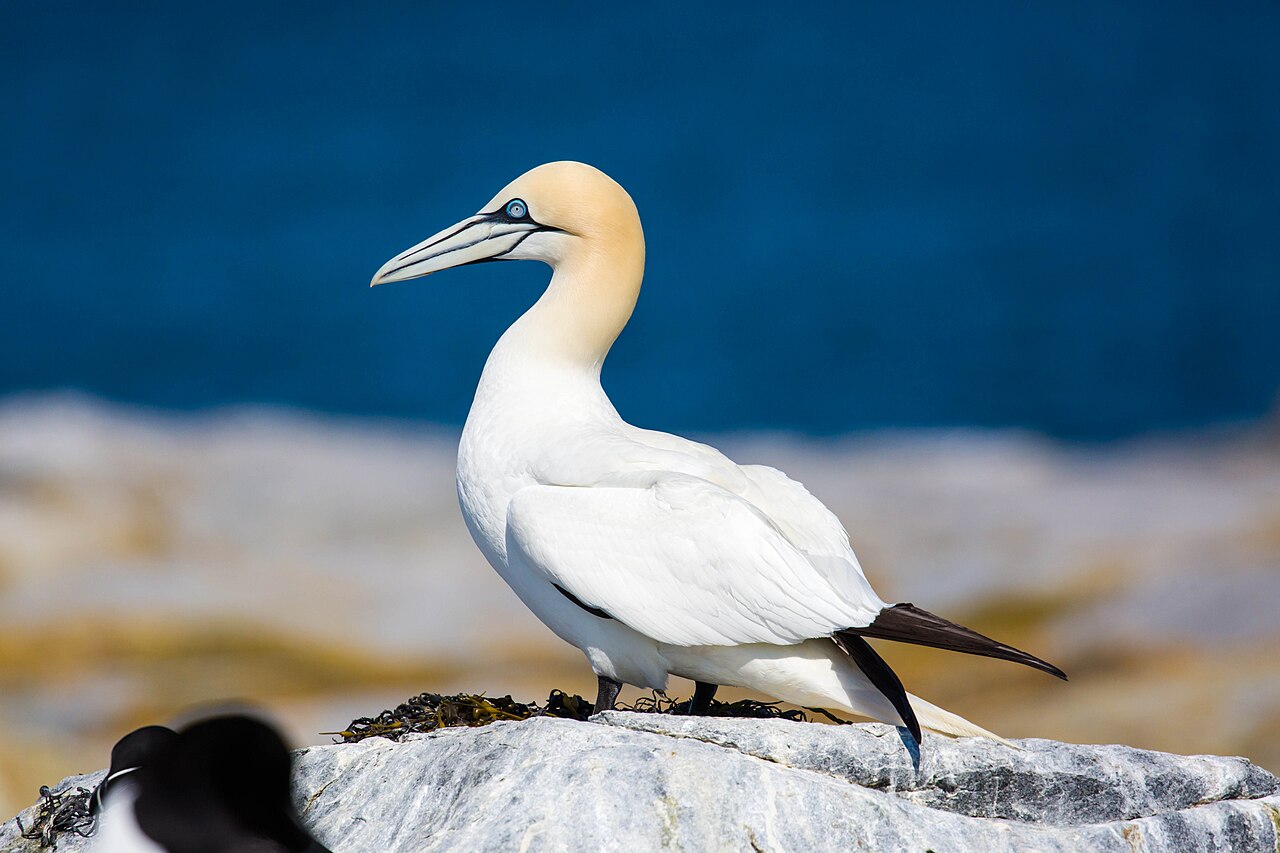
The Northern Gannet is the largest seabird of the North Atlantic: snow white, with ink-black wingtips, an ochre head and a wingspan close to two metres. In North America it breeds at exactly six places, all in Quebec and Newfoundland, while it spends the winter off Florida and in the Gulf of Mexico.
Voice
At the colony the sound is a hard, low arrah-arrah, which an incoming bird starts tens of metres before landing and which its neighbours answer. Every bird sounds slightly different, and partners and chicks pick each other out of the din by that alone. The young beg with a thin, high piping that cuts sharply through the adults' croaking. A colony of tens of thousands can be heard for kilometres across the water on an onshore wind, as a steady low drone.
Recording: Simon Gillings — CC BY-NC-SA 4.0 · Bempton Cliffs, East Riding of Yorkshire, England, United Kingdom · xeno-canto
Identification
A cigar-shaped, elongated bird with pointed wings, a pointed tail and a long, tapering blue-grey bill — head, neck and tail held out to the same extent, so that the silhouette ends in a point at both ends. The adult is white with black primaries, an ochre-yellow head and neck and a thin black line around eye and bill; the blue ring around the eye is bright at close range. First-year birds are dark slate grey with fine white speckling and pass in four years, through a piebald mixture of white and black, into adult plumage. The sexes are alike; over the sea the flight is low and stiff, a series of beats and then a long glide close above the waves.
Confusion species
At a distance Great Black-backed Gull (Larus marinus) is the first confusion: as white and black, but with a broad, rounded wing, a thick yellow bill and a far looser flight. In the Gulf of Mexico and off Florida there is Brown Booby (Sula leucogaster), smaller, with a sharply cut-off brown head and breast against a white belly. Masked Booby (S. dactylatra) is white with a black tail and a black trailing edge along the whole wing, not only at the tip. Young gannets are so dark that they are taken for skuas or immature gulls, but the long silhouette, pointed at both ends, remains.
Habitat
Open sea over the continental shelf, where shoals of herring, mackerel and capelin come within reach of the surface; beyond that, over deep water, it is scarce. To breed it needs steep cliff ledges or flat island tops free of foxes and rats, with enough approach room to land into the wind. Outside the breeding season it comes close inshore, and in a gale with an onshore wind sometimes into bays and river mouths. It does not use the interior.
Where the bird is most often found, arranged by the USNVC — the vegetation classification of the United States and Canada — and CMECS for sea and coast.


Range and movements
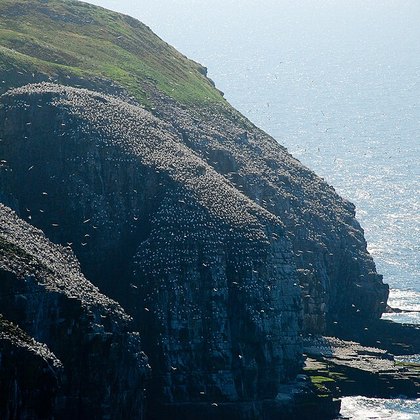
Breeds on both sides of the North Atlantic; on the American side at six colonies, three in the Gulf of St. Lawrence and three off Newfoundland. Outside the breeding season the birds move south along the coast, as far as Florida and into the Gulf of Mexico, the young going furthest. It reaches Greenland only in some years and in a handful of records, and for that reason it is not on the map. After the colonies were protected numbers grew throughout the twentieth century and new colonies were founded.
- Resident
- Breeding (summer)
- Winter
- Passage
- dark = core range, pale = thinly spread
Where and when to look
Stand on an Atlantic headland in November or December in a hard onshore wind: the birds then pass low, and you sometimes see one drop out of the sky within a hundred metres. Over a group of gulls at sea, look for a white bird that suddenly folds its wings against its body — usually the first thing you notice. At a colony any hour of the day will do, but late afternoon light sets off the white and the ochre best.
Conservation
The world population is large and grew steadily for more than a century; the species is listed as Least Concern (LC). In 2022 avian influenza H5N1 struck the colonies hard on both sides of the ocean, with mass mortality in the Gulf of St. Lawrence; surviving birds often turned out to have a black iris instead of a pale blue one, and researchers have recognised them by it ever since. Beyond that the main threats are drowning in fishing gear, plastic worked into the nests and shifting fish stocks.
Scientific name
Morus bassanus | (Linnaeus, 1758)
Linnaeus described the species in 1758 as Pelecanus bassanus, among the pelicans; because it was later moved to another genus, author and year stand in parentheses. The genus Morus was introduced by Vieillot in 1816, after Greek moros 'foolish, slow' — the same idea as in the English word booby, from how tame these birds are at the breeding place. bassanus refers to Bass Rock in the Firth of Forth in Scotland, the rock the species takes its name from and where one of the largest colonies in the world still sits. Linnaeus gave 'America' as the origin; the type locality was later fixed at Bass Rock.