All species › Gannets and cormorants › Boobies and gannets › Red-footed Booby
Red-footed Booby | Sula sula
Roodpootgent | Piquero Patirrojo
Red-footed Booby is the smallest and most widely distributed of the seven species in the genus Sula, and the only one of them that nests in trees rather than on the ground. Its plumage ranges from entirely white to entirely chocolate-brown, but the bright red legs and the blue-and-pink base of the bill remain the same field mark in every form.

Voice
At sea it is almost silent; only at the colony does it make itself heard. The male greets his partner with a thin, high-pitched whistle, and the female answers with a hoarse, snoring quack that carries far across the colony. Around the nest a soft, rhythmic grunting also accompanies mutual bill and head preening between partners. Chicks beg with a persistent, piping call that only stops once a parent has regurgitated food.
Recording: Barry Edmonston — CC BY-NC-SA 4.0 · Isla Santa María (Floreana) (Cab. en Pto. Velasco Ibarra), San Cristobal, Islas Galápagos, Ecuador · xeno-canto
Identification
In the white morph the body is entirely white with black primaries and a white tail — the feature that instantly separates it from Masked Booby and Nazca Booby, both of which have a black tail. The brown morph is a warm chocolate-brown with a somewhat paler belly and a narrow white rump patch; intermediate birds with a white tail but a brown body also occur. In every adult colour morph the coral-red to pink legs stand out, together with a blue-grey bill with a pink or blue base and bare, blue-black facial skin around the eye. The silhouette is that of a slim, small booby: narrower wings and a lighter build than the other American species, with a tapering tail in flight. Juveniles are dull greyish-brown with grey, uncoloured legs, which makes them hard to tell from young birds of the other brown-plumaged boobies.
Confusion species
The white morph is confused with Masked Booby (Sula dactylatra) and Nazca Booby (Sula granti), but both of those have a black tail and yellow to orange-pink bills, against the white tail and blue-grey bill of Red-footed Booby — and both are considerably larger. The brown morph resembles Brown Booby (Sula leucogaster), which shows a sharp border between brown chest and white belly, but has yellowish rather than red legs and no white rump patch. Young birds of the two species are the most similar: there, the smaller size and narrower wing shape of Red-footed Booby are the deciding features.
Habitat
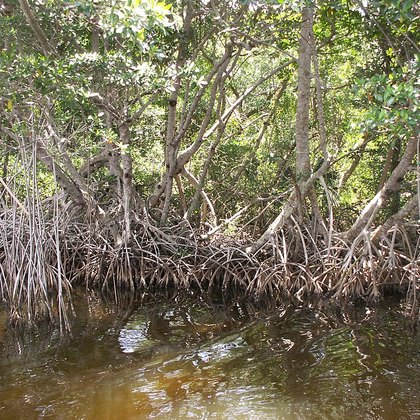
Outside the breeding season it spends almost its entire life on the open ocean, far from land, hunting by sight for flying fish and squid. For breeding it seeks low trees and shrubs on uninhabited tropical islands: mangrove, coastal woodland or sturdy scrub provide the branches in which it builds its stick nest. Unlike the other American booby species, it avoids bare ground without standing vegetation as a nest site. Colonies often share islands with frigatebirds and Red-tailed Tropicbirds.
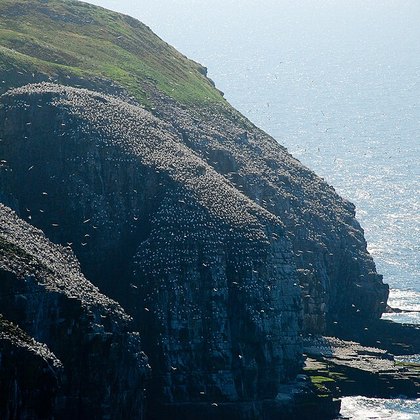
Where the bird is most often found, arranged by the USNVC — the vegetation classification of the United States and Canada — and CMECS for sea and coast.

Range and movements
Red-footed Booby breeds around the equator in all three oceans; within the area of this guide the two best-known colonies are on Half Moon Caye off the coast of Belize, with several thousand pairs one of the largest colonies in the Atlantic, and at Kilauea Point on the north shore of Kauaʻi, Hawaii. Outside the breeding season it wanders widely over tropical and subtropical seas, and turns up as a rare vagrant on the Gulf Stream off Florida and North Carolina and, after severe storms, occasionally as far as the Dry Tortugas. Numbers at the known colonies appear reasonably stable in recent decades, though a long count series is lacking for most islands.
- Resident
- Breeding (summer)
- Winter
- Passage
- dark = core range, pale = thinly spread
Where and when to look
At Kilauea Point National Wildlife Refuge on Kauaʻi the species can be seen from land: from the cliff trail you look straight into nests in the coastal vegetation. Check leg colour and tail to tell the white morph apart at once from the frigatebirds and tropicbirds sharing the same cliffs.
Conservation
Worldwide the species numbers an estimated several hundred thousand breeding pairs and is listed as Least Concern (LC). On isolated, predator-free islands such as Half Moon Caye, colonies remain vulnerable to rats and feral cats, and to the warming seawater that affects its flying-fish prey. Where islands are protected, as at both colonies named above, the trend is stable to slightly increasing.
Scientific name
Sula sula | (Linnaeus, 1766)
Linnaeus described the species in 1766 as Pelecanus Sula, among the pelicans; because it was later moved to another genus, author and year stand in parentheses. The genus Sula was already introduced in 1760 by Brisson, its name derived from the North Germanic word for gannet, as in Faroese súla. The species epithet sula repeats the same name. The type locality, at first vaguely given as 'in the Indian Ocean', was restricted in 1933 by Grant and Mackworth-Praed to Barbados in the West Indies.