All species › Gannets and cormorants › Boobies and gannets › Brown Booby
Brown Booby | Sula leucogaster
Bruine gent | Piquero pardo
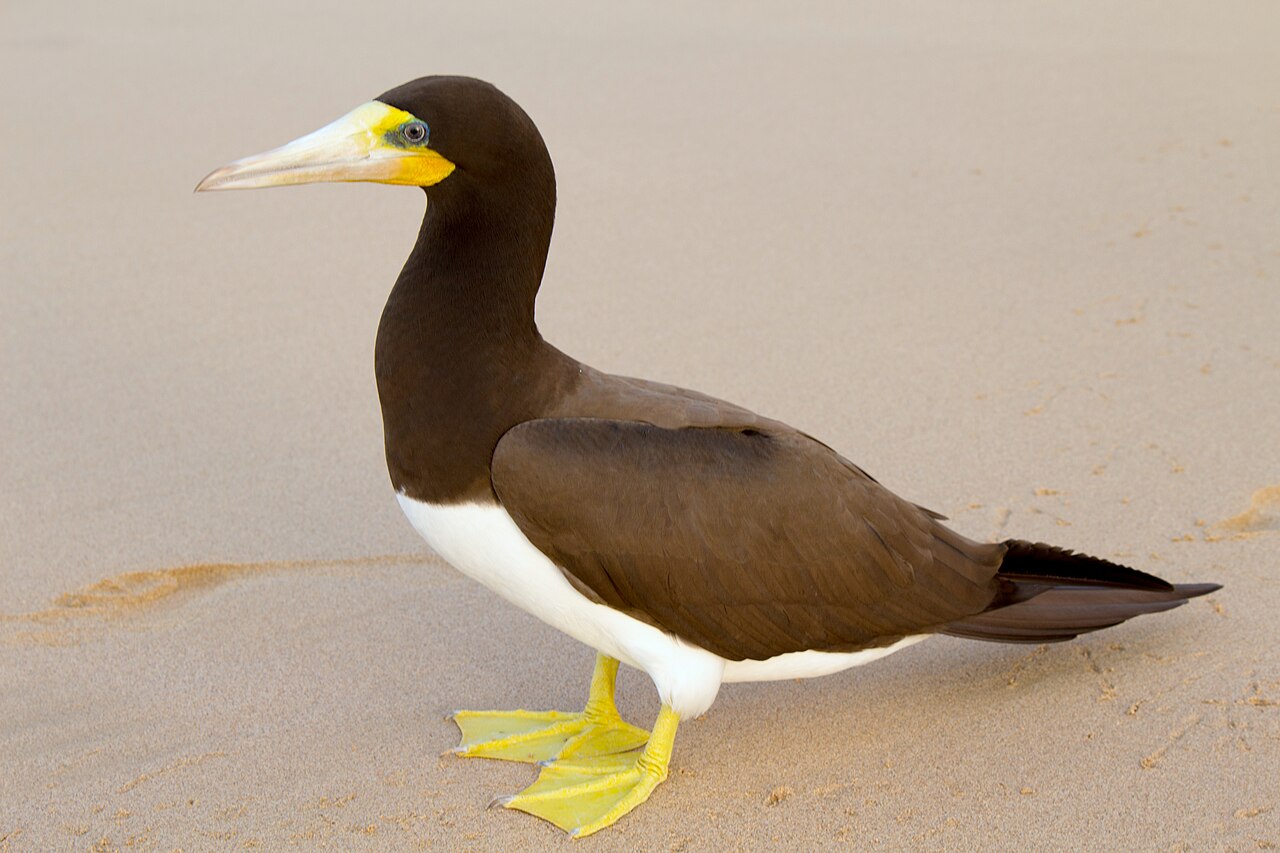
Brown Booby is the booby of warm water: dark chocolate brown from head to tail, with white underparts cut off sharply across the breast. It fishes close inshore, along reefs and over shoals, and between two flights it sits on buoys, channel markers and oil platforms. Over the past decade it has been turning up more and more often along the northern Gulf coast and off southern California.
Voice
At sea it is silent. At the colony the sexes sound different: the female gives a low, hoarse raa or kwaa with something of a goose in it, the male a thin rising whistle, sweee. You hear them most as a bird flies in and as the pair changes over at the nest, the two voices running through each other. Chicks beg with a continuous thin piping. Away from the colony it comes to no more than a short growl when two birds want the same buoy.
No freely licensed recording has been found for this species yet; what to listen for is described below.
Identification
The adult is evenly dark brown over head, neck, breast and upperparts, with a white belly and white underwing coverts; the border across the breast runs straight and sharp. Bill and feet are yellow to greenish yellow; the bare skin around bill and eye is yellower on the female and grey-blue on the male, and on the Pacific side of Mexico the male also has a frosted greyish white head. The female is slightly larger and heavier. Juveniles are dull brown right across the underside, so the adult's contrast is missing; only after two or three years is the belly fully white. In flight it is long-bodied, with narrow pointed wings and a wedge-shaped tail, alternating a few strong beats with long glides low over the water. It dives at a shallow angle, often only metres beyond the surf.
Confusion species
Northern Gannet (Morus bassanus), which winters in the Gulf of Mexico and off Florida, is a third larger, pointed at both ends in every plumage, and as an adult has black only at the wingtips; young gannets are dark, but lack the straight, sharp border between brown breast and white belly. Masked Booby (Sula dactylatra) is white with a black trailing edge and a black tail, the colours divided the other way round. Young Brown Pelicans are brown with a paler belly too, but have an enormous pouched bill and draw the neck in. Magnificent Frigatebird is as dark and as long-winged, but has a deeply forked tail, a kinked wing, and it never enters the water.
Habitat
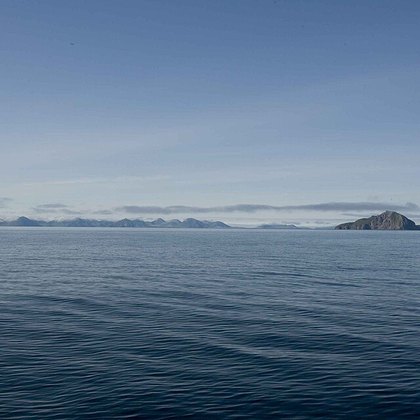
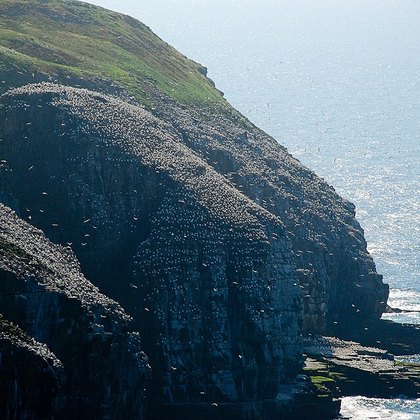
Warm coastal water over the shelf: around islands, reefs and shoals, where it dives from ten or twenty metres onto shoals of flying fish and sardines. To breed it uses bare islets and cliff ledges without rats or cats; the nest is a scrape in the ground, sometimes with a few twigs and feathers in it. Outside the breeding season it settles on anything standing above the water: buoys, markers, jetties, platforms and the masts of shrimp boats. It avoids cold water, and it does not go inland.
Where the bird is most often found, arranged by the USNVC — the vegetation classification of the United States and Canada — and CMECS for sea and coast.



Range and movements
It breeds in all warm seas; in this region on the islands of the Gulf of California, on Isla Isabel and the Revillagigedo Islands off the Pacific coast of Mexico, on the reefs off Yucatán and Veracruz, and throughout the Caribbean from the Bahamas and Cuba to Puerto Rico and the islands off the Venezuelan coast. In the Gulf of Mexico and along the coast of Central America it can be seen all year. Since about 2010 records at the edge of the range have grown: birds now nest in the Dry Tortugas off Florida, and off southern California it has gone from vagrant to annual visitor. Further north it remains a matter of single records.
- Resident
- Breeding (summer)
- Winter
- Passage
- dark = core range, pale = thinly spread
Where and when to look
Stand on a pier or a harbour mole on the Gulf of Mexico or in the Caribbean and work along the buoys and markers that line the channel: that is where it sits, alone or a few together, upright with the bill tilted slightly up. Behind an incoming shrimp boat the chance is best, in among the gulls and the pelicans. Watch the straight border across the breast; it still shows against the light.
Conservation
AviList carries no Red List category for this species. The world population is put at a few hundred thousand birds, large enough for it not to count as threatened. On the breeding islands introduced rats, cats and goats are the main threat, together with disturbance of colonies that lie on open ground. At sea birds become entangled in monofilament and fishing line, above all where they beg for fish around boats and jetties.
Scientific name
Sula leucogaster | (Boddaert, 1783)
Boddaert named the species in 1783 as Pelecanus leucogaster, among the pelicans; because it was later moved to another genus, author and year stand in parentheses. His description is no more than a name attached to a coloured plate by Daubenton, a way of working that was ordinary in the eighteenth century. The genus Sula was introduced by Brisson in 1760; sula is the Norwegian word for the gannet. leucogaster is Greek for 'white-bellied', after the one pale part of the bird. The type locality is Cayenne, on the coast of French Guiana.