All species › Waterfowl › Ducks, swans and geese › Northern Pintail
Northern Pintail | Anas acuta
Pijlstaart | Ánade rabudo
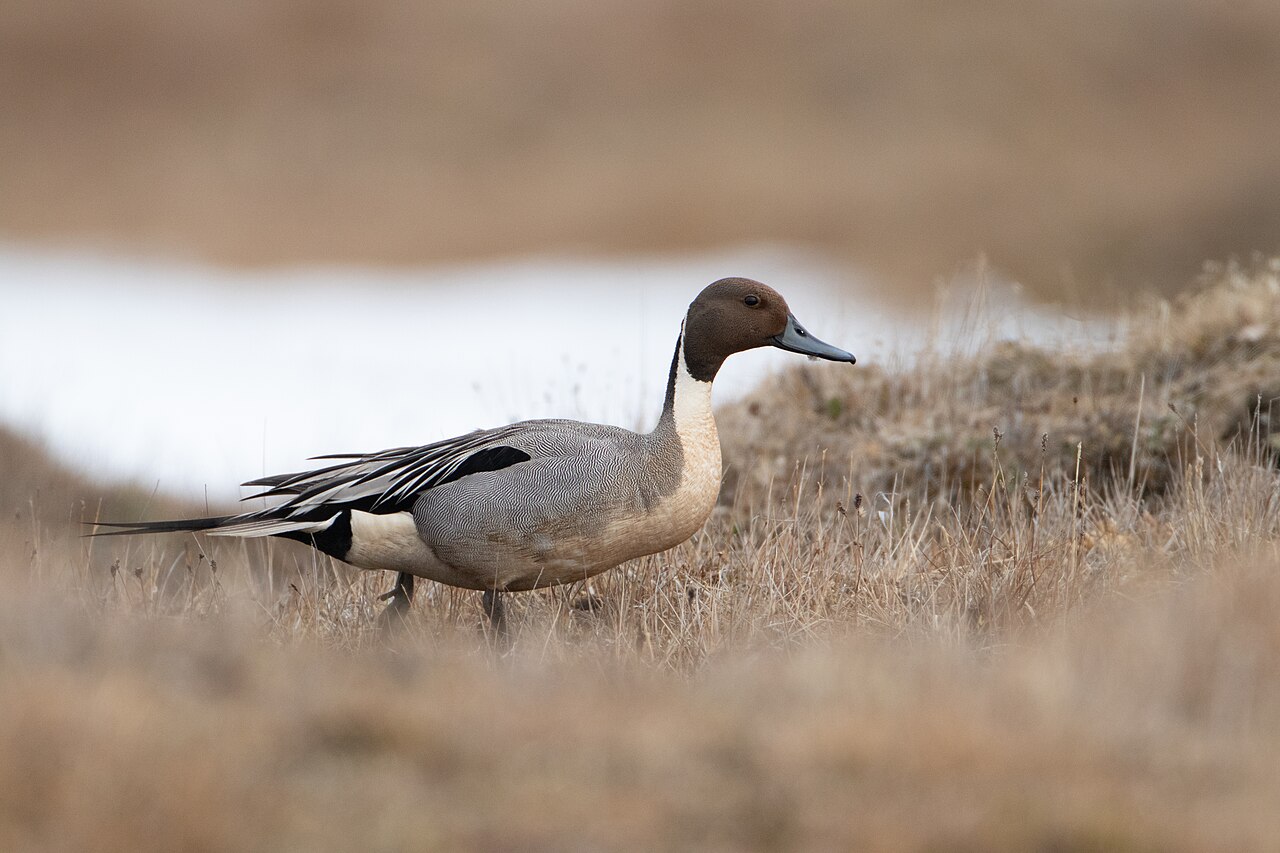
The Northern Pintail is the slimmest of all dabbling ducks: a long, slender body on a long, slim neck, with a needle-like tail extending well beyond the wingtips. It breeds across nearly the whole north of the continent, from tundra to prairie, and winters in large flocks south deep into Mexico and the Caribbean.
Voice
The male gives a soft, gurgling, two-note whistle, proop-proop, often from the water or during display flight, plus a higher, burry note used in group courtship. The female quacks harshly and low, quieter and less sharp than a Mallard's, in a short series of three to five notes. Outside the breeding season the species is largely silent and betrays itself more by its flight silhouette than by voice.
Recording: Stanislas Wroza — CC BY-NC-SA 4.0 · Kaamanen, Finland · xeno-canto
Identification
The breeding male has a chocolate-brown head with a sharply defined white stripe running up the side of the neck, a white foreneck and breast, finely vermiculated grey flanks, and a long, black, tapering tail that gives the species its name. The female is evenly mottled brown, more finely patterned than most female ducks, with a more pointed, shorter tail than most other females in the same genus. Both sexes have a long, thin neck and a blue-grey bill with a black ridge. In flight the long, slender silhouette stands out, with narrow, pointed wings and, in the male, a bronze-green speculum edged white at the rear.
Confusion species
The female is most often confused with a female Mallard, but has a greyer, less contrasting head, a thinner blue-grey rather than orange-and-black bill, and a noticeably more pointed tail. From the female Northern Shoveler the Pintail is told by its much thinner, shorter bill — broad and spoon-shaped in the shoveler — and its longer neck. The male in eclipse plumage, outside spring, closely resembles the female but can be recognized by its still-present grey wing coverts and slightly longer tail point.
Habitat
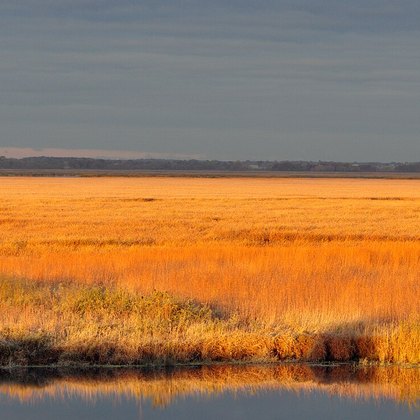
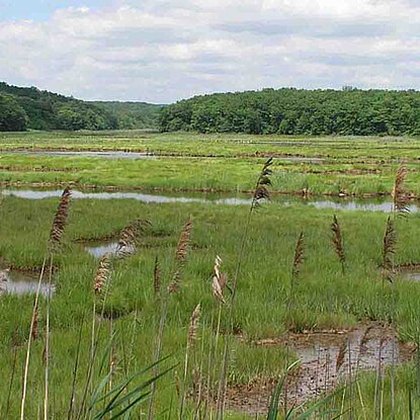
It breeds on open, shallow water in prairie potholes, tundra pools and grassland dotted with ponds, where low grass or herbaceous cover shelters the nest some distance from the water's edge. Outside the breeding season it uses shallow freshwater marshes, flooded rice fields, waterlogged farmland and sheltered coastal lagoons and bays, both dabbling and feeding on stubble fields. It avoids deep, fast-flowing or densely vegetated water; for this wary species, open visibility around it matters more than cover.
Where the bird is most often found, arranged by the USNVC — the vegetation classification of the United States and Canada — and CMECS for sea and coast.


Range and movements
The Northern Pintail breeds across nearly all of Alaska and Canada, from arctic coastal tundra to the prairies of the Great Plains, with an isolated population in the western United States. It winters along both coasts of the United States, across the southern Great Plains, and through nearly all of Mexico into Central America and the Caribbean, with the largest concentrations in California's Central Valley and along the Gulf Coast. The North American breeding population has fallen sharply since the mid-twentieth century, chiefly through the loss of prairie potholes to agriculture, and numbers also fluctuate strongly with rainfall on the breeding grounds.
- Resident
- Breeding (summer)
- Winter
- Passage
- dark = core range, pale = thinly spread
Where and when to look
Look for it in autumn and winter on shallow, flooded farmland and rice fields in the south, where Pintails are often among the first flocks of dabbling ducks to arrive from the north. The male is already recognizable by the long tail point breaking the surface even while the head is submerged to feed.
Conservation
The species is listed globally as Least Concern (LC); the global breeding population is estimated at just over five million birds, but has fallen by roughly three-quarters since 1966, one of the steepest declines among North American dabbling ducks. The chief cause is the loss of prairie potholes to drainage for agriculture, which sharply lowers nest success because birds then more often nest in crop stubble, where farming operations destroy clutches. It is hunted within quotas that are set partly in response to this trend.
Scientific name
Anas acuta | Linnaeus, 1758
Linnaeus described the species in 1758 as Anas acuta, among the ducks where it is still placed; author and year therefore stand without parentheses. Anas is Latin for 'duck', acuta Latin for 'sharp, pointed', after the long tail point. The type locality lies in Europe; Linnaeus himself restricted it to Sweden in 1761.