All species › Waterfowl › Ducks, swans and geese › White-cheeked Pintail
White-cheeked Pintail | Anas bahamensis
Bahamapijlstaart | Pato Gargantillo
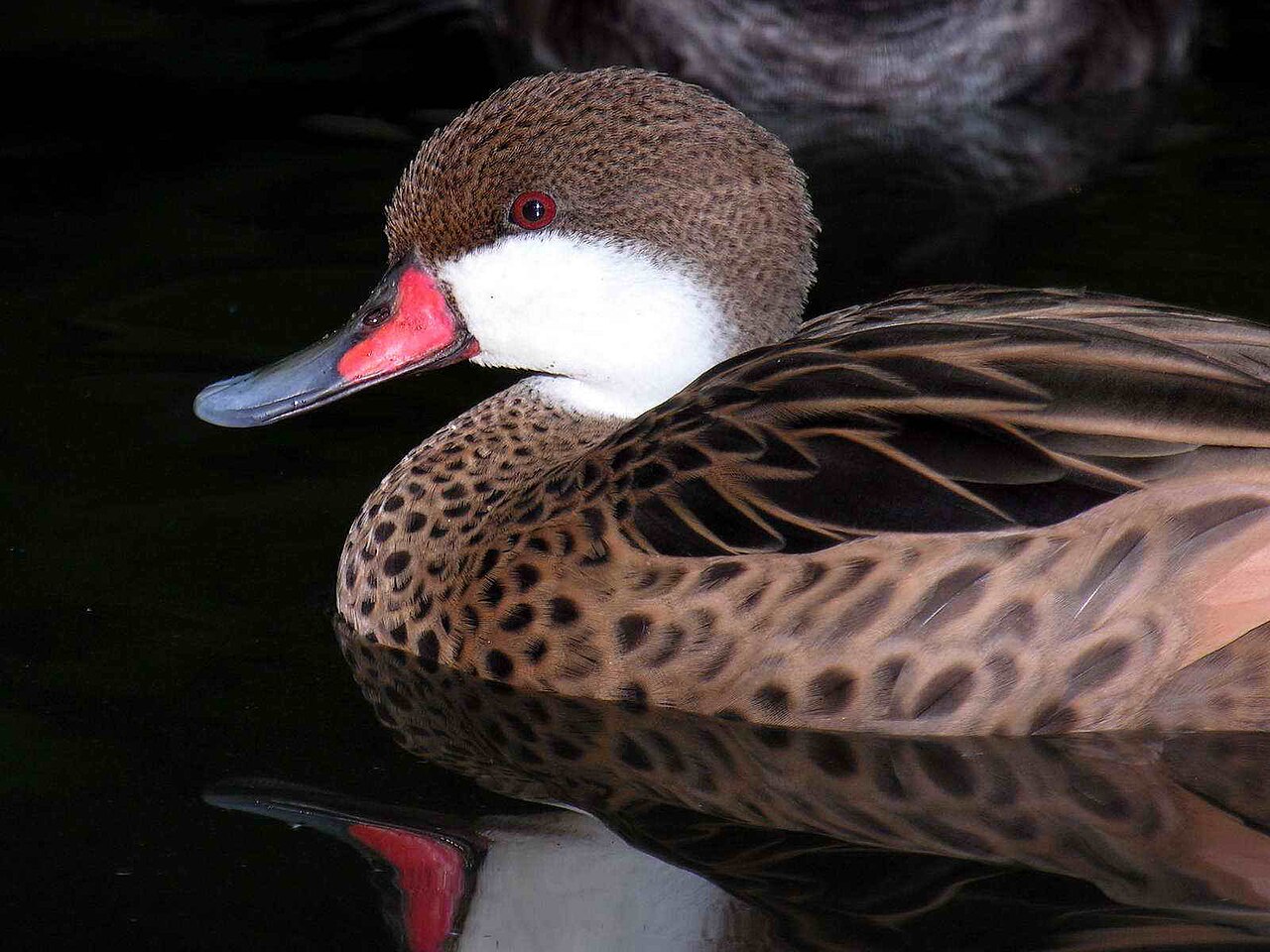
White-cheeked Pintail is the only duck of the Caribbean with sharply defined white cheeks and throat set against an otherwise brown plumage, and a red base to the grey bill. It lives on brackish to strongly saline lagoons and mangrove swamps from the Bahamas to the coast of northern South America, and unlike most ducks in this guide is resident there year-round. As a popular ornamental waterbird it is also kept worldwide, and escaped birds sometimes turn up far outside this range.
Voice
The male gives a high, squeaky whistle, softer and thinner than the quack of most ducks. The female gives an ordinary duck-like quack, shorter and less loud than a Mallard's. When disturbed, both sexes give a short, grunting call. During courtship, which on most islands can fall at any time of year with a peak from May to July, these calls are given more often and in short series.
Recording: Ignacio Escobar — CC BY-NC-SA 4.0 · Talcahuano, Concepcion, Bío Bío, Chile · xeno-canto
Identification
The plumage is mostly warm brown, with dark spotting on the breast and flanks, and the sharply white cheeks and throat that stand out in any light. The bill is grey with a red base, duller in young birds. The tail comes to a point, less pronounced than in Northern Pintail but clearly longer and sharper than in most other ducks of this genus. In flight the bird shows a glossy green speculum. Male and female look much alike; the female is on average slightly smaller and duller, with a less vivid red bill base.
Confusion species
Within its range White-cheeked Pintail is barely confusable: no other Caribbean duck combines the white cheeks with the red bill base. Outside its own range, in Florida and Texas, escaped ornamental birds must be taken into account: the species is kept in parks and private collections worldwide, and not every bird seen there is a genuine wild vagrant. Blue-winged Teal and Green-winged Teal are of similar size but entirely lack the white cheeks and have a much shorter, blunter tail.
Habitat
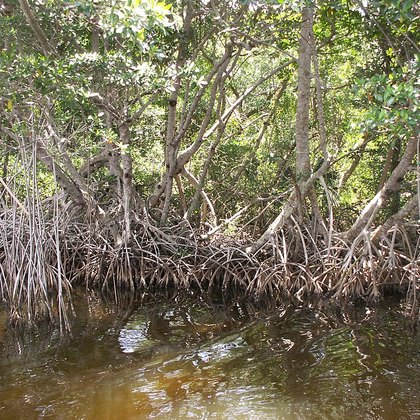
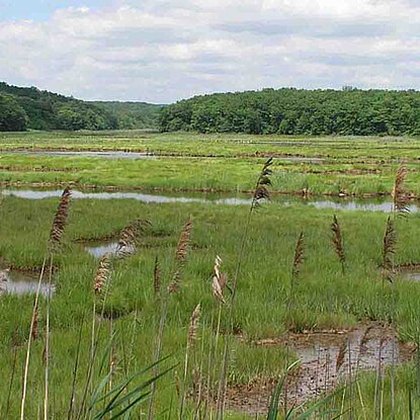
From fresh to strongly hypersaline water: brackish lagoons, coastal lakes, salt pans and mangrove swamp form the core of its habitat, supplemented by freshwater pools where available. For food it dabbles at the surface for seeds of marsh plants such as Ruppia, algae and small invertebrates. A nest site needs no more than dense ground vegetation, sometimes some distance from open water, in dry scrub or open woodland. It avoids fast-flowing water and coasts without sheltered, shallow margins.
Where the bird is most often found, arranged by the USNVC — the vegetation classification of the United States and Canada — and CMECS for sea and coast.


Range and movements
Resident on the islands of the Bahamas and the Greater and Lesser Antilles, from Cuba and Jamaica through Hispaniola and Puerto Rico to the Cayman Islands and the Turks and Caicos, and along the coast of northern South America from Colombia to northeastern Brazil. Other subspecies inhabit the Galápagos Islands and the southern part of South America; these are not covered in this guide. The species does not migrate, but does move between islands within the Caribbean in search of water, depending on rainfall. Occasional birds in Florida are treated with caution, since escaped park birds can produce the same sightings as a genuine vagrant.
- Resident
Where and when to look
Look for it on a brackish lagoon or salt pan in early morning or late afternoon, when it feeds actively at the surface; in the middle of the day it often rests hidden at the water's edge. The white cheeks are visible at long range and are sufficient for identification as soon as the bird lifts its head. For a clean record, avoid ponds in parks and resorts, where the chance of an escaped bird is highest.
Conservation
Not threatened (LC), with a wide distribution across the whole Caribbean, though the Red List gives the global trend as declining. Habitat loss through the draining of coastal marsh for tourism and agriculture, and illegal hunting on some islands, are the main concerns; in Puerto Rico the species is already considered locally vulnerable. The large captive population kept worldwide does nothing to support the wild birds, and escaped individuals if anything make it harder to judge the status of wild populations elsewhere.
Scientific name
Anas bahamensis | Linnaeus, 1758
Linnaeus described the species as early as 1758, in the tenth edition of his Systema Naturae, directly as Anas bahamensis, in the genus it still stands in today; author and year therefore stand without parentheses. The name refers to the Bahamas, where the type locality lies and where the first described specimen probably came from as well. Linnaeus based his description partly on an earlier illustration and description by Mark Catesby, who called the bird the 'Ilathera duck', after the island of Eleuthera in the Bahamas.