All species › Passerines › Tyrant flycatchers and allies › Olive-sided Flycatcher
Olive-sided Flycatcher | Contopus cooperi
Sparrenpiewie | Pibí Boreal
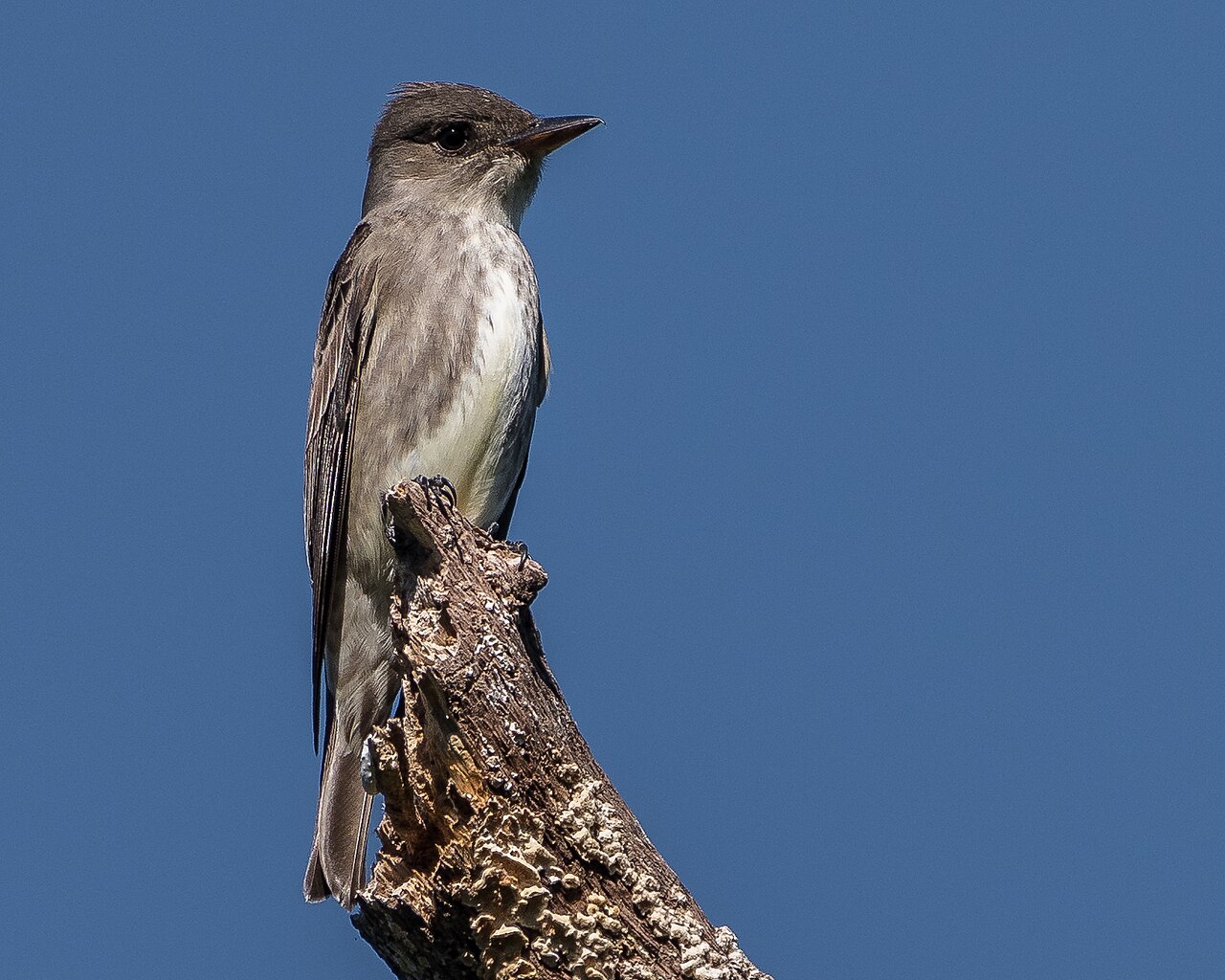
The Olive-sided Flycatcher is the largest pewee in North America: a heavy, short-tailed flycatcher that hunts from the top of a dead tree in coniferous forest. It is recognised by dark sides that stand out like an open waistcoat against a white central stripe, and by a loud three-note whistle that gave rise to its English mnemonic. Travelling from Alaska to Bolivia, it makes one of the longest migrations of any American flycatcher.
Voice
The song is three clear whistles, rendered in English as quick, three beers!: a short, softer first note, then a loud high note and a falling final note, roughly pip — PEEE-weer. That drawn-out middle note carries hundreds of metres across a valley. The call is a series of short, hard pip pip pip notes, often in threes, also used when driving off intruders. It sings from arrival in May into August, including through the middle of the day.
Recording: Greg Irving — CC BY-NC-SA 4.0 · Surveyor Creek Trail, Deer Park Clearcut, Clallam County, Washington, United States · xeno-canto
Identification
Large for a flycatcher, with a heavy head, a broad bill and a short tail, so that the wingtips reach nearly to the tail tip. The upperparts are olive-grey, the flanks and breast sides dark and coarsely streaked, with a narrow white band between them running from throat to belly. White tufts of down often show at the sides of the rump. The lower mandible is orange-yellow with a dark tip; wingbars are faint or absent. It perches upright on a bare, high branch and returns to the same spot after each sally.
Confusion species
Greater Pewee is the same size and also short-tailed, but plain grey below without the waistcoat pattern, with a pointed crest and an entirely orange lower mandible; it whistles ho-SAY ma-REE-a rather than three separate notes. Western and Eastern Wood-Pewees are clearly smaller and slimmer, with two visible wingbars and without the sharply set-off dark sides. Myiarchus flycatchers show rufous in wing and tail and a yellow belly. At distance the perch helps: only Olive-sided almost always chooses the highest dead branch in the stand.
Habitat
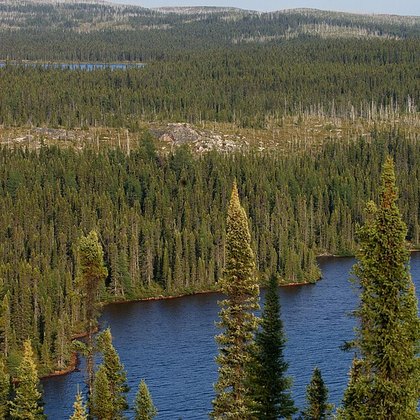
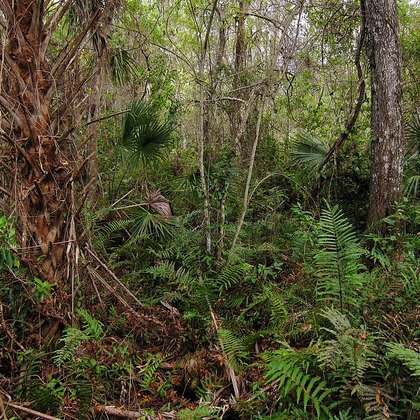
Open coniferous forest and forest edge with plenty of standing dead wood: boreal forest, bog and muskeg (boggy spruce peatland typical of boreal Canada), montane conifer forest to around 3000 metres, and above all recently burned stands and cutovers with snags left standing. Nearly always near water or open bog. In winter it uses montane cloud forest and lowland evergreen forest in the Andes and in Central America, again on projecting dead branches at forest edges.
Where the bird is most often found, arranged by the USNVC — the vegetation classification of the United States and Canada — and CMECS for sea and coast.




Range and movements
Breeds from central Alaska and Yukon east across boreal Canada to Newfoundland and south through the Cascades, the Sierra Nevada and the Rocky Mountains to California, Arizona and New Mexico, and in the east to New England and the Great Lakes. Wintering is almost entirely in South America, centred on the Andes of Colombia, Ecuador, Peru and Bolivia. Mexico and Central America are crossed on passage only; migration is late in spring — most birds reach the breeding grounds only in late May — and early in the late summer.
- Breeding (summer)
- Winter
- Passage
- dark = core range, pale = thinly spread
Where and when to look
Look for it in June by sound: stand at a burned or recently logged conifer stand and scan the highest dead top in view after the first quick, three beers. Migrants are often silent and perch lower, but keep the habit of returning to the same branch each time. Watch too for the white tuft of down at the side of the rump, which shows between wing and tail on a perched bird.
Conservation
The IUCN now lists the species as Least Concern (LC); it was previously classed as Near Threatened (NT). The world population is put at about 1.9 million birds and has been falling for decades; North American breeding bird surveys give a decline of roughly three per cent a year and of about three quarters since 1970. In Canada the species was assessed as threatened in 2007; after a reassessment in 2018 it has been listed under the Species at Risk Act as a species of special concern since 2023. The causes named are the decline of flying insects, loss of montane forest on the wintering grounds, and the disappearance of standing dead wood through fire suppression and salvage logging. North American watch lists carry it as a species in steep, sustained decline.
Scientific name
Contopus cooperi | (Nuttall, 1831)
Thomas Nuttall described the species in 1831 as Muscicapa cooperi; because it was later moved to another genus, author and year stand in parentheses. The species name honours William Cooper, an American naturalist and co-founder of the Lyceum of Natural History in New York. The genus Contopus was introduced in 1855 by Jean Cabanis, from Greek kontos 'short' and pous 'foot', after the short legs of these flycatchers. The Dutch name refers to the conifer forest in which it breeds, the English name to the olive sides and the Spanish name to the boreal breeding range.