All species › Passerines › Tyrant flycatchers and allies › Tufted Flycatcher
Tufted Flycatcher | Mitrephanes phaeocercus
Geelbuiktiran | Mosquero Moñudo Común
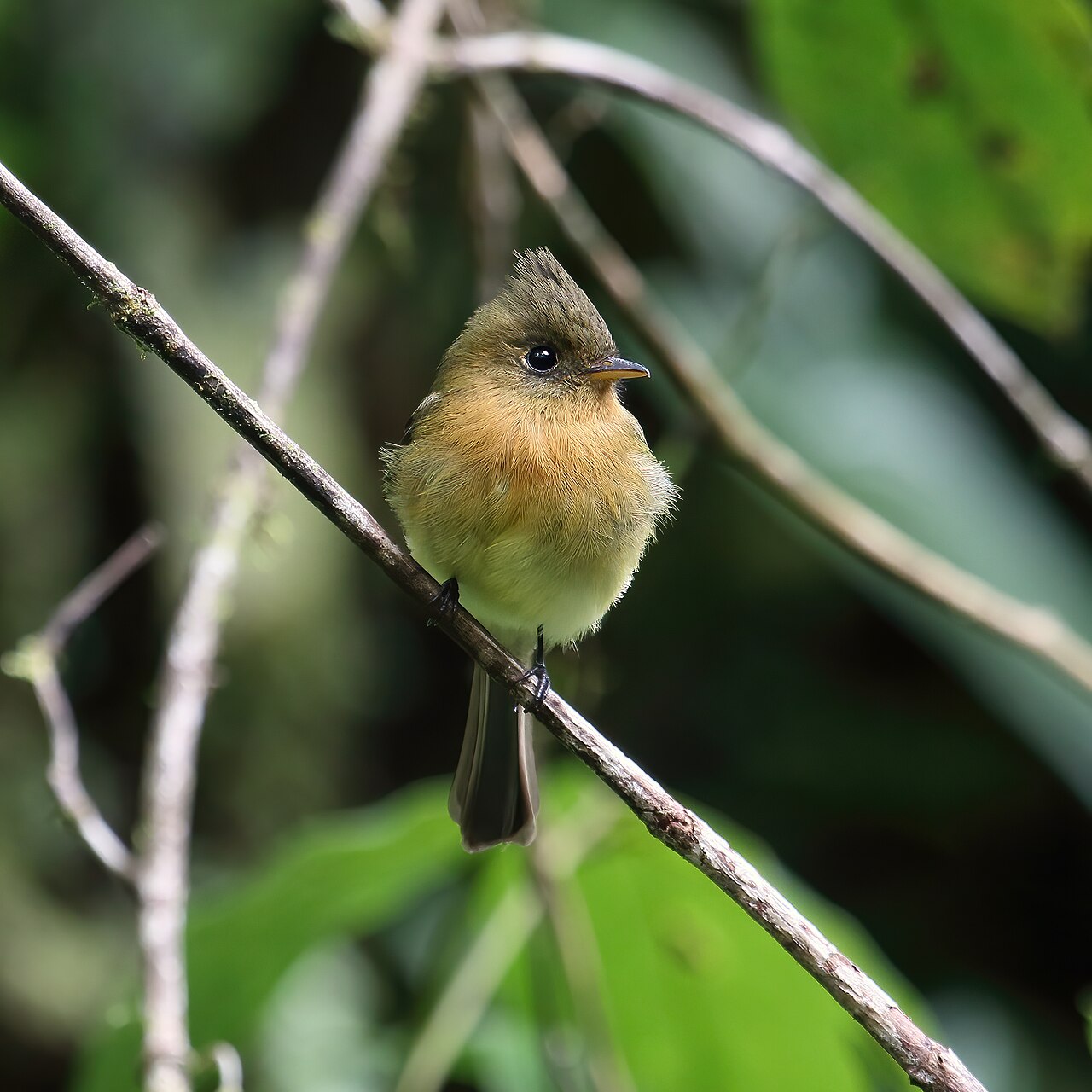
The Tufted Flycatcher is a small tyrant flycatcher of Middle American mountain forest, with a pointed crest and warm cinnamon underparts. Its range begins in the highlands of Sonora and Chihuahua and reaches Ecuador. North of the Mexican border it is a vagrant: the first record came from Big Bend, Texas, in 1991, followed by records in western and southern Texas and in the mountains of southeastern Arizona, where pairs have nested successfully in the Huachuca Mountains.
Voice
The call is a short, sharp pik or beek, often in series of three or four as the bird pivots on its perch. There is also a clear, slightly upslurred tchwee or turee, given singly or in rapid repetition. The dawn song is a rapid series of high, thin notes in varying order, usually before sunrise and from one fixed branch.
Recording: Manuel Grosselet - Rebeca Martinez — CC BY-NC-SA 4.0 · Capulalpam de Méndez, Ixtlán de Juárez, Oaxaca, Mexico · xeno-canto
Identification
Small and short-tailed, with a pointed crest held up even at rest, which makes the silhouette immediately recognisable. The upperparts are brownish olive, the wings dark with two narrow buff wingbars; face, throat and breast are warm cinnamon to ochre, grading to ochre-yellow on the belly. A thin buff-white eyering and a pale spot above the lores break up the face. The lower mandible is orange-yellow, the upper mandible black. The sexes look alike.
Confusion species
No other North American flycatcher combines a permanently raised crest with uniformly cinnamon underparts. Vermilion Flycatcher has a much longer tail and a pale throat against a rufous belly, and no crest. Dull Empidonax flycatchers are olive to grey below, with a more clearly closed eyering and a flatter crown. Myiarchus flycatchers are far larger, with a grey throat and rufous in tail and wing. In the hand or on a photograph, the short tail relative to the wing is the quickest supporting mark.
Habitat
Montane forest in the upper tropical and lower temperate zones, roughly between 1200 and 3000 metres: pine, pine-oak, evergreen cloud forest and older second growth. It keeps to edges, gaps and streamsides with free branches to hunt from, rather than closed canopy. In Arizona and Texas it uses comparable canyons of pine, maple and oak.
Where the bird is most often found, arranged by the USNVC — the vegetation classification of the United States and Canada — and CMECS for sea and coast.





Range and movements
Resident from northwestern Mexico to northwestern South America. The western subspecies group occupies southeastern Sonora and southwestern Chihuahua south to western Jalisco; the nominate group runs from Zacatecas and San Luis Potosí south through eastern and central Mexico, Guatemala, Belize, Honduras, El Salvador and Nicaragua and beyond. In the United States it is rare but close to annual: a few birds in the mountain canyons of southeastern Arizona, where pairs have stayed through whole summers and raised young, and scattered records at Big Bend and along the Rio Grande in Texas.
- Resident
- Breeding (summer)
- Winter
- Passage
- dark = core range, pale = thinly spread
Where and when to look
In Arizona, search the upper reaches of Ramsey Canyon and Miller Canyon in the Huachuca Mountains, and watch behaviour first: the bird hunts from a low, open branch, hovers briefly at foliage and returns each time to the same perch. A short pointed crest above a cinnamon breast is the first clue at distance. Document any record with a photograph or recording; it is a review species in both states.
Conservation
The Red List keeps the species at Least Concern (LC). The world population is put above 500,000 mature birds, with a declining trend. It is common in the mountain forests of northern Central America and Costa Rica; loss of pine-oak forest to logging, fire and conversion to farmland is the main pressure. The attempts to settle in Arizona coincide with a series of northward range shifts among Mexican montane birds.
Scientific name
Mitrephanes phaeocercus | (Sclater, 1859)
Philip Lutley Sclater described the species in 1859 as Mitrephorus phaeocercus; because it was later moved to another genus, author and year stand in parentheses. The genus Mitrephanes was introduced in 1882 by Elliott Coues, from Greek mitra 'headband, mitre' and -phanes 'resembling', after the crest. The species name phaeocercus comes from phaios 'dusky' and kerkos 'tail', so 'with the dusky tail'. The specimen described came from Córdoba in Veracruz, Mexico. The Dutch name refers to the ochre-yellow belly, the English and Spanish names to the crest.