All species › Passerines › Thrushes and allies › ʻOmaʻo
ʻOmaʻo | Myadestes obscurus
Hawaiilijster | Solitario ʻomaʻo
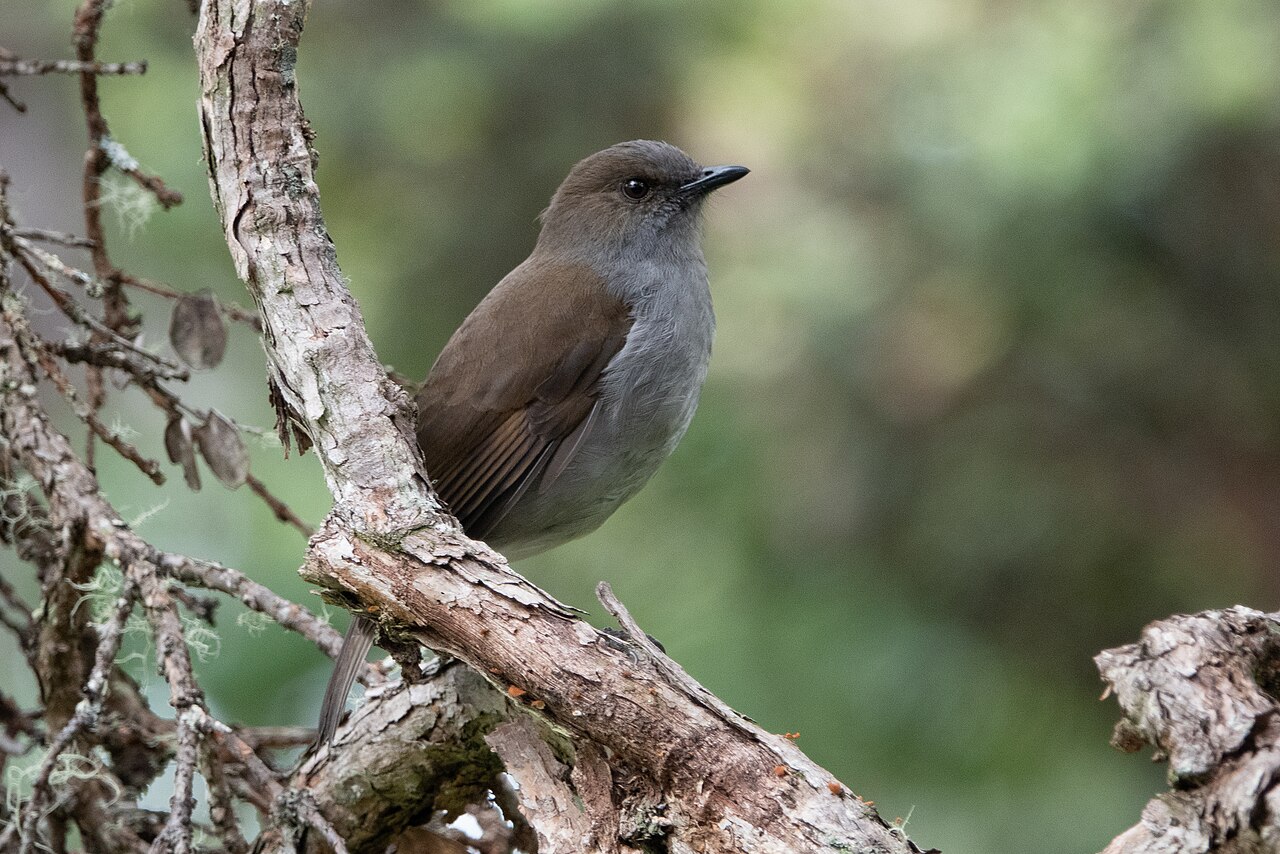
The ʻOmaʻo is the only solitaire still widespread on the island of Hawaii: a stocky, olive-brown bird of the wet ohia forest, usually detected by ear. Of the five Hawaiian solitaires two are extinct and one has not been seen in decades; this species still holds about thirty per cent of its original range.
Voice
The song consists of short, rough, clucking and whistled phrases that break off abruptly, with long silences between them; it is given from the canopy and in closed forest is virtually the only sign of the bird's presence. The call is a hoarse, rasping rrr and a high, cat-like mew. Males perform a song flight in which they climb above the canopy and descend while singing — a display known as skylarking.
Recording: Paul Buckley — CC BY-NC-SA 4.0 · Hawaii (near Pāhoa), Hawaii County, Hawaii, United States · xeno-canto
Identification
A short, solid bird with a large head, short tail and upright stance, dull brown-olive above and grey below, with a faint pale eye-ring and dark legs. Characteristic is the rapid quivering of the wings while the bird sits still, repeated several times a minute. It feeds mainly on fruit, often plucking it while hovering. Juveniles are scaled with buff-brown spots over head, back and underparts.
Confusion species
On Hawaii there is no other brown forest bird of this size; the only possible confusion is with the Puaiohi, which occurs on Kauaʻi alone and has pink legs, a clean white eye-ring and a slimmer build. Juvenile ʻOmaʻo have been taken for ʻIʻiwi or young honeycreepers because of their scaled underparts; the short straight bill and the wing-quivering rule that out. The song, with its broken phrases and long pauses, differs from the sustained whistling of the Puaiohi.
Habitat
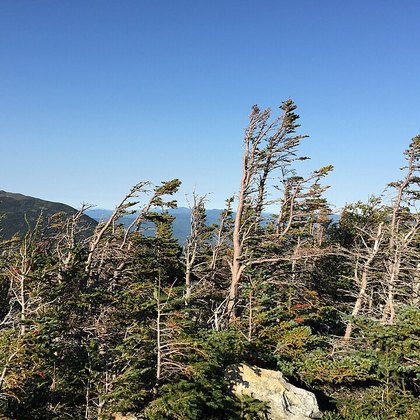
Mesic and wet montane forest of ohia with koa (Acacia koa, a native Hawaiian tree), with a dense understorey of ferns and fruiting shrubs such as olapa and kawau. The range formerly ran from 300 to 3000 metres; the bulk of it now lies above 1000 metres, with a smaller population in alpine scrub between 2000 and 3000 metres. The lower limit coincides with the elevation above which mosquitoes are scarce. For nesting it uses tree cavities, fern crowns and rock niches.
Where the bird is most often found, arranged by the USNVC — the vegetation classification of the United States and Canada — and CMECS for sea and coast.


Range and movements
The species occurs only on the island of Hawaii, where it forms two main populations: on the eastern slope of Mauna Loa and Mauna Kea and in the south around Kilauea and the Kau forest, plus a smaller group in alpine scrub higher up. It has gone from the west, the north and the lowlands of the island. It has never bred on the other Hawaiian islands; the related solitaires there — Kamao of Kauaʻi, Olomao of Molokaʻi and Lanaʻi, Amaui of Maui — are extinct or lost.
- Resident
Where and when to look
The best chance is on the high trails of Hawaii Volcanoes National Park and in the Hamakua forest reserves above 1200 metres, early in the morning: listen first for the hoarse call, then scan the canopy for a silent, short-tailed bird quivering its wings. Stand still by a fruiting olapa — the birds come to the fruit.
Conservation
The IUCN treats the species as Near Threatened (NT); the forest bird surveys of 1976 to 1983 put the population at about 170,000 birds, and numbers below 1200 metres appear stable or slightly increasing since. The main threat is avian malaria, carried by the introduced mosquito Culex quinquefasciatus: the species disappeared from the lower forests where that mosquito occurs, and rising temperatures carry it further up the mountain. Rats take nests and feral pigs damage the understorey. Management consists of fencing, removal of ungulates, rat and cat control and restoration of native forest above 1500 metres.
Scientific name
Myadestes obscurus | (Gmelin, 1789)
Gmelin described the species in 1789 as Muscicapa obscura, from material from the Sandwich Islands — Cook's name for the Hawaiian archipelago; because it was later placed in Myadestes, author and year stand in parentheses. The species name obscurus is Latin for 'dark' or 'dull', after the plain plumage. The genus name Myadestes means 'fly-eater', from Greek muia and edestes. The Hawaiian name ʻomaʻo means 'green', after the olive tone of back and wings.