All species › Passerines › Thrushes and allies › Townsend's Solitaire
Townsend's Solitaire | Myadestes townsendi
Bergsolitaire | Solitario norteño
Townsend's Solitaire is a plain grey thrush of western mountain forest that sits upright on an exposed branch the year round. In winter it leaves the high ground and defends a juniper bush of its own: its food is then almost entirely the fleshy cones of that single plant.
Voice
The song is a long, continuous run of clear, flute-like phrases rising and falling in no fixed order, sometimes held for minutes; it is given year-round, including in midwinter from a juniper. The call is a single, high, slightly squeaky heeh, which in winter serves as a territorial signal and is often all you hear along a woodland edge. In the breeding season the male also sings in a climbing flight of a hundred metres or more.
Recording: Greg Irving — CC BY-NC-SA 4.0 · Obstruction Point Road, Olympic NP, Port Angeles, Clallam County, Washington, United States · xeno-canto
Identification
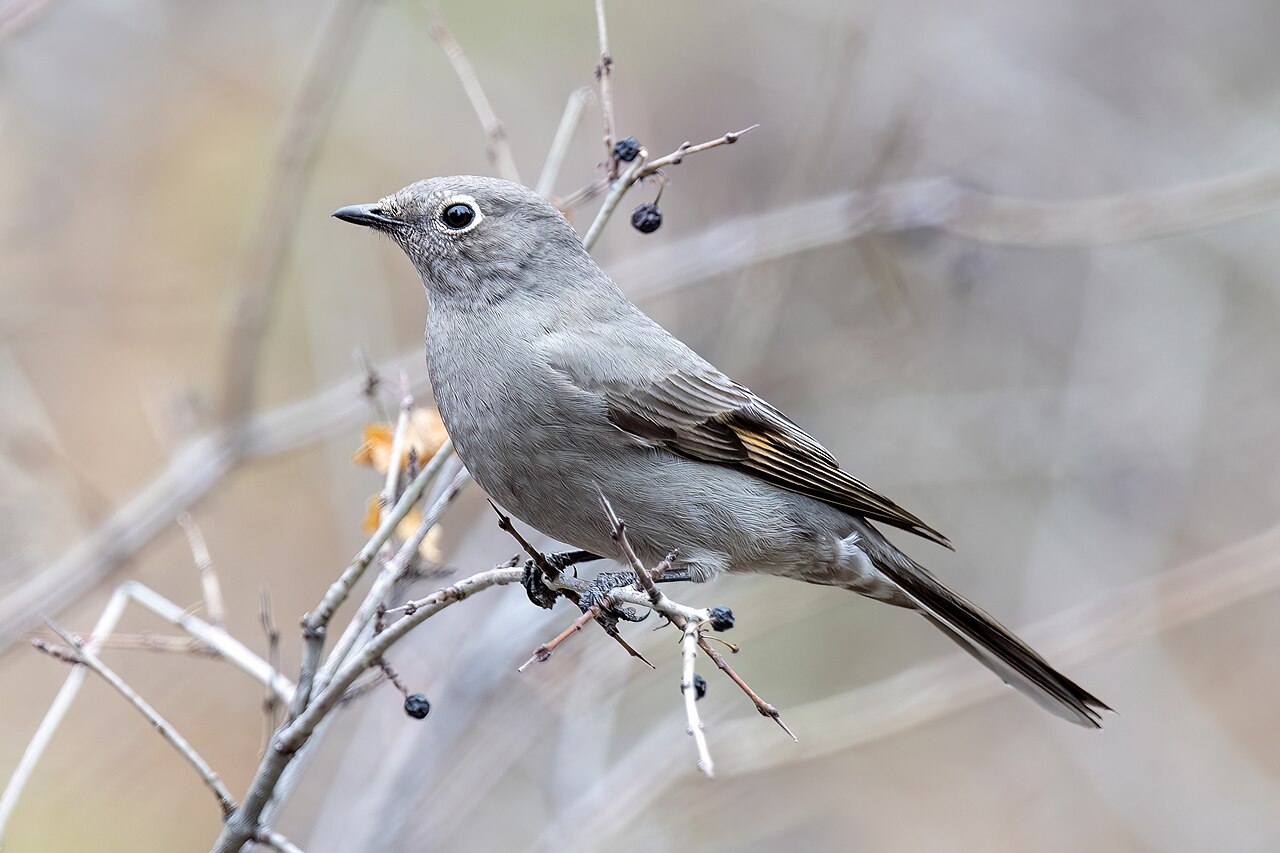
A slim, long-tailed grey bird with a white eye-ring on an otherwise unmarked head, a short black bill and a long tail edged white. A buff stripe crosses the wing and flares as a broad patch in flight, and the flight feathers are buff-edged. Perched, it is the upright stance on a free branch that stands out. Juveniles are grey with white spots over head, back and breast, with the wing stripe already showing.
Confusion species
Brown-backed Solitaire of Mexico is browner above and lacks the buff wing stripe. A female Mountain Bluebird has a shorter tail, blue in wing and tail and no buff in the wing. At distance the silhouette can suggest a shrike or a flycatcher, but the white eye-ring, the buff wing stripe and the white tail edges together are distinctive. The flight is irregular and jerky, unlike a shrike's direct flight.
Habitat
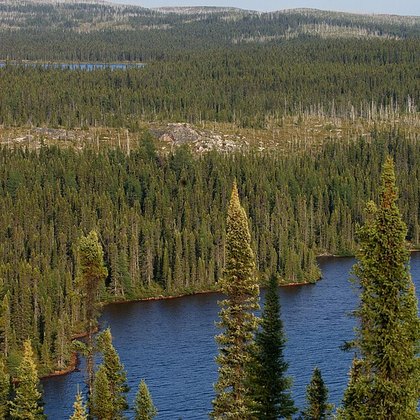
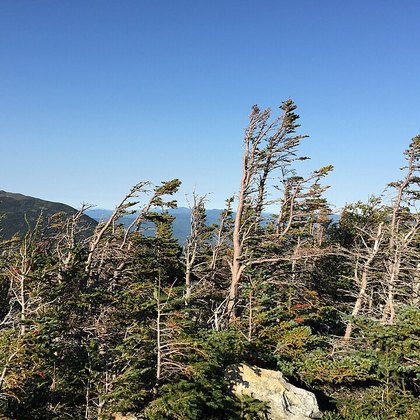
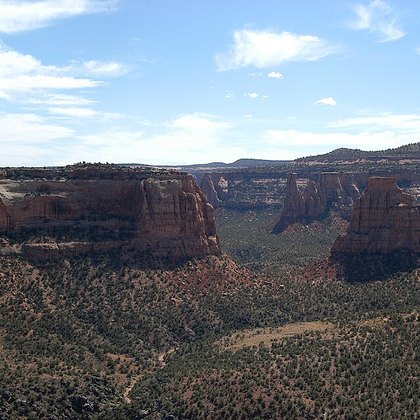
Montane conifer forest: pine, spruce and fir with an open understorey, usually between 350 and 3500 metres, and up into the krummholz (stunted, wind-pressed tree growth at the treeline). It nests on the ground, in a hollow under an eroding earth bank, tree roots or a rock ledge, for which it needs steep bare soil. In winter it comes down to juniper and pinyon woodland, canyons, desert oases and the edge of the Great Plains.
Where the bird is most often found, arranged by the USNVC — the vegetation classification of the United States and Canada — and CMECS for sea and coast.




Range and movements
It breeds from southern Alaska and Yukon through British Columbia and Alberta south over the western ranges to Arizona, New Mexico and the mountains of northern Mexico, with an eastern outpost in the Black Hills. In the western states it is present year-round because it only shifts in elevation. The winter range extends across the western Great Plains to Texas, Oklahoma, Kansas and Nebraska and onto the northern Mexican plateau. How many birds winter in any area depends on the juniper crop; in a year without berries they move hundreds of kilometres further.
- Resident
- Breeding (summer)
- Winter
- Passage
- dark = core range, pale = thinly spread
Where and when to look
Walk a juniper slope in Colorado or New Mexico in December or January and listen for the single heeh: each calling bird holds a bush of its own, so they can be counted off at intervals. In the breeding season the song is the best lead — work along steep stream valleys in spruce forest, where the nest sits under an eroding bank.
Conservation
Partners in Flight puts the breeding population at about 1.1 million birds and the species is rated Least Concern (LC), with a broadly stable trend. Its main dependence is on juniper: clearing of pinyon (a low-growing pine of the dry south-western foothills) and juniper woodland for grazing reduces the winter range, and large fires in montane conifer forest affect the breeding habitat. Because the species spreads thinly over a wide area in winter it is hard to census, and regional trends remain uncertain.
Scientific name
Myadestes townsendi | (Audubon, 1838)
Audubon described the species in 1838 as Ptiliogonys townsendi; because it was later placed in Myadestes, author and year stand in parentheses. The genus name Myadestes comes from Greek muia 'fly' and edestes 'eater', hence 'fly-eater'. The species name honours John Kirk Townsend, who collected the described specimen on the Columbia River near Astoria, Oregon. 'Solitaire' is the standing group name for this genus and refers to the solitary habit, which is most pronounced in winter.