All species › Passerines › Thrushes and allies › Mountain Bluebird
Mountain Bluebird | Sialia currucoides
Bergsialia | Azulejo claro
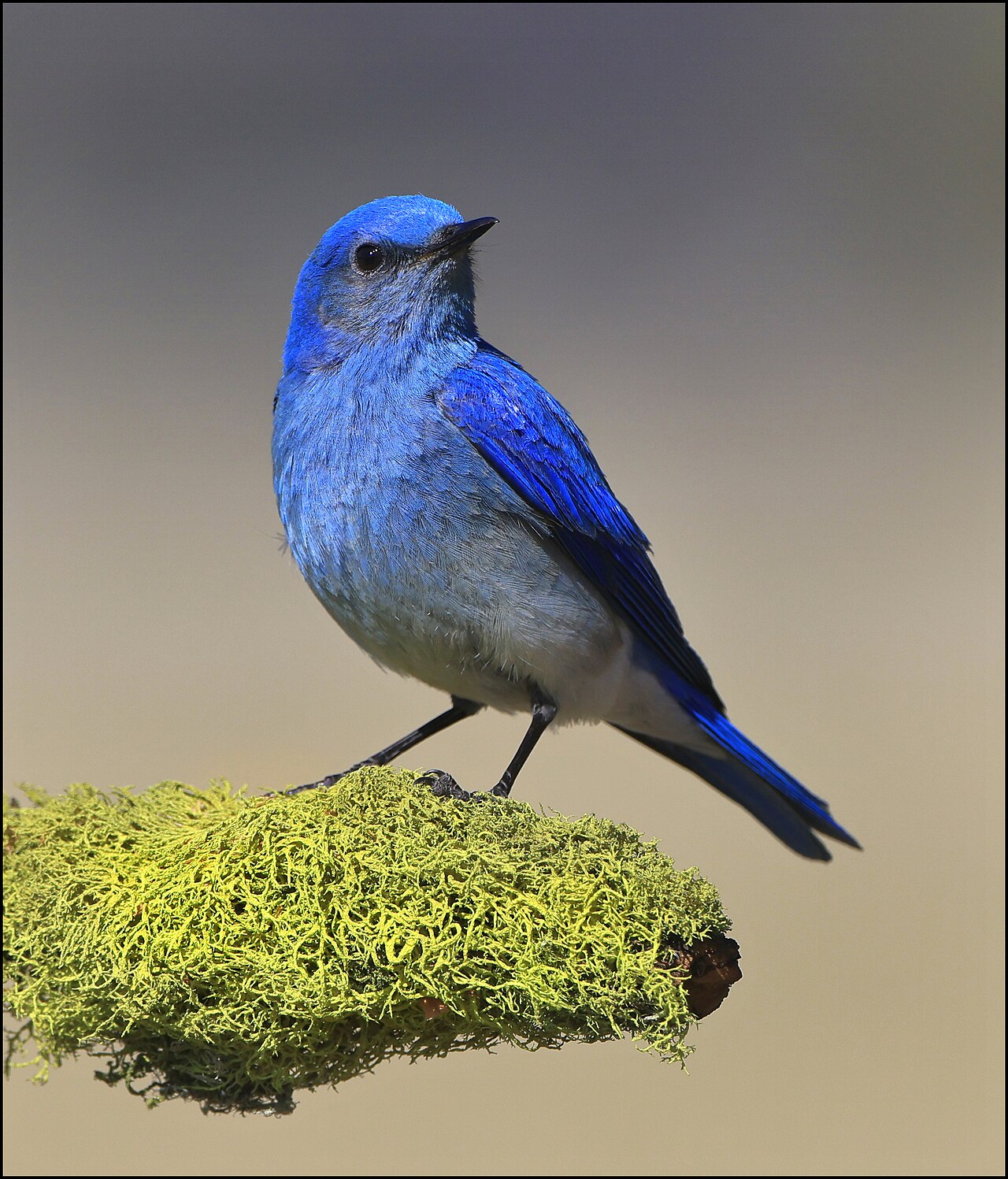
The Mountain Bluebird is the bluebird of open country at altitude: sagebrush (grey-green wormwood scrub of the dry western interior) flats, mountain meadows and the edges of conifer forest, up beyond treeline. The male is the only bluebird that is wholly blue with no rust at all, and the species hunts differently from its relatives — hovering over short grass rather than dropping from a perch.
Voice
The call is a thin, high tew or few, single and slight, often from a bird passing overhead. The song is a low, roughly warbled series of chur-chur notes, mostly well before sunrise and delivered from a high branch or post; by day it sings little. At the hole both parents give a short, hard chak. The whole species is quiet: on a windy slope the song barely carries fifty metres.
Recording: Paul Marvin — CC BY-NC-SA 4.0 · Beartooth Pass area, Carbon County, Montana, United States · xeno-canto
Identification
The male is sky-blue above and paler blue below, bluest on wing and tail, with white on the lower belly and undertail coverts; rust is entirely absent. The female is grey-brown with blue wings and tail, a pale eye-ring, and in fresh autumn plumage a reddish wash on throat and breast that turns brown towards the flanks. The species is slimmer and longer-winged than the other bluebirds, with a wing of about 11 centimetres, and hovers over grass — a picture no other bluebird gives.
Confusion species
Western Bluebird always shows rust on breast and flanks and has a shorter wing; the male is also darker and deeper blue. Eastern Bluebird has an orange throat and breast. Females are the hard case: a female Mountain is colder grey, without the warm rusty breast, with a plainer white eye-ring and a longer, more pointed wing. Where both occur the behaviour helps: hover-hunting over open grass points to Mountain.
Habitat
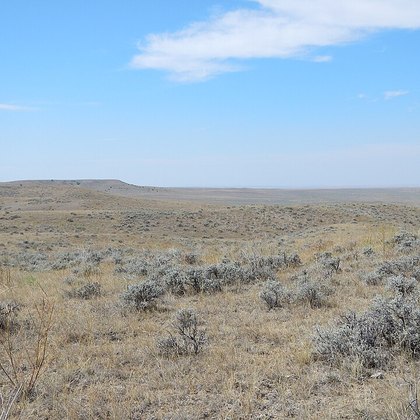
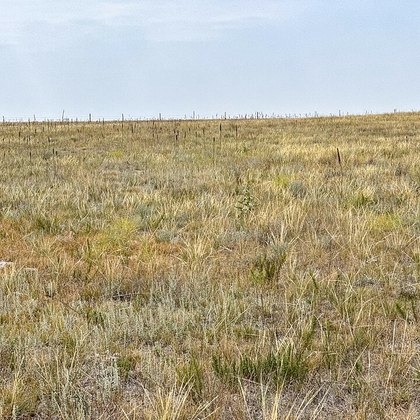
Open, largely treeless country at altitude: sagebrush steppe, shortgrass prairie, alpine and subalpine meadow, mountain pasture and the edges of pine and spruce forest, usually between 1500 and 3500 metres. It nests in cavities — woodpecker holes, rock crevices, holes in earth banks and nest boxes — and also needs low perches and short grass. Burns, clearcuts and grazed pasture all qualify. In winter it moves to lower open country with juniper and mistletoe.
Where the bird is most often found, arranged by the USNVC — the vegetation classification of the United States and Canada — and CMECS for sea and coast.



Range and movements
It breeds from central Alaska, Yukon and the southern Northwest Territories through British Columbia, Alberta, Saskatchewan and western Manitoba south over all the western ranges to Arizona and New Mexico, and east to the Black Hills and the western Great Plains. In Colorado, Utah, Nevada, California, Arizona and New Mexico it breeds high and winters low, so those states are occupied year-round. The winter range shifts to Texas, Oklahoma and Kansas and onto the northern Mexican plateau, roughly to Jalisco and Querétaro. Numbers at any one wintering site swing widely with the juniper berry crop.
- Resident
- Breeding (summer)
- Winter
- Passage
- dark = core range, pale = thinly spread
Where and when to look
Look for it in May and June on a sagebrush flat or mountain meadow with a fence line: males sit on the posts or hover a few metres above the grass, which shows the blue from above to good effect. In winter the juniper slopes of Arizona and New Mexico produce flocks that may run into dozens of birds.
Conservation
Partners in Flight puts the global breeding population at 4.6 million birds; 80 per cent spend part of the year in the United States, 20 per cent breed in Canada and 31 per cent winter in Mexico. The Breeding Bird Survey shows a decline of about 26 per cent between 1966 and 2014. Shortage of nest cavities is part of that: removal of dead timber, competition from European Starling and House Sparrow, and the retreat of open sagebrush. Nest-box trails in the Rockies and on the Canadian prairies now carry a large share of the breeding population.
Scientific name
Sialia currucoides | (Bechstein, 1798)
Bechstein described the species in 1798 as Motacilla s. Sylvia Currucoides; because it was later placed in Sialia, author and year stand in parentheses. The species name currucoides is built from curruca, the name Linnaeus gave the Lesser Whitethroat, and the Ancient Greek suffix -oidēs 'resembling' — hence 'whitethroat-like'. The stated type locality is 'Virginien', but it is read as western North America, since the species does not occur in Virginia.