All species › Passerines › New World warblers › Ovenbird
Ovenbird | Seiurus aurocapilla
Ovenvogel | Reinita hornera
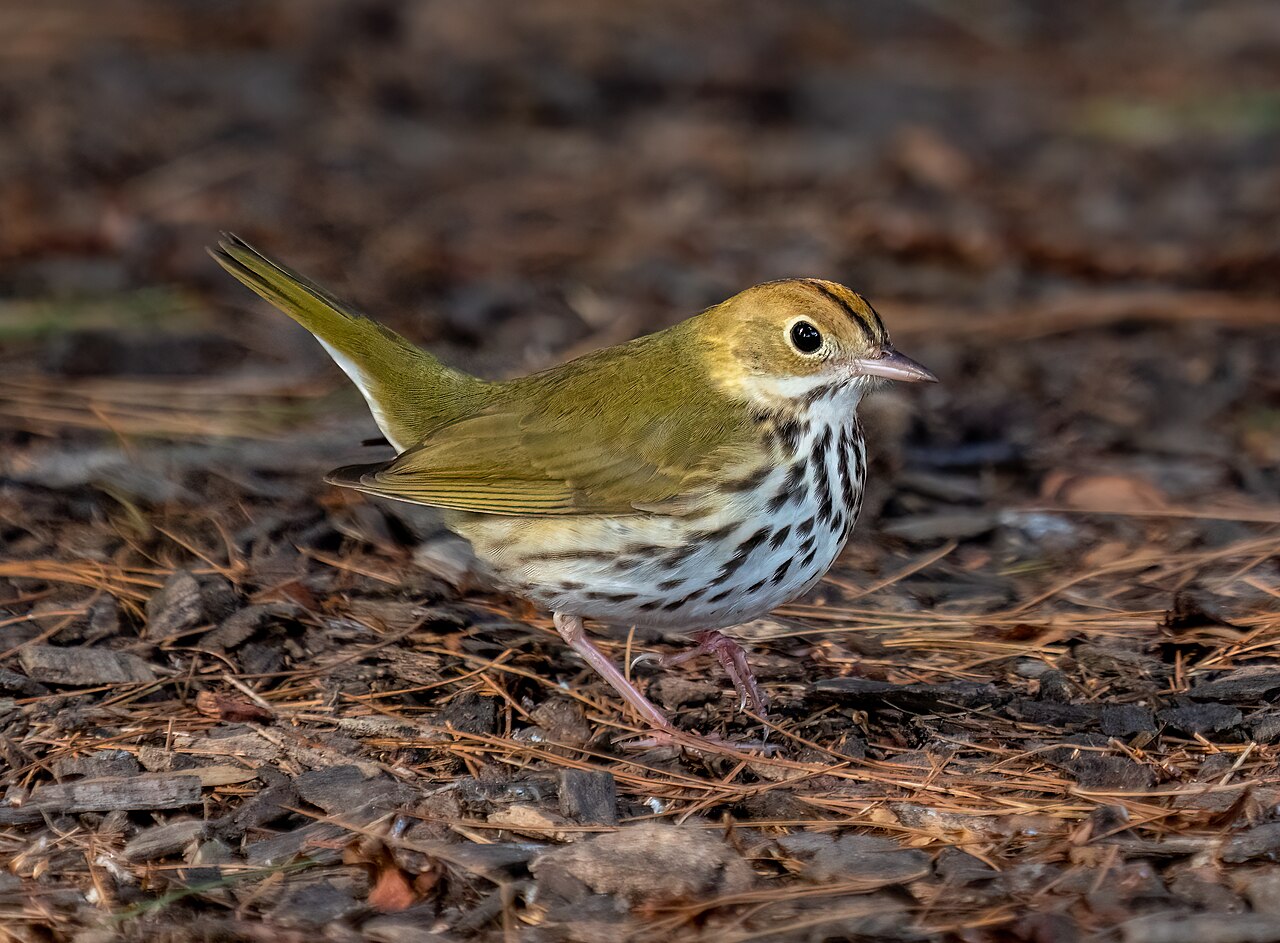
The Ovenbird is the American wood-warbler that does not flit in the canopy but walks over the forest floor, tail raised and head nodding. It breeds in closed deciduous and mixed forest from British Columbia to Newfoundland and south to the Gulf states, and takes its name from its domed nest on the ground.
Voice
The song is a series of two-syllable notes rising in loudness: cher-tea cher-tea cher-TEA, usually written teacher-teacher-TEACHER. It carries far through closed forest and is often the most frequent sound of a June morning. The male also has a longer, jumbled flight song, mostly at dusk. The call is a sharp, dry chek.
Recording: Jeff Stewart — CC BY-NC-SA 4.0 · Cavan-Monaghan (near Millbrook), Peterborough County, Ontario, Canada · xeno-canto
Identification
A compact, short-tailed warbler, olive-brown above and white below with heavy black streaking arranged in rows, like a small thrush. A stripe over the crown runs orange to rusty, bordered black on each side; it shows only on a perched bird seen from in front. A complete white eye-ring stands out in an otherwise plain face. There are no wingbars. Behaviour is decisive: it walks rather than hops, steps deliberately over the leaf layer and holds the tail slightly raised.
Confusion species
Northern and Louisiana Waterthrushes also walk on the ground, but are slimmer, have a broad pale eyebrow instead of an eye-ring and no orange crown stripe, and bob the rear body continuously; they also keep to the water's edge. Thrushes of the genus Catharus, such as Swainson's Thrush, are much larger, longer-tailed and heavier-billed and lack the crown stripe. The song separates the Ovenbird from all of these beyond doubt.
Habitat
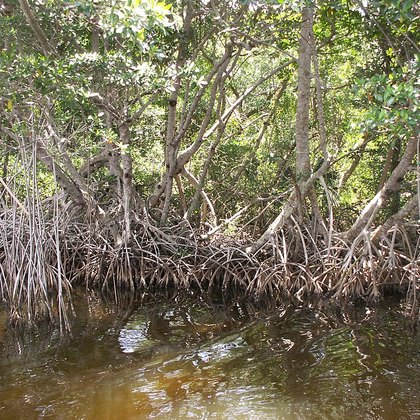
Extensive closed deciduous and mixed forest with a high canopy and an open, leaf-covered floor; also mature conifer forest in the north. It avoids dense shrub layers and young regrowth, and avoids wet forest floor, where the waterthrushes take over. Nesting success drops sharply in small forest fragments. In winter it uses tropical deciduous forest, shade coffee and mangrove edge, again walking over the ground.
Where the bird is most often found, arranged by the USNVC — the vegetation classification of the United States and Canada — and CMECS for sea and coast.




Range and movements
The breeding range runs from northeastern British Columbia and the southern Northwest Territories east across the Canadian provinces to Newfoundland, and in the United States from the northern prairie states and the Great Lakes to New England and south through the Appalachians to Georgia and Arkansas. Wintering lies largely outside the guide area, but within it it covers southern Florida, the Gulf slope of Mexico from Veracruz to Yucatán, Chiapas and Oaxaca, all of Central America as far as Nicaragua, and the Greater and Lesser Antilles. Through the southeastern United States and northeastern Mexico it is a migrant.
- Resident
- Breeding (summer)
- Winter
- Passage
- dark = core range, pale = thinly spread
Where and when to look
In May and June follow the song into the middle of a large woodland and then stand still: the bird often walks past within a few metres without otherwise drawing attention. In autumn it turns up on migration in town parks and gardens, again walking on the ground rather than moving through the shrubs.
Conservation
Partners in Flight puts the world population at about 26 million birds; the North American Breeding Bird Survey shows a stable to slightly rising trend between 1966 and 2019 and the species is listed as Least Concern (LC) and rated of low conservation concern. Regionally the picture differs: forest fragmentation raises the chance of nest parasitism by Brown-headed Cowbird and of predation, so small woodlots produce few young. Because it migrates at night it is among the species that frequently strike lit buildings.
Scientific name
Seiurus aurocapilla | (Linnaeus, 1766)
Linnaeus described the species in 1766 as Motacilla aurocapilla, among the wagtails; because it was later moved, author and year stand in parentheses. The species name is from Latin aurum 'gold' and capillus 'hair', after the orange crown stripe. The genus Seiurus was introduced in 1827 by Swainson, from Greek seiō 'to shake, to move' and oura 'tail'. The Dutch and English names refer to the domed ground nest with a side entrance, which recalls a baker's oven.