All species › Passerines › New World blackbirds, troupials and allies › Great-tailed Grackle
Great-tailed Grackle | Quiscalus mexicanus
Langstaarttroepiaal | Zanate mexicano
The Great-tailed Grackle is the largest grackle in North America and the bird of plazas, parking lots and irrigation canals in Mexico and the American Southwest. Since about 1880 it has spread northward along cities, arable farming and man-made water, and it now reaches Oregon, Idaho and Minnesota.
Voice
The male's repertoire runs from clear rising whistles and tinkling notes to harsh grating, clattering series and a sound recalling a rusty hinge; these parts follow one another in a fixed order. The female mostly gives a rattling chek-chek. Dialects differ between regions. In a town square dozens of males sing at once from the same trees.
Recording: Manuel Grosselet — CC BY-NC-SA 4.0 · Papago Park, Phoenix, Maricopa County, Arizona, United States · xeno-canto
Identification
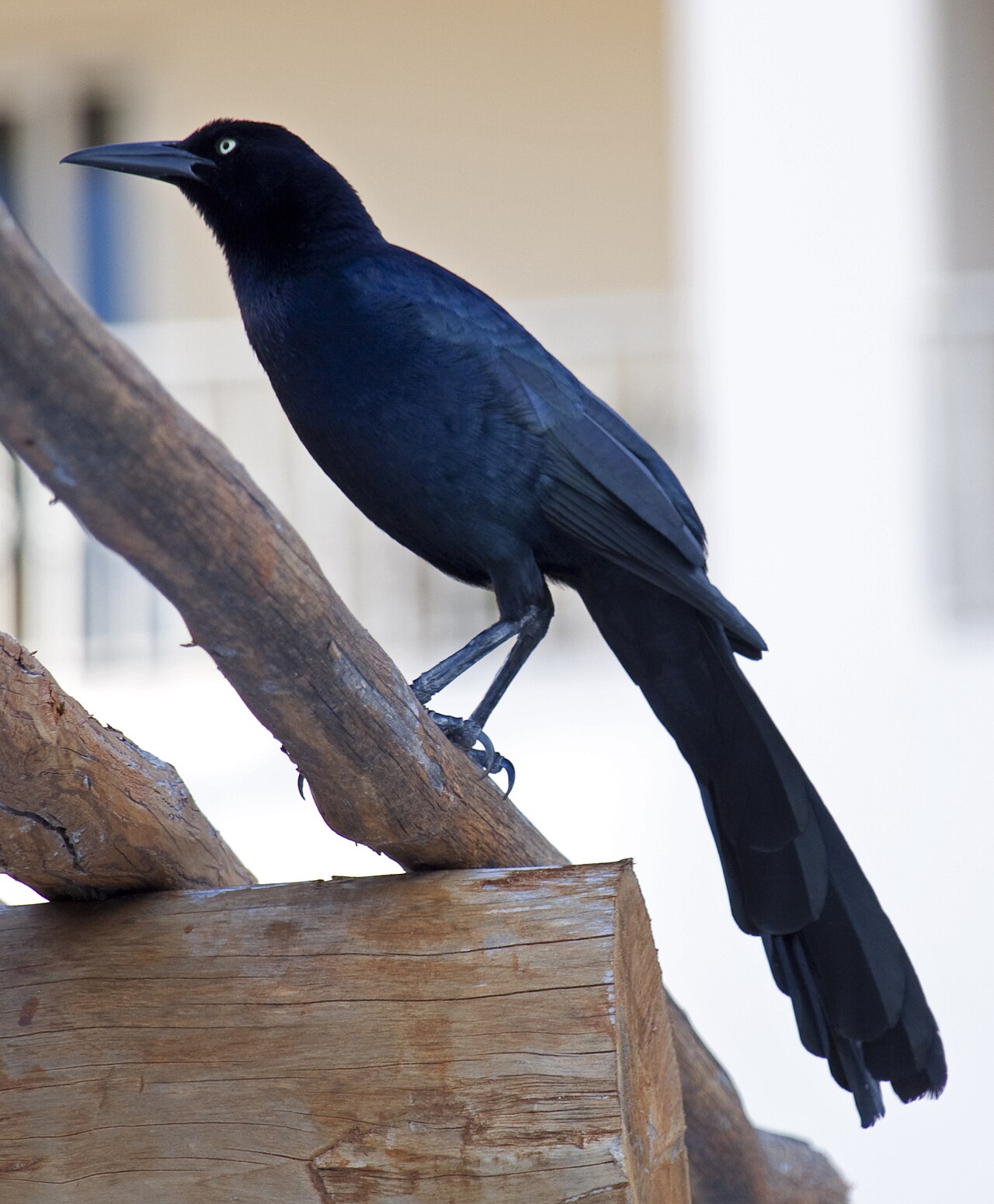
The male is entirely black with a purple-blue sheen, with a long, broadly keeled tail making up nearly half the total length, a heavy bill, long legs and a bright yellow iris. The female is barely more than half his weight, warm brown above and paler tawny below with a pale eyebrow, and has a much shorter tail. Young birds are dull brown, with a dark iris and streaked underparts.
Confusion species
Boat-tailed Grackle overlaps along the Gulf Coast of Texas and Louisiana: it is slightly smaller, the male shows a blue rather than purple gloss, the iris is dark on the Gulf Coast, and the female is a deeper tawny below. Only Great-tailed has the clear whistles and clucking notes in the song. Common Grackle is much smaller, with a bronze or purple back and a shorter tail. Females are sometimes taken for a large thrush or a mockingbird on colour alone; the yellow iris and the heavy bill rule that out.
Habitat
Open, moist farmed and built-up country: town squares and parks, parking lots, farmyards, feedlots, rice and maize fields, irrigation canals, fish farms, reservoir shores and, on the coast, lagoons and mangrove edge. For roosting and nesting it chooses tall trees in the middle of settlement or reedbeds in shallow water. Dry closed forest and mountain woodland it avoids.
Where the bird is most often found, arranged by the USNVC — the vegetation classification of the United States and Canada — and CMECS for sea and coast.







Range and movements
Resident from northern and central Mexico through Central America and south beyond the guide area, and in the southwestern United States from California and Nevada through Arizona, Utah, New Mexico and Colorado to Texas, Oklahoma, Kansas and Louisiana. The northern edge is still moving: in Nebraska, Iowa, Missouri, Wyoming, Idaho and Oregon it is a recent and partly summer-only breeder. At the northern edge birds withdraw some way south in winter.
- Resident
- Breeding (summer)
- Winter
- Passage
- dark = core range, pale = thinly spread
Where and when to look
Look for it in the last hour before sunset at the trees of a town square or a shopping centre, as the roost fills. In Texas and Louisiana always compare with Boat-tailed Grackle: the yellow iris, the purple gloss and the whistles in the song are then the deciding marks.
Conservation
The species is numerous and increasing; the IUCN keeps it in the Least Concern (LC) category, and the North American Breeding Bird Survey shows a strong increase and range expansion since 1966, carried by irrigated farming, stock keeping and urban growth. Where numbers build up it is controlled in rice and maize and at urban roosts. There is no sign that this reverses the national trend.
Scientific name
Quiscalus mexicanus | (Gmelin, 1788)
Gmelin described the species in 1788 as Corvus mexicanus, that is as a crow; because it was later moved, author and year stand in parentheses. The species name means 'of Mexico', after the origin of the described specimen, which has been traced to the neighbourhood of Veracruz. The genus Quiscalus was introduced in 1816 by Vieillot; the origin of that name is uncertain. The Spanish name zanate goes back to Nahuatl tzanatl.