All species › Passerines › Finches, euphonias and allies › Pine Grosbeak
Pine Grosbeak | Pinicola enucleator
Haakbek | Camachuelo picogrueso
The Pine Grosbeak is the largest finch in North America: a heavy, slow-moving boreal bird with a short, strongly curved bill and two white wing bars. It lives in conifer forest from Alaska to Newfoundland and in the western mountains south to California and New Mexico, and in some winters appears in small flocks far south of that range.
Voice
The contact call is a clear whistled pui-pui-pui of three or four notes, often from a party crossing the forest, and a two-syllable chii-vli. The song is a short warbling series of whistles on a falling line, softer and rounder than a crossbill's. Calls differ measurably between populations: researchers distinguish several call types, which hold associated groups together through the winter. A bird feeding in a mountain-ash is almost silent.
Recording: Teet Sirotkin — CC BY-SA 4.0 · Neljän Tuulen Tupa, Lappi, Finland · xeno-canto
Identification
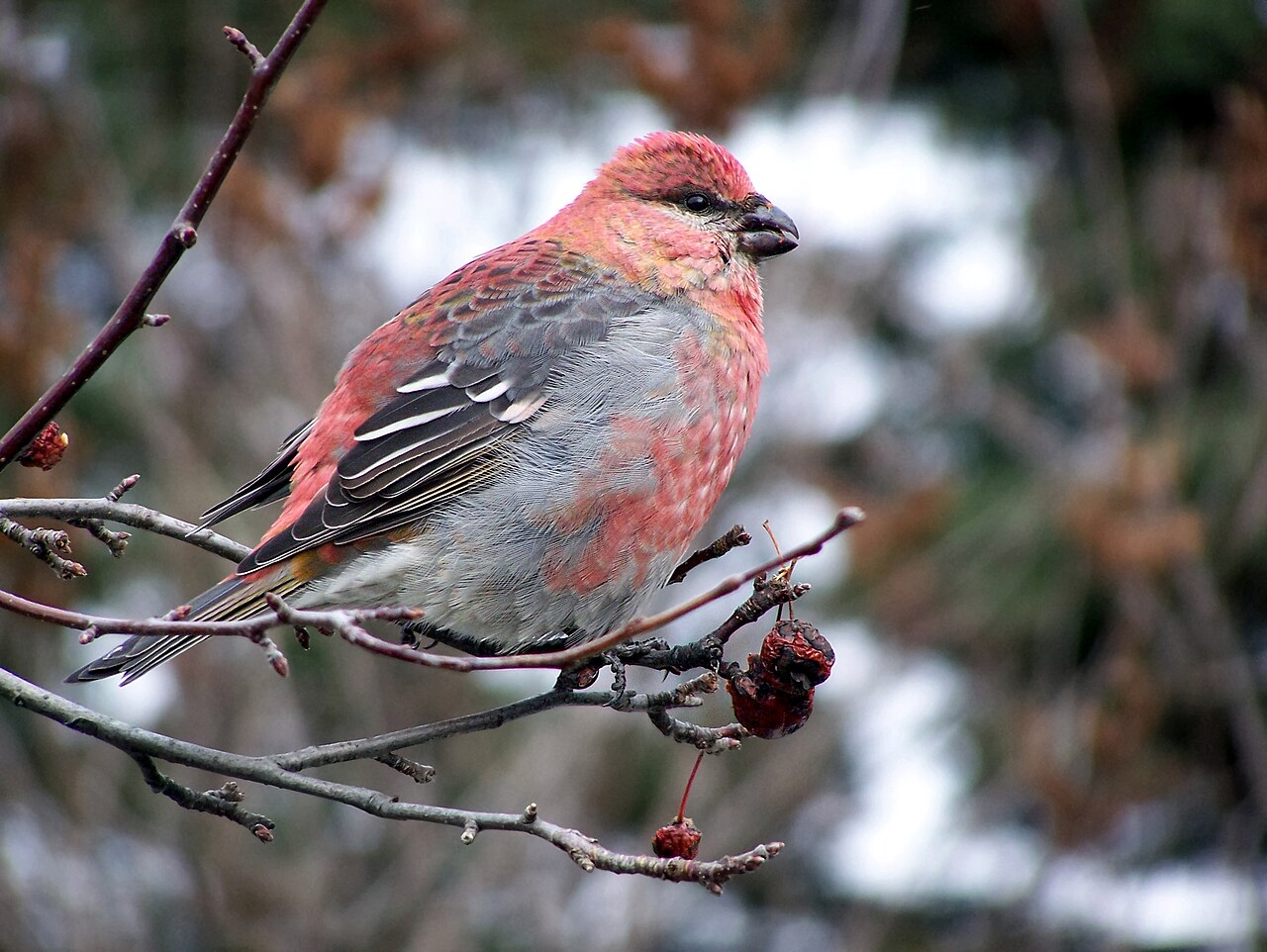
A thick, long-tailed finch the size of a robin, with a round head and a short, bulging bill whose upper mandible hooks down at the tip. The male is rose-red on head, back and rump, with grey flanks and belly and black wings with two white bars. The female and the young bird are grey with an olive-yellow or russet head and rump, and the same wing pattern. The tail is long and slightly forked. The bird moves slowly and allows observers to come close.
Confusion species
Red Crossbill and White-winged Crossbill are clearly smaller and have crossed bill tips; White-winged Crossbill also shows white wing bars, but has a shorter tail and streaked undertail coverts. The rosy-red house, purple and Cassin's finches are half the size, have a straight conical bill, and in the female a streaked breast, where the Pine Grosbeak is plain grey below. The best mark remains the combination of size, the hooked bill tip and the unstreaked grey underparts.
Habitat
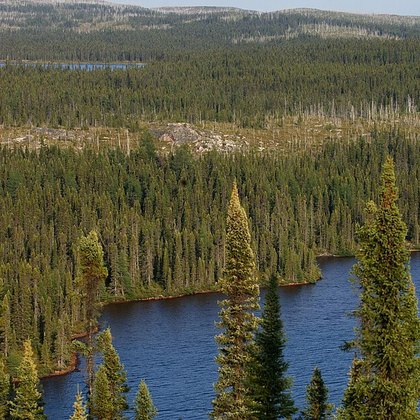
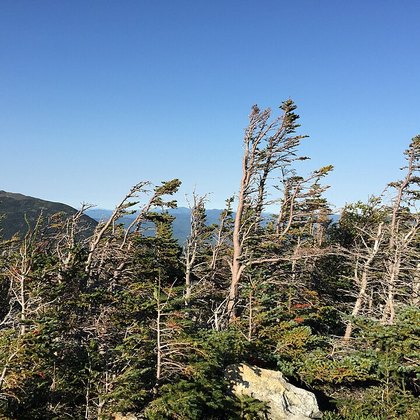
Open conifer forest of spruce, pine and larch, up to treeline; in the west subalpine forest of Engelmann spruce, lodgepole pine and subalpine fir above roughly 1800 metres. In winter it leaves closed forest for trees holding persistent fruit: mountain-ash, crabapple, ash and maple, including in villages, parks and along roads. Feeding stations with sunflower seed are then visited.
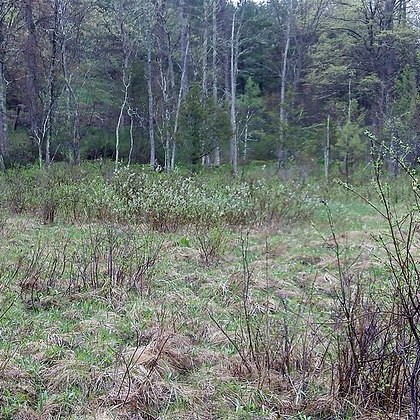
Where the bird is most often found, arranged by the USNVC — the vegetation classification of the United States and Canada — and CMECS for sea and coast.


Range and movements
Circumboreal: from Scandinavia through Siberia to Kamchatka, and in North America from western Alaska across boreal Canada to Newfoundland. Southward the range follows the mountains: the Cascades and the Sierra Nevada to central California, the Rocky Mountains to northern New Mexico, and in the east northern New England and the Adirondacks. The species does not migrate in the ordinary sense but wanders: in years with a poor seed and fruit crop in the north, flocks reach the northern Midwest and the northeastern United States, while in other winters they stay away almost entirely.
- Resident
- Breeding (summer)
- Winter
- Passage
- dark = core range, pale = thinly spread
Where and when to look
From November to March, look for a row of mountain-ash or crabapple in a village at the edge of the boreal forest and watch for heavy, motionless birds shelling the fruit and dropping the skins. The whistled three-note call overhead betrays a passing group sooner than the eye does. Because the birds hardly flush, this is one of the few finches you can watch from a few metres away.
Conservation
Partners in Flight puts the world population at about eleven million birds and the species is listed as not threatened. Because the breeding range lies largely beyond the reach of surveys and numbers swing strongly from winter to winter, the trend is hard to measure; North American winter counts point to a decline in the southern part of the range. Warming and the shifting of treeline count as the main long-term pressure on the boreal and subalpine forests the species depends on.
Scientific name
Pinicola enucleator | (Linnaeus, 1758)
Linnaeus described the species in 1758 as Loxia enucleator, from a specimen from Sweden; because it later moved to another genus, author and year stand in parentheses. The genus Pinicola was introduced in 1808 by Vieillot, from Latin pinus 'pine' and colere 'to dwell': 'pine-dweller'. The species name enucleator comes from Latin enucleare 'to take out the kernel', after the way the bird shells seeds and fruit. The Dutch name refers to the hook at the tip of the upper mandible; English grosbeak goes back to French grosbec 'thick bill'.