All species › Passerines › Finches, euphonias and allies › Hawaiʻi ʻAkepa
Hawaiʻi ʻAkepa | Loxops coccineus
Hawaiʻi-ʻakepa | ʻAkepa de Hawái
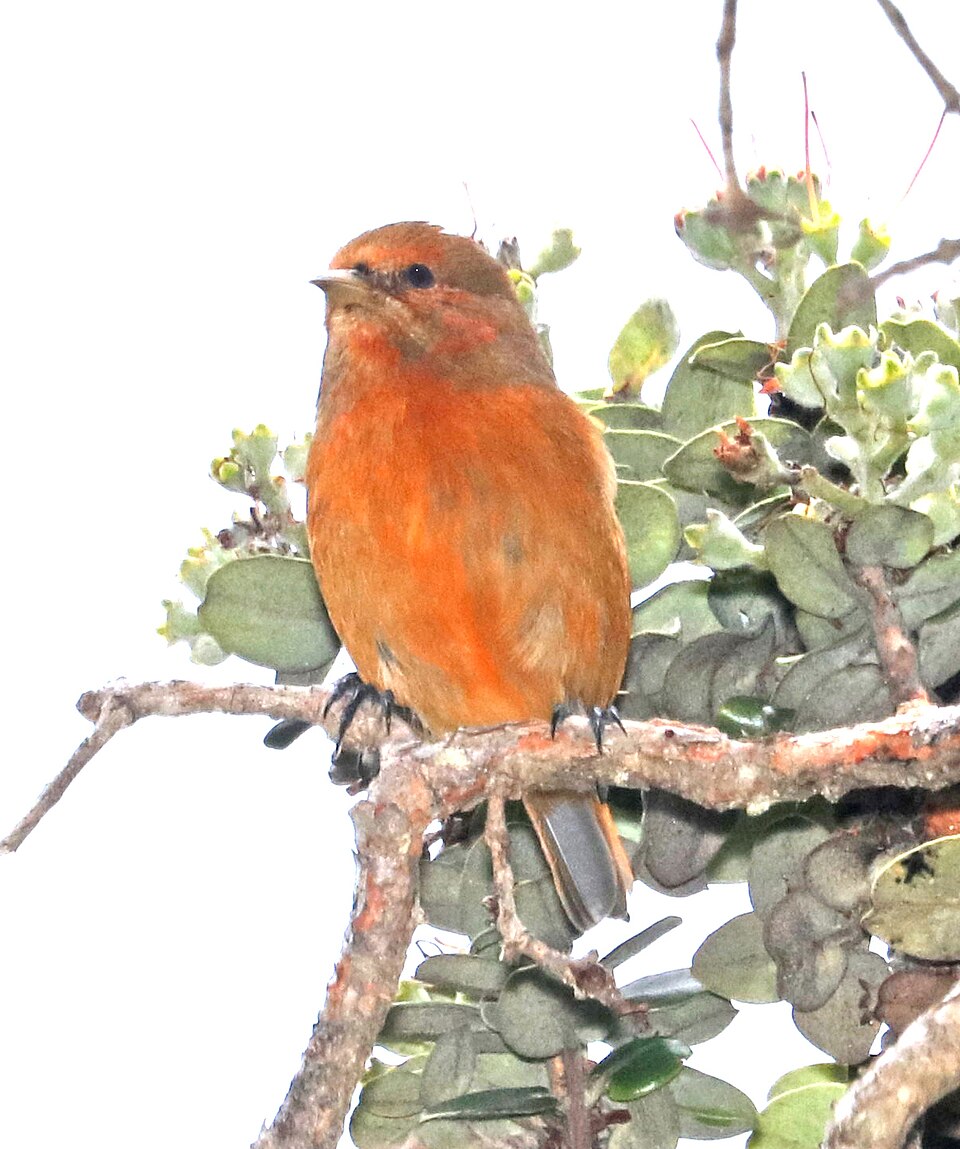
The Hawaiʻi ʻAkepa is the smallest honeycreeper on the island of Hawaii: a ten-centimetre bird whose male is uniformly orange. It is the only bird in the archipelago that nests exclusively in tree cavities, which ties it to old, hollow ohia and koa trees.
Voice
The song is a wavering trill that changes pitch and alternately speeds up and slows down, usually held for several seconds. The call is a soft, two-syllable tiddle-ee, given constantly by both sexes while feeding — often the first sign that a small party is up in the canopy. The song carries poorly and is lost in the noise of the forest in any wind.
Recording: Viral joshi — CC BY-NC-SA 4.0 · Hilo, Hawaii County, Hawaii, United States · xeno-canto
Identification
About ten centimetres, slightly smaller than the Hawaiʻi Creeper. The adult male is bright orange with dark wings and tail; that colour is reached only in the third year, so young males are blotched orange, yellow and vermilion. The female is dark grey-green above and paler grey below, with a variable orange wash across the breast. The bill is minute and slightly crossed; the tail is fairly long and notched at the tip.
Confusion species
The Hawaiʻi Creeper is larger, has a grey throat, a sharp black mask and a clearly longer bill, and climbs along trunks. The Hawaiʻi ʻAmakihi has a longer, curved bill and a square tail and is yellower below. On females and young birds the combination of minute bill and long notched tail is the most useful mark; the crossed bill tips are almost never visible in the field.
Habitat
Old, closed montane forest of ohia and koa (Acacia koa, a native Hawaiian tree) above roughly twelve hundred metres, where transmission of avian malaria and avian pox stays limited. The bird keeps high in the canopy and prises leaf buds open for caterpillars and other insects. For nesting it needs naturally formed cavities in thick trunks and limbs, which only old trees provide; young regrowth does not offer them, even where it is otherwise suitable.
Where the bird is most often found, arranged by the USNVC — the vegetation classification of the United States and Canada — and CMECS for sea and coast.

Range and movements
Confined to the island of Hawaii, with three remaining populations: Hakalau Forest National Wildlife Refuge on the Hamakua coast, the high forests of Kaʻu in the south, and the north slope of Hualalai, where the species may now be gone. Around 2000 the population was put at about fourteen thousand birds. At Hakalau it was the only native forest bird to decline across every stratum and elevation band surveyed over 1987–2024.
- Resident
Where and when to look
Hakalau Forest is the most reliable place, reached by a rough mountain road or with a permitted guide. Look in the morning in the crowns of old koa and ohia and let the soft tiddle-ee calls lead you. An orange bird in the canopy is the male without further question; for females it pays to check the notched tail and the absence of a mask.
Conservation
The species is listed as Endangered (EN) and has held federal protection since 1975. Disease carried by introduced mosquitoes is the main pressure, but the shortage of hollow trees matters as much: logging and grazing in the nineteenth and twentieth centuries took out precisely the old trunks, and regrowing forest takes a long time to supply new cavities. Rat predation on eggs and young adds to this. At Hakalau numbers fell despite fencing and replanting, while the Hawaiʻi Creeper there stayed stable.
Scientific name
Loxops coccineus | (Gmelin, 1789)
Johann Friedrich Gmelin described the species in 1789 as Fringilla coccinea, from material collected on the voyages of James Cook; because it was later moved to another genus, author and year stand in parentheses. The species name coccineus is Latin for 'scarlet', after the male's plumage. The genus Loxops was introduced in 1847 by Jean Cabanis, from Greek loxos 'slanting' and ops 'face', after the sideways-crossed bill tips. ʻAkepa is the bird's Hawaiian name.