All species › Waders, gulls and terns › Plovers and lapwings › Piping Plover
Piping Plover | Charadrius melodus
Dwergplevier | Chorlitejo Silbador
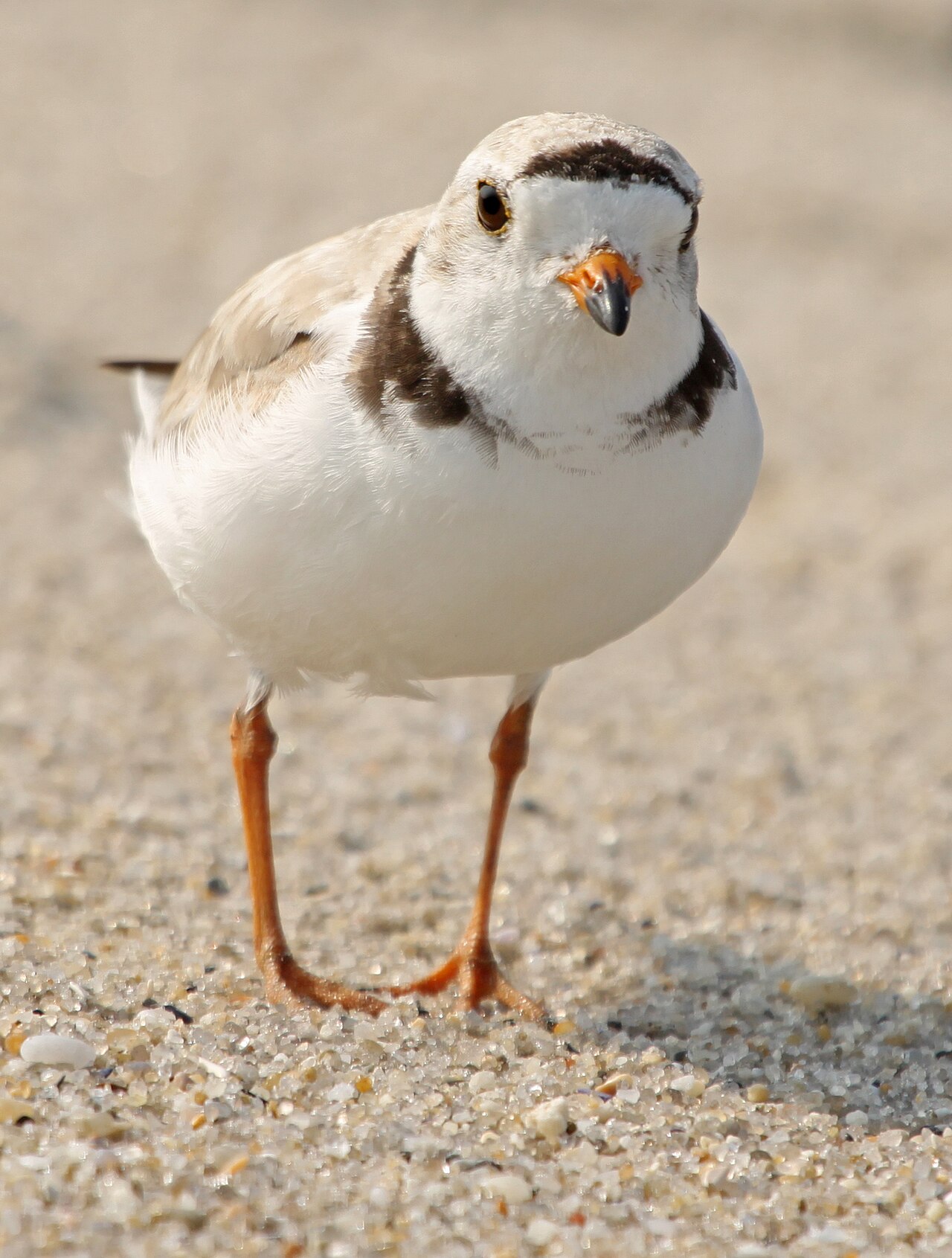
The Piping Plover is as pale as dry sand and on a wide beach is next to invisible until it moves. It breeds only in North America, in three widely separated regions — the Atlantic coast, the shores of the Great Lakes, and the sandbars and alkali flats of the northern prairies — and the whole world population is under nine thousand adults. Its English name comes from the clear whistle that gives it away.
Voice
The call is a pure, plaintive two-note whistle, peep-lo, the second note lower than the first; it carries far over open sand and is often the first sign that a bird is standing there. In display flight over the breeding beach the male hangs on slow, deep wingbeats and repeats a series of the same notes at an ever quicker rhythm. On the ground, boundary disputes bring a low purring rattle while two males walk side by side up and down the line. Danger close to the nest turns the call into a short hard peep, given while the bird walks away from the nest with one wing trailing.
Recording: Will Sweet — CC BY-NC-SA 4.0 · Laudholm Beach, Wells, United States · xeno-canto
Identification
Small and round in build, with a round head, large dark eyes and a short bill; the upperparts are pale sandy grey, exactly the colour of dry beach sand, the underparts white. In breeding plumage it has a black bar across the forehead and a narrow black breast band that is often broken in the middle, with an orange bill tipped black. Outside the breeding season the bill is wholly black and the band fades to two grey patches on the sides of the breast. The legs are yellow-orange all year, the best mark on a bird in winter plumage. In flight a broad white wingbar shows, and a white rump against the dark tip of the tail. Juveniles resemble winter adults, with fine pale fringes on the back feathers.
Confusion species
Snowy Plover (Anarhynchus nivosus) is as pale and of the same size, but has dark grey to black legs, a thin all-black bill and, instead of a breast band, two separate dark patches at the sides of the breast, with a dark ear patch above them. Semipalmated Plover (Charadrius semipalmatus) is clearly darker brown above and carries a complete, broad breast band. Killdeer is much larger, long-tailed and has two black bands. On a winter beach the combination of pale back, orange legs and black bill settles it; leg colour, however, is easily misread on wet sand and into the light.
Habitat
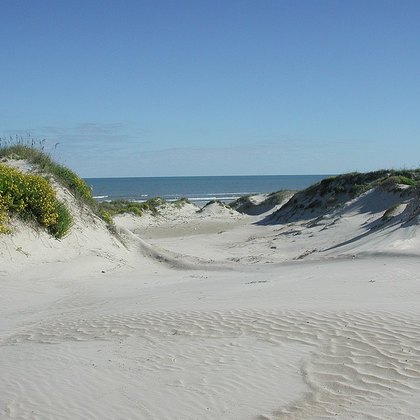
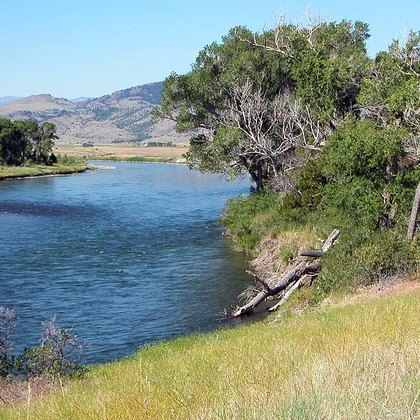
Breeds on wide, flat sandy beaches above the tideline, on sandbars in the Missouri and the Platte, on the bare shores of prairie alkali lakes and on the sand beaches of the Great Lakes. It needs open, sparsely vegetated ground with loose sand, shell grit or fine gravel in which the nest scrape disappears; as soon as beach grass and shrubs close the flat over, it goes. Outside the breeding season it stands on sand flats and mud margins exposed at low water, usually within a few metres of the waterline. It avoids narrow, steep beaches and shores with heavy traffic.
Where the bird is most often found, arranged by the USNVC — the vegetation classification of the United States and Canada — and CMECS for sea and coast.



Range and movements
It breeds in three separate populations: along the Atlantic coast from Newfoundland and the Îles-de-la-Madeleine to North Carolina, along the shores of the Great Lakes, and inland from Alberta and Saskatchewan south to Nebraska and Oklahoma. It winters on the Gulf of Mexico and the southern Atlantic coast, from North Carolina to Texas and on into Tamaulipas, Yucatán, the Bahamas, Cuba and the Turks and Caicos; the Bahamas alone hold a large share of the world population. During the twentieth century the Great Lakes population shrank to a handful of pairs, and in 1986 the species was listed under United States law. Since breeding beaches have been fenced off and predators kept out the Atlantic population has grown again, while the Great Lakes birds remain below the recovery target of a hundred and fifty pairs.
- Resident
- Breeding (summer)
- Winter
- Passage
- dark = core range, pale = thinly spread
Where and when to look
Go to a roped-off stretch of breeding beach between mid-May and July and watch from the line or the edge of the fence; that is close enough, because the birds run right up to it. Look not for a bird but for movement: a standing Piping Plover disappears against dry sand, a running one does not. Watch for the trembling of one foot in the wet sand, with which it brings prey to the surface. Stay outside the fence — a sitting bird driven off leaves eggs or chicks in the sun.
Conservation
Partners in Flight arrives at about eight thousand four hundred adults; the Red List keeps the species at Near Threatened (NT). In the United States the Great Lakes population is listed under federal law as Endangered and the Atlantic coast and prairie populations as Threatened. Numbers have fallen by more than half in fifty years, and the causes are the same everywhere: beach recreation and loose dogs, coastal building, predators that live off human waste, water management on the prairie rivers and rising sea level. Nest exclosures and the removal of foxes and crows work, but have to be set up again every year.
Scientific name
Charadrius melodus | Ord, 1824
George Ord described the species in 1824 as Charadrius melodus, in his revised seventh volume of Alexander Wilson's American Ornithology; because it still stands in that genus, author and year appear without parentheses. The genus Charadrius is Late Latin for a yellowish bird named in the fourth-century Vulgate, taken from Greek kharadrios, a bird of ravines and stream beds. melodus comes from Greek melōidos, 'tuneful', and refers to the clear whistle; the English name Piping Plover says the same thing. Ord gave the type locality as Great Egg Harbor, New Jersey.