All species › Waders, gulls and terns › Jaegers and skuas › Pomarine Jaeger
Pomarine Jaeger | Stercorarius pomarinus
Middelste jager | Págalo pomarino
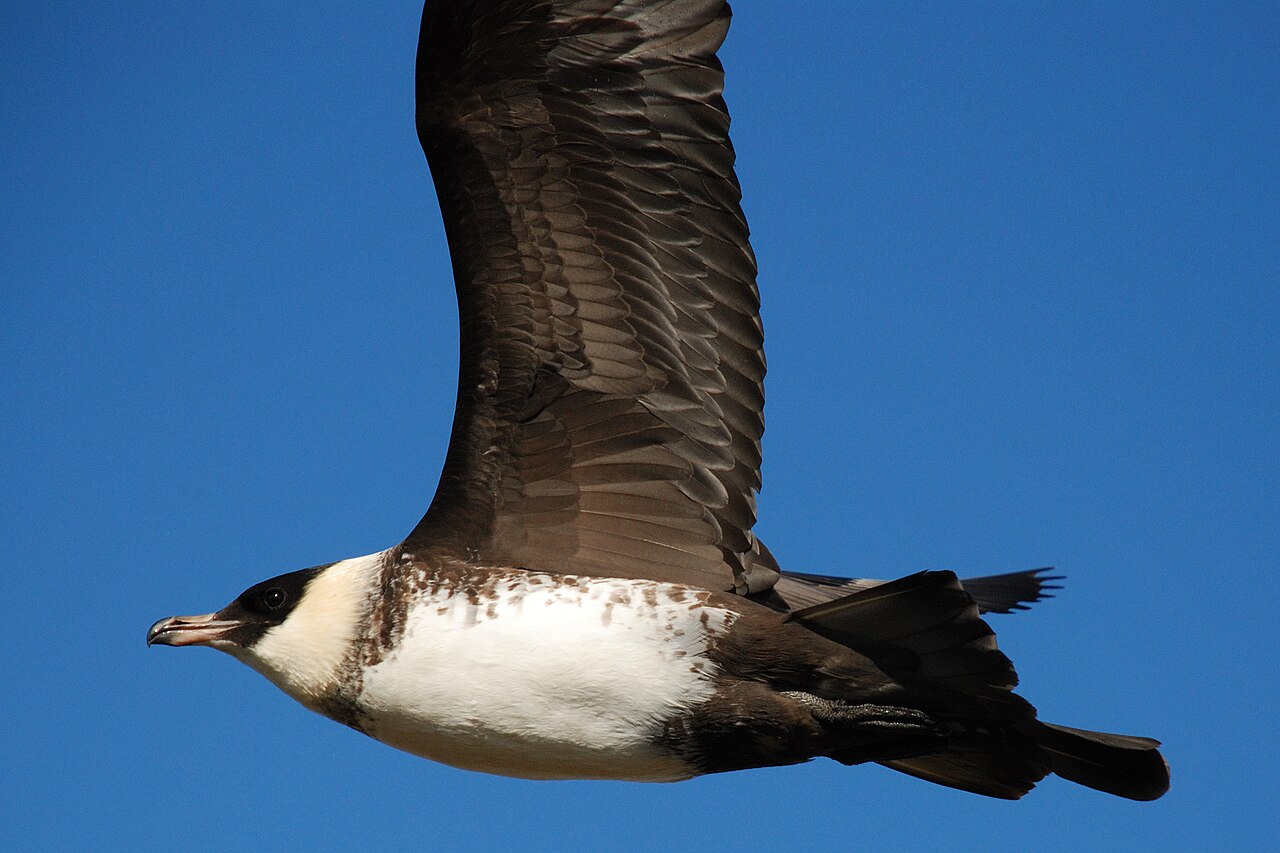
The heaviest of the three jaegers with elongated tail feathers: broad in the wing, deep in the chest, and with a slow beat that suggests a gull rather than a falcon. In the adult the two central tail feathers are broadened at the tip into a blunt, twisted spoon. How many pairs breed depends entirely on the lemmings: in a good lemming year a stretch of tundra is full of them, and the next year not a pair nests there at all.
Voice
At sea it is almost always silent; to hear it you must go to the breeding grounds, or find a group squabbling over the same prey. Over the territory it gives a hard, nasal week-week and a hoarse, barking series of yek-yek-yek, lower and rougher than the cat-like wailing of the Parasitic Jaeger. Approach the nest and this becomes a drawn-out screaming while the bird shears low over the intruder and strikes at the head with its feet. In the wintering grounds you hear at most a short, raw cry as two birds dispute a gull between them.
Recording: Benjamin Drillat — CC BY-NC-SA 4.0 · Utqiagvik, North Slope Borough, Alaska, United States · xeno-canto
Identification
A heavy jaeger, about the length of a Ring-billed Gull but far more solidly built, with a broad chest, a thick two-toned bill and broad wings that stay broad at the base; the beat is slow and gull-like. The pale form has a black cap, yellow cheeks and white underparts, with most females showing a complete, dark-mottled breast band and barred flanks; the dark form is uniformly sooty brown and occurs in a small proportion of birds. Five to eight white feather shafts flash in the wing, and on the underwing there is a second pale patch at the base of the primary coverts — a mark the other jaegers do not show in the same way. The adult carries two elongated central tail feathers, broadened at the tip and turned a quarter twist, so that they project like a knob seen from the side and like a spoon seen from behind. Young birds are cold grey-brown and closely barred, with short blunt tail points and a sharply defined pale base to the bill. The sexes are identically marked; the female is larger.
Confusion species
Parasitic Jaeger (Stercorarius parasiticus) is slimmer and lighter, flies in a falcon-like manner and has pointed, unbroadened central tail feathers. Long-tailed Jaeger (S. longicaudus) is slimmer still, colder grey above, lacks the breast band and carries long thin tail streamers. Great Skua (S. skua) is as heavy and barrel-shaped but uniformly brown, without a cap and without elongated tail feathers, and with even larger white wing patches. Young birds of all four look alike: go by the heaviness of the bill, the broad wing base and the second pale patch under the hand, not by colour. Great Black-backed Gull is taken for a jaeger at a distance, but has a white head, a plain black upperwing with a white trailing edge, and does not chase other birds.
Habitat
Breeds on flat, wet coastal tundra of the high Arctic: sedge flats, peat polygons and pool country holding lemmings, usually within a few kilometres of the sea and seldom more than a few tens of metres above sea level. Outside the breeding season it lives entirely at sea, preferring the edge of the continental shelf and upwelling grounds where fish and fishery waste come to the surface. On migration it follows the coastline a few kilometres out, and in an onshore gale it comes into bays, inlets and harbour mouths. It does not use the interior, apart from the odd bird crossing the Great Lakes in autumn.
Where the bird is most often found, arranged by the USNVC — the vegetation classification of the United States and Canada — and CMECS for sea and coast.




Range and movements
Breeds right around the pole; in North America from northern and western Alaska east through the Northwest Territories and Nunavut to Baffin Island; along the coasts of Greenland it occurs on passage. Migration runs south along both coasts, with a concentrated spring flight close inshore off California and Oregon and a broader autumn passage on the Atlantic. It winters in warm water — the Gulf of Mexico, the Caribbean Sea and both oceans well beyond the equator; that open sea is not a map unit and is therefore left uncoloured. Numbers on the breeding grounds swing from year to year with the lemmings, so that ground holding hundreds of pairs one season can be empty the next.
- Resident
- Breeding (summer)
- Winter
- Passage
- dark = core range, pale = thinly spread
Where and when to look
Stand on a west-coast headland in April or May, or on an east-coast pier in October and November with the wind onshore: that is when Pomarine Jaegers pass closest to land. Look for the slowest, broadest bird in the field of view — it reads as a young gull rather than a falcon — and wait for it to turn, because the twisted tail spoons show only from the side or from behind. On a boat trip it often follows the ship and stays in view for minutes at a time; that is the one place where the underwing can be studied at leisure.
Conservation
Least Concern (LC), but poorly counted: estimates of the world population differ widely, because the breeding range is all but uninhabited and the number of breeding pairs moves each year with the lemmings. For North America there is no usable trend series; what exists comes from sea-watch counts along the coast, and those measure passage rather than numbers. The risk is indirect: if snow cover changes the rhythm in which lemming years return, it changes with it the number of years in which any breeding happens at all.
Scientific name
Stercorarius pomarinus | (Temminck, 1815)
Coenraad Jacob Temminck described the species in 1815 as Lestris pomarinus; because it was later placed in another genus, author and year stand in parentheses. The genus Stercorarius was introduced by Brisson in 1760, after Latin stercus 'dung': sailors believed the bird ate what its victims dropped in flight, where in fact it was disgorged fish. The species name is formed from Greek pōma 'lid' and rhis 'nose', after the horny plate that half covers the nostrils at the base of the bill; Temminck wrote pomarinus where pomatorhinus was meant, and the shortened form has stood ever since. He gave its origin as the Arctic regions of Europe.