All species › Waders, gulls and terns › Jaegers and skuas › Long-tailed Jaeger
Long-tailed Jaeger | Stercorarius longicaudus
Kleinste jager | Págalo rabero
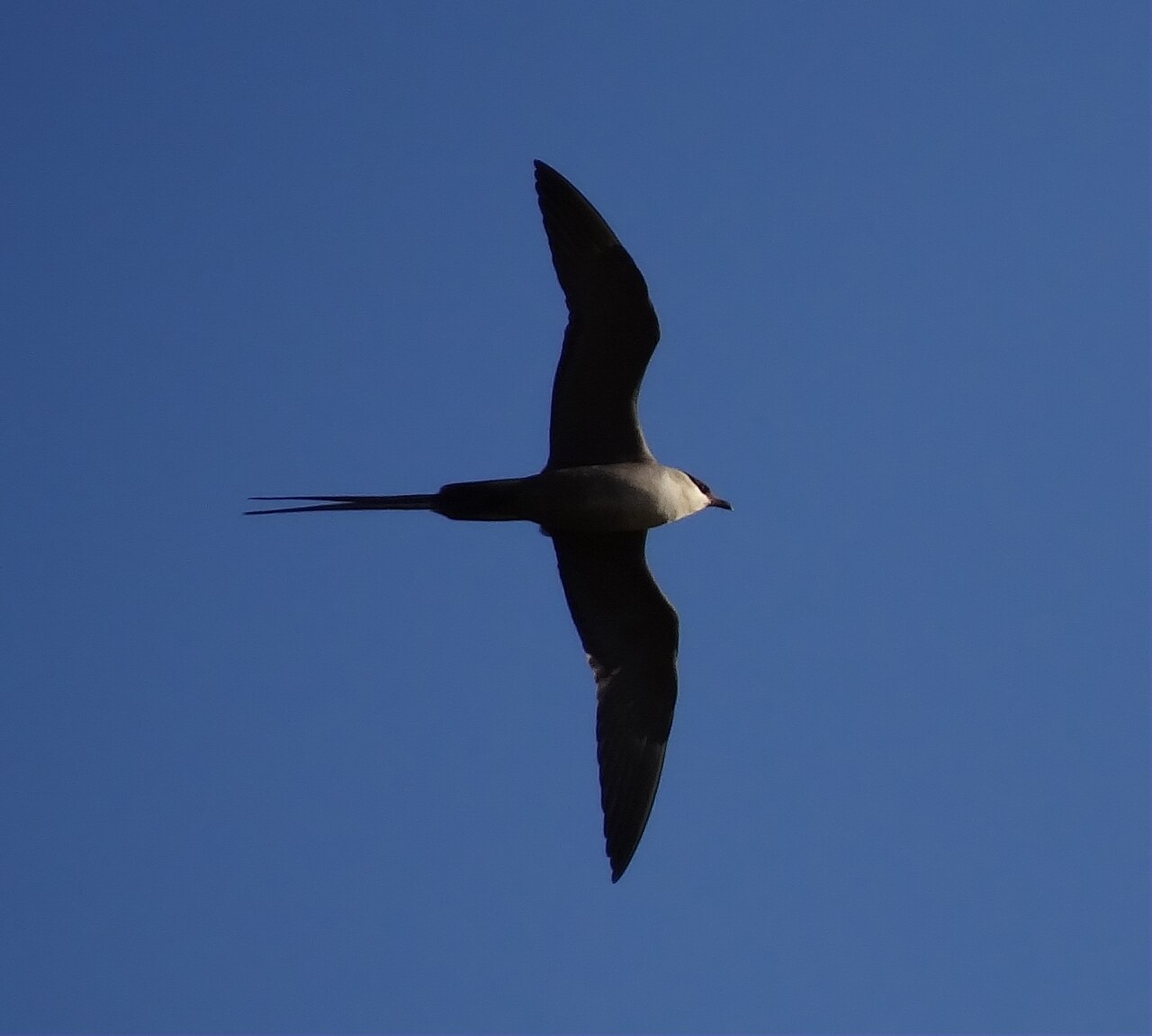
The Long-tailed Jaeger is the slenderest of the three jaegers: a seabird with long narrow wings and two whip-thin tail streamers trailing behind it. It breeds on dry high-arctic tundra and lives there mainly on lemmings, but spends three quarters of the year over the open ocean, far into the southern hemisphere. Jaegers rob other seabirds of their catch; this species does so least of all and prefers to hunt for itself.
Voice
On the breeding grounds it gives a long series of some twenty shrill notes lasting about ten seconds: the notes start short, become drawn out in the middle of the series and end short again. That series is the territorial call, usually delivered from a rise in the ground or in a hovering flight with the wings held up. Anyone who comes too close to the nest is met with a sharp, nasal, insistent yapping as the pair dives past. At sea it is almost always silent; to hear it there is a piece of luck.
Recording: Stanislas Wroza — CC BY-NC-SA 4.0 · Vadso, Finland · xeno-canto
Identification
A slender, tern-like seabird whose light, buoyant flight recalls a large tern rather than a gull. The adult is cool grey-brown above, with a sharply defined black cap, a creamy wash on the sides of the neck and a white breast grading into dark grey behind. Only the two outermost primary shafts are white, so the wing shows barely any pale flash — in the other jaegers that flash is conspicuous. The central tail feathers are thin and flexible and project up to some twenty centimetres beyond the tail. Juveniles range from dark brown to pale greyish white but are always colder grey than those of the other jaegers, with crisp barring on undertail coverts and underwing and two short, bluntly rounded central tail feathers. The bill is short and thick, pale at the base with a sharply defined dark tip.
Confusion species
Parasitic Jaeger (Stercorarius parasiticus) is heavier and warmer brown, has an obvious white flash in the primaries, pointed but far shorter tail streamers and often a dark breast band; it also occurs in a dark morph, which in Long-tailed Jaeger is all but unknown. Pomarine Jaeger (Stercorarius pomarinus) is bulkier still, with broad wings, a heavy bill and twisted, spoon-shaped tips to the central tail feathers. Great Skua (Stercorarius skua) and South Polar Skua (Stercorarius maccormicki) are heavy and broad-winged, with large white wing flashes and no elongated tail feathers. Young jaegers are also confused with young gulls; then watch for the sharply defined pale base to the bill, and for the fact that a jaeger always flies purposefully and fast, never loafing.
Habitat
It breeds on dry, windswept tundra: ridges, dwarf-shrub heath and stony slopes with a view, always within reach of damp hollows holding lemmings and voles. Over those hollows it hunts by hovering, hanging motionless head-to-wind like a kestrel before dropping on its prey. Outside the breeding season it is purely pelagic: it lives on the open ocean, over the edge of the continental shelf and along currents such as the Gulf Stream, and seldom or never comes to land there. Unlike the gulls it avoids the coast, the harbour and the fishing boat; to see it away from the breeding grounds you have to leave the land behind.
Where the bird is most often found, arranged by the USNVC — the vegetation classification of the United States and Canada — and CMECS for sea and coast.




Range and movements
It breeds right around the pole: in Alaska, arctic Canada, Greenland, northern Scandinavia and Siberia. The winter is spent at sea in the southern hemisphere, chiefly over the rich waters off South America and southern Africa — outside the guide area. Migration runs largely far offshore, so the map here shows only where it is regularly seen: the breeding grounds and the coastal waters where it is recorded from a boat or a headland, not the full ocean route it actually flies. How many pairs breed depends on the lemming supply: in a poor lemming year a large share of the birds skip breeding altogether and hardly a chick is to be found on the tundra.
- Breeding (summer)
- Passage
- dark = core range, pale = thinly spread
Where and when to look
The best chance is a boat trip out to deep water in late August or September off California, Oregon or Washington, or in the east over the Gulf Stream. Watch the flight — light, buoyant and tern-like — and watch the wing: no conspicuous white flash in the primaries means almost certainly this species. In juveniles, which lack the streamers, the two bluntly rounded central tail feathers and the sharply defined dark bill tip settle it.
Conservation
The breeding population is put at about 1.7 million birds and the species is listed as Least Concern (LC). Numbers swing sharply from year to year with the lemming cycle, and the warming of the tundra is making that cycle flatter and less predictable in many places. A bird that spends three quarters of the year on the open ocean is also hard to count: the estimates are broad and the trend is unknown for most of the range.
Scientific name
Stercorarius longicaudus | Vieillot, 1819
Vieillot described the species in 1819 as Stercorarius longicaudus. Author and year do not stand in parentheses here, and that means something: the species is still in the genus in which it was described. Stercorarius is Latin for 'of dung', from stercus; the name comes from the old misunderstanding that what a harried seabird disgorges — and what the jaeger then catches — was its droppings. longicaudus is compounded from longus (long) and cauda (tail), after the two elongated tail feathers. Vieillot gave as its source 'the north of Europe, Asia and America'; the type locality was later restricted to northern Europe.