All species › Waders, gulls and terns › Jaegers and skuas › Parasitic Jaeger
Parasitic Jaeger | Stercorarius parasiticus
Kleine jager | Págalo parásito
The Parasitic Jaeger is the pirate of the north: a slim, falcon-like bird with pointed wings that earns its living by chasing terns and auks until they let go of their catch. It breeds on the Arctic tundra and spends the rest of the year on the open sea, far into the southern hemisphere. Adults carry two pointed, elongated central tail feathers, and both a pale and a dark colour form occur.
Voice
At sea it is almost always silent; to hear it you have to go to the breeding grounds. There it gives a nasal, cat-like ee-air that sounds like a mewing, and over the territory a drawn-out, complaining wail. Approach the nest and this turns into a sharp, chopping kek-kek-kek while the bird shears low over the intruder's head. During the chases within a colony pairs call to each other with a high, excited yelping.
Recording: Teet Sirotkin — CC BY-SA 4.0 · Stormyra, Kongsfjord, Finnmark, Norway · xeno-canto
Identification
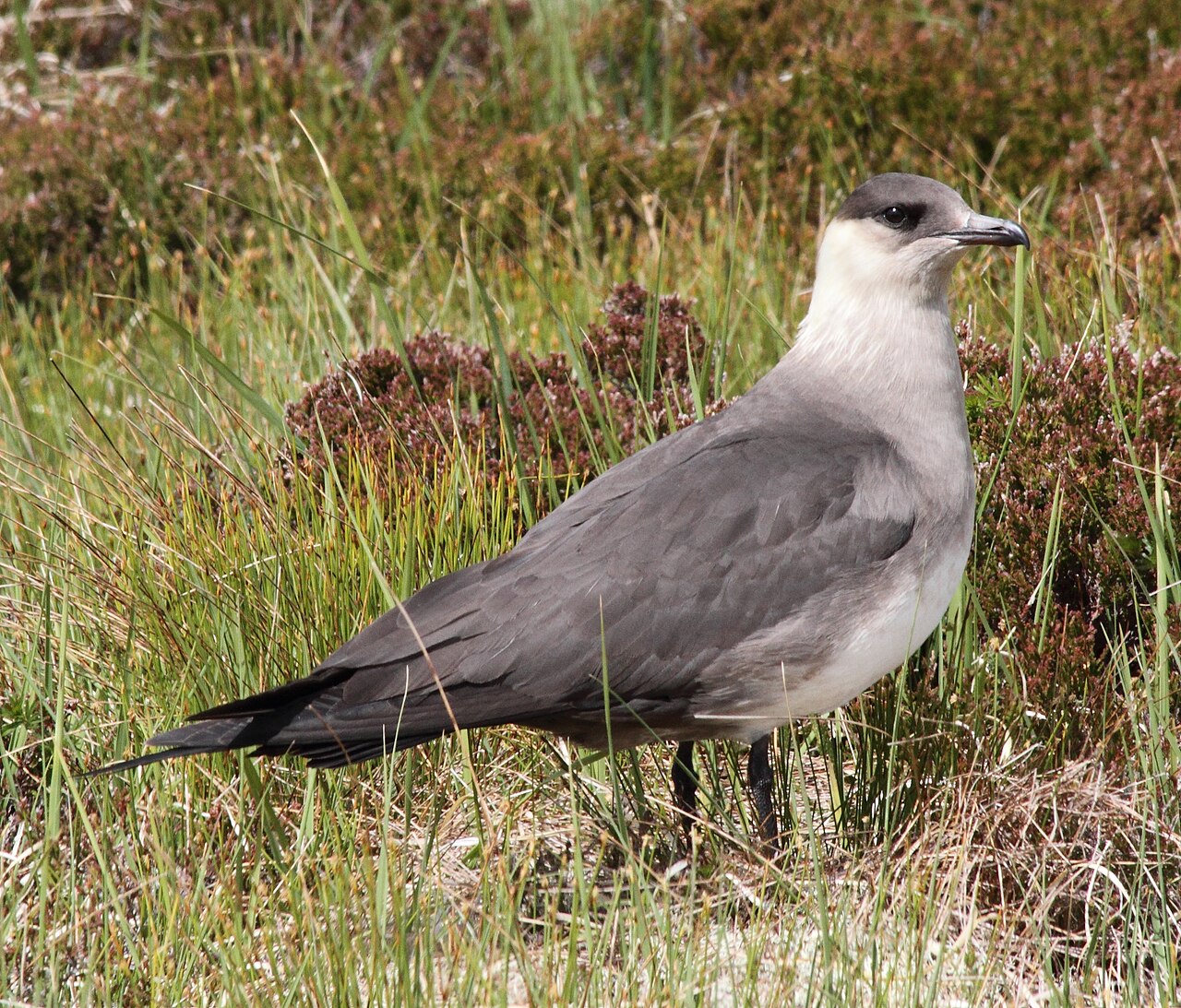
A slim jaeger the size of a Black-headed Gull, with narrow pointed wings and a fast, agile flight that suggests a falcon rather than a gull. The pale form has a dark cap, yellowish cheeks, white underparts and usually a faint grey breast band; the dark form is uniformly sooty brown. Both forms show a pale flash at the base of the primaries, because a handful of feather shafts are white. Adults carry two pointed central tail feathers projecting five to eight centimetres beyond the tail. Young birds are warm brown and finely barred, with short, blunt tail points, and are the hardest to name. The sexes look alike; the female is slightly larger.
Confusion species
Pomarine Jaeger (Stercorarius pomarinus) is heavier built, with broader wings, a slower gull-like beat and, in the adult, central tail feathers broadened into a twisted spoon. Long-tailed Jaeger (S. longicaudus) is slimmer and colder grey above, lacks the breast band, has only two white feather shafts in the wing and very long thin tail streamers, and flies lightly and buoyantly like a tern. Great Skua (S. skua) is bulky and barrel-shaped, uniformly brown, with strikingly large white wing patches. Young birds of all three look alike; go by the shape of the tail points, the heaviness of the bill and the manner of flight, and not by colour.
Habitat
Breeds on the low Arctic tundra: damp sedge flats, peat hummocks and ridges covered in dwarf shrub, often close to a tern colony or a cliff of auks from which it can take its food. Also on coastal islands and thin coastal heath, down to sea level. Outside the breeding season it lives on the open sea, keeping to fishing fleets and to flocks of hunting terns; it then avoids the interior entirely, apart from the odd bird crossing the Great Lakes. Closed forest and high mountains it does not use.
Where the bird is most often found, arranged by the USNVC — the vegetation classification of the United States and Canada — and CMECS for sea and coast.





Range and movements
Breeds right around the pole: in North America from Alaska through the Canadian north to Nunavut, Labrador and northern Quebec, and along both coasts of Greenland. On migration it follows the coastlines of the Atlantic and the Pacific, and every autumn migrants appear on the Great Lakes. It winters far outside the area of this map, on the open ocean off South America, West Africa and Australia; that sea is not a map unit and is therefore left uncoloured. On the north-eastern side of the Atlantic numbers are falling, because the terns and kittiwakes it lives off are themselves breeding badly.
- Resident
- Breeding (summer)
- Winter
- Passage
- dark = core range, pale = thinly spread
Where and when to look
Stand on a headland or a pier by the sea in September or October, and look not for the jaeger itself but for the disturbance: a flock of terns scattering all at once, with one dark bird beneath them singling out a single victim. The chase often lasts half a minute and ends in a dive in which the food is caught in mid-air. On the Great Lakes the same thing happens in October over the gulls at the harbour moles.
Conservation
The world population is put at more than three million birds and the species counts as not threatened. Regionally the picture is less calm: on the north-eastern side of the Atlantic, where the kittiwake and tern colonies have collapsed, numbers have fallen sharply since the 1990s. For North America good counts are lacking, because the breeding range is thinly peopled and the birds spend the rest of the year out of sight of any coast.
Scientific name
Stercorarius parasiticus | (Linnaeus, 1758)
Linnaeus described the species in 1758 as Larus parasiticus, among the gulls; because it was later moved to another genus, author and year stand in parentheses. The genus Stercorarius was introduced by Brisson in 1760, after Latin stercus 'dung': sailors believed the bird ate the droppings its victims released in flight, where in fact it was the disgorged fish. parasiticus means 'parasitic', from Greek parasitos, one who eats at another's table. Linnaeus gave as its origin the region within the Tropic of Cancer of Europe, America and Asia; the type locality was later restricted to the coast of Sweden.