All species › Waders, gulls and terns › Sandpipers and allies › White-rumped Sandpiper
White-rumped Sandpiper | Calidris fuscicollis
Bonapartes strandloper | Correlimos culiblanco
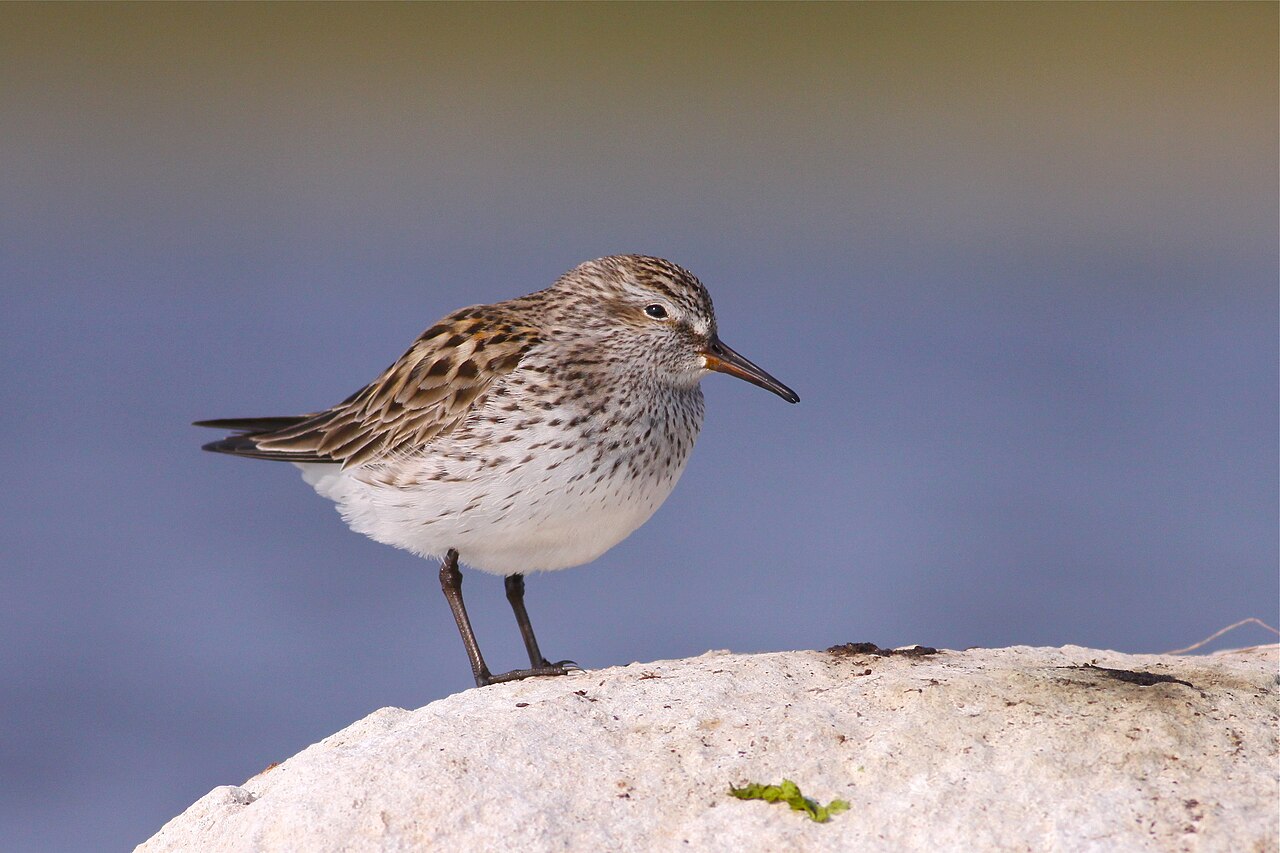
The White-rumped Sandpiper makes one of the longest migrations of any North American bird: from the wet high-arctic tundra to Tierra del Fuego and the Falkland Islands, sometimes in legs of four thousand kilometres without landing. It can be told by a clean white band above the tail that no other small sandpiper on the continent has. It has recently been listed as Vulnerable (VU) on the Red List.
Voice
The call is a high, thin, electric-sounding tzeet, often likened to the squeak of a mouse — a sound that carries over the murmur of a mixed flock and lets you find the species without seeing it. Once you know it, you hear the bird in flight before the white rump band comes into view. On the breeding tundra the male sings a mechanical, insect-like song that alternates rapidly between a wiry buzz and a low, guttural or snoring note, delivered in a hovering display flight. Within the flock it also gives short contact notes, far softer and less conspicuous than the flight call.
Recording: Jacob Wijpkema — CC BY-NC-SA 4.0 · Est Parraga, Yacuma, Beni Department, Bolivia · xeno-canto
Identification
Slightly larger and above all longer than the other small sandpipers, with a drawn-out silhouette because the wingtips clearly project beyond the tail at rest. The clinching mark is the broad, clean white band across the uppertail coverts, which shows only as the bird takes off. In breeding plumage it is brown with rusty tones and fine dark stippling on head, breast and — this matters — well down the flanks, where the other small sandpipers are white. Nonbreeding birds are plainer grey-brown without rust; juveniles look scaly through bright chestnut and gold feather fringes. The short, straight bill has a pale reddish-brown patch at the base of the lower mandible, visible in good light and at close range.
Confusion species
Baird's Sandpiper (Calidris bairdii) is the most confusing species: equally long-winged and elongated, but warmer buff on the breast, without flank streaking and with a dark stripe down the centre of the rump. Semipalmated Sandpiper (Calidris pusilla) and Western Sandpiper (Calidris mauri) are shorter-winged — the wingtips do not reach past the tail — and lack the white rump band. Curlew Sandpiper (Calidris ferruginea) also shows a white rump but stands higher on its legs, with a long, evenly decurved bill. Dunlin (Calidris alpina) is heavier, with a longer curved bill and a dark central stripe on the rump.
Compare sandpipers, snipes and allies: bill, legs, wing bar and rump
Habitat
It breeds on wet high-arctic tundra with a low cover of grass, moss or dwarf shrubs, preferring hummocks in sodden sedge meadows. On spring migration it is an inland bird: flooded pastures, wet fields, shallow prairie wetlands and the muddy edges of reservoirs, often far from the sea. In autumn it shifts to the coast and uses tidal flats, salt marshes and lagoons to lay on fat for the crossing. Deep water, dense vegetation and rocky shores play no part; what it needs is soft mud into which it can drive its bill to the base.
Where the bird is most often found, arranged by the USNVC — the vegetation classification of the United States and Canada — and CMECS for sea and coast.





Range and movements
The breeding range runs from the north coast of Alaska eastward across arctic Canada to the northwestern shore of Hudson Bay and over the islands from Banks to Devon and Baffin. It winters in the far south of South America — Argentina, Chile, southeastern Brazil and the Falkland Islands — outside the guide area of this guide. The outward and return routes differ sharply: in spring it moves through the Great Plains and the Mississippi valley, in autumn down the Atlantic coast of Canada and New England, from where it crosses to South America in a single flight over the ocean of sometimes four thousand kilometres. On that route part of the population passes through the Caribbean and Bermuda; in the west of the continent it is scarce.
- Resident
- Breeding (summer)
- Passage
- dark = core range, pale = thinly spread
Where and when to look
Look for it in May on a flooded pasture in the Great Plains, walking among Pectoral Sandpipers, and go by length first: wingtips past the tail and a long, flat back. Then wait for the flock to lift — the white band above the tail settles the matter in a second. On the east coast in autumn the call helps most: that high mouse-squeak picks it out of a flock of hundreds.
Conservation
Partners in Flight puts the breeding population at about 1.7 million birds, but the Red List now places the species in the Vulnerable (VU) category because of a rapid decline. The threats lie mainly along the flyway: the draining of wetlands and the conversion of wet meadows to arable land, both in North America and on the wintering grounds of the Argentine pampas. Added to that is the warming of the high-arctic breeding grounds, which shifts both the vegetation and the timing of the insect supply. A bird that flies thousands of kilometres at a stretch has no margin: if one link in the chain of stopovers fails, it does not reach the next.
Scientific name
Calidris fuscicollis | (Vieillot, 1819)
Vieillot described the species in 1819 as Tringa fuscicollis; because it was later placed in the genus Calidris, author and year stand in parentheses. Calidris goes back to Greek kalidris, a word Aristotle used for grey birds of the waterside; fuscicollis is Latin for 'dark-necked', from fuscus (dark) and collum (neck). Vieillot based his description not on a bird of his own but on number 404 in the work of Félix de Azara, which makes the type locality Paraguay — a wintering area, far from the tundra. The Dutch name honours Charles Lucien Bonaparte, the ornithologist who in the nineteenth century brought the American and European bird lists into line with each other.