All species › Waders, gulls and terns › Sandpipers and allies › Least Sandpiper
Least Sandpiper | Calidris minutilla
Kleinste strandloper | Correlimos menudillo
The Least Sandpiper is the smallest shorebird in the world: a fifteen-gram bird picking its way over the mud on yellow-green legs. It is also the most widespread of North America's small sandpipers — breeding from Alaska to Nova Scotia, wintering from Oregon to Brazil. Precisely because it is everywhere, it is seldom noticed.
Voice
The flight call is a high, thin, slightly rising kreep, held longer and less hard than the dry jeet of the Western Sandpiper; it is the sound that gives away a flock as it lifts. On the breeding grounds the male sings during a fluttering display flight, a long series of rich trills alternating with high thin notes, kept up for minutes at a time. At danger near the nest it delivers loud trills while feigning injury and drawing the intruder away. The alarm note is a thin, drawn-out seeet, heard on the tundra more often than the bird is seen.
Recording: Jeff Stewart — CC BY-NC-SA 4.0 · Cavan-Monaghan (near Millbrook), Peterborough County, Ontario, Canada · xeno-canto
Identification
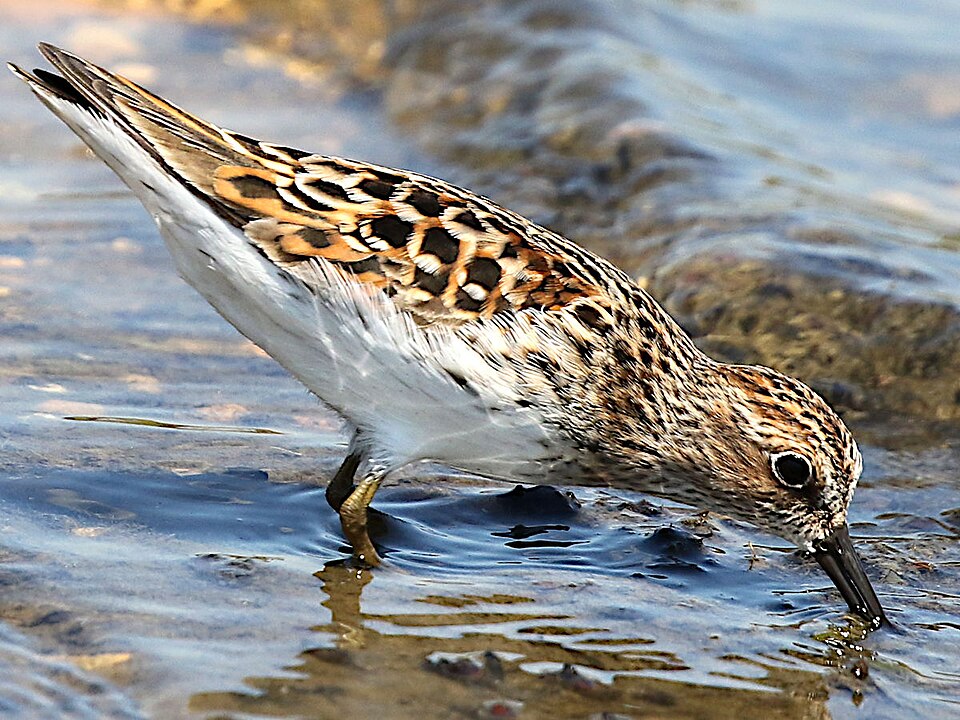
A minute sandpiper with dark brown upperparts, a fully streaked grey-brown breast band and — the mark everything turns on — yellow-green legs. The bill is short, fine and slightly drooping at the tip, clearly thinner than in the other small sandpipers. In breeding plumage the upperparts are black with rufous and cinnamon fringes; juveniles are more brightly scaly still, with a pale V on the mantle. In nonbreeding plumage it is dull brown with a streaked, rather grubby-looking breast. It feeds with a hunched back and drawn-in neck, far more crouched than its relatives, and in flight shows a narrow white wingbar and a dark central line between the white sides of the rump. Mud on the legs can make leg colour useless; then go by that crouched silhouette.
Confusion species
Semipalmated Sandpiper (Calidris pusilla) and Western Sandpiper (Calidris mauri) have black legs, are greyer and whiter, and wade further out into the water. Little Stint (Calidris minuta), a vagrant from Eurasia, also has black legs, together with clean white underparts without a breast band and a dead-straight bill. Long-toed Stint (Calidris subminuta), possible in western Alaska, also has yellow legs but stands upright on longer legs, with a longer neck, longer toes and a stronger supercilium that nearly meets on the forehead. Pectoral Sandpiper (Calidris melanotos) has the same yellow legs but is far larger, with a breast band that cuts off sharply against the white belly.
Compare sandpipers, snipes and allies: bill, legs, wing bar and rump
Habitat
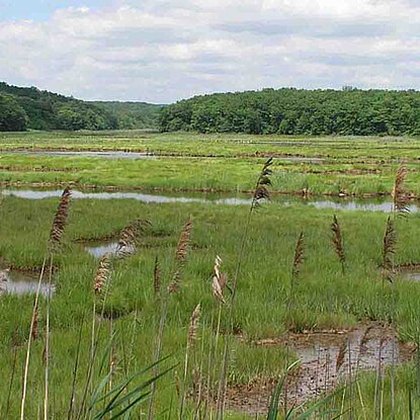
On the breeding grounds it chooses wet sedge meadows, sphagnum hummocks, muskeg (boggy spruce peatland typical of boreal Canada) and the grassy margins of tundra pools, from the arctic coast far into the boreal zone. On migration and in winter it is the sandpiper of the vegetated edge: muddy banks with a tuft of grass above them, flooded pastures, rice fields, ditches, salt marsh and the back of tidal flats. It avoids the open bare flat where the other small sandpipers stand, and broad open water altogether. That gives a field rule: if it stands higher up the bank than the rest of the flock, it is probably this bird.
Where the bird is most often found, arranged by the USNVC — the vegetation classification of the United States and Canada — and CMECS for sea and coast.




Range and movements
It breeds from the eastern Aleutians through Alaska and across Canada east to Labrador, Newfoundland and Nova Scotia, and winters from Oregon and the southern United States through Mexico, Central America and the Caribbean to northern South America, south to Chile and Brazil. Unlike most small sandpipers it migrates on a broad front and uses hundreds of small, scattered stopovers rather than a handful of great ones — a strategy that makes it less vulnerable to the loss of any single site. Passage runs from March to May and from July to October, with adults heading south weeks before the young. In eastern North America numbers are falling, while the populations of western and central Canada appear stable.
- Resident
- Breeding (summer)
- Winter
- Passage
- dark = core range, pale = thinly spread
Where and when to look
Do not look at the open flat but at its upper edge, where the mud runs into grass: that is where they stand, hunched and close to cover, while the black-legged species wade in the water. Once you have one, two marks are enough: yellow-green legs and a streaked breast band running right across. In autumn the first week of August is often the best time inland, when the adults are already moving south and the juveniles have yet to arrive.
Conservation
The population is put at about 700,000 birds; the birds of eastern North America in particular are declining, and the species now stands as Near Threatened (NT) on the Red List. The main threat is the loss and drying out of small inland wetlands and coastal marshes along the whole flyway. Because it stops over in so many places at once, the decline goes unnoticed for a long time: nowhere does a whole flock vanish at once, only a little everywhere.
Scientific name
Calidris minutilla | (Vieillot, 1819)
Vieillot described the species in 1819 as Tringa minutilla; because it was later placed in the genus Calidris, author and year stand in parentheses. Calidris goes back to Greek kalidris, a word Aristotle used for grey birds of the waterside. minutilla is Medieval Latin for 'very small', a diminutive of minutus, and in this species it is literally true. Vieillot gave no more of a source than 'America beyond Canada'; the American Ornithologists' Union later fixed the type locality at Halifax, Nova Scotia.