All species › Waders, gulls and terns › Sandpipers and allies › Little Stint
Little Stint | Calidris minuta
Kleine strandloper | Correlimos menudo
The Little Stint is a Eurasian bird: it breeds on the tundra from northern Scandinavia far into Siberia and winters in Africa and southern Asia. In North America it is a rare vagrant, not certainly recorded until 1975. Anyone who wants to see one here goes to western Alaska, or picks it out of a flock of autumn peeps on the east coast.
Voice
The call is a short, dry, hard stit, often given in series of two or three and sharper than the drawn-out kreep of the Least Sandpiper. In a flock it stands out by that hard, almost cracking quality, without the hoarse undertone of the Semipalmated Sandpiper. On the breeding tundra the male sings in a low display flight, a monotonously repeated buzzing swirr-swirr-swirr that sounds more like an insect than a bird. Outside the breeding season only short contact notes from feeding birds are heard; vagrants in North America are usually silent.
Recording: Stanislas Wroza — CC BY-NC-SA 4.0 · Soppavann, Finland · xeno-canto
Identification
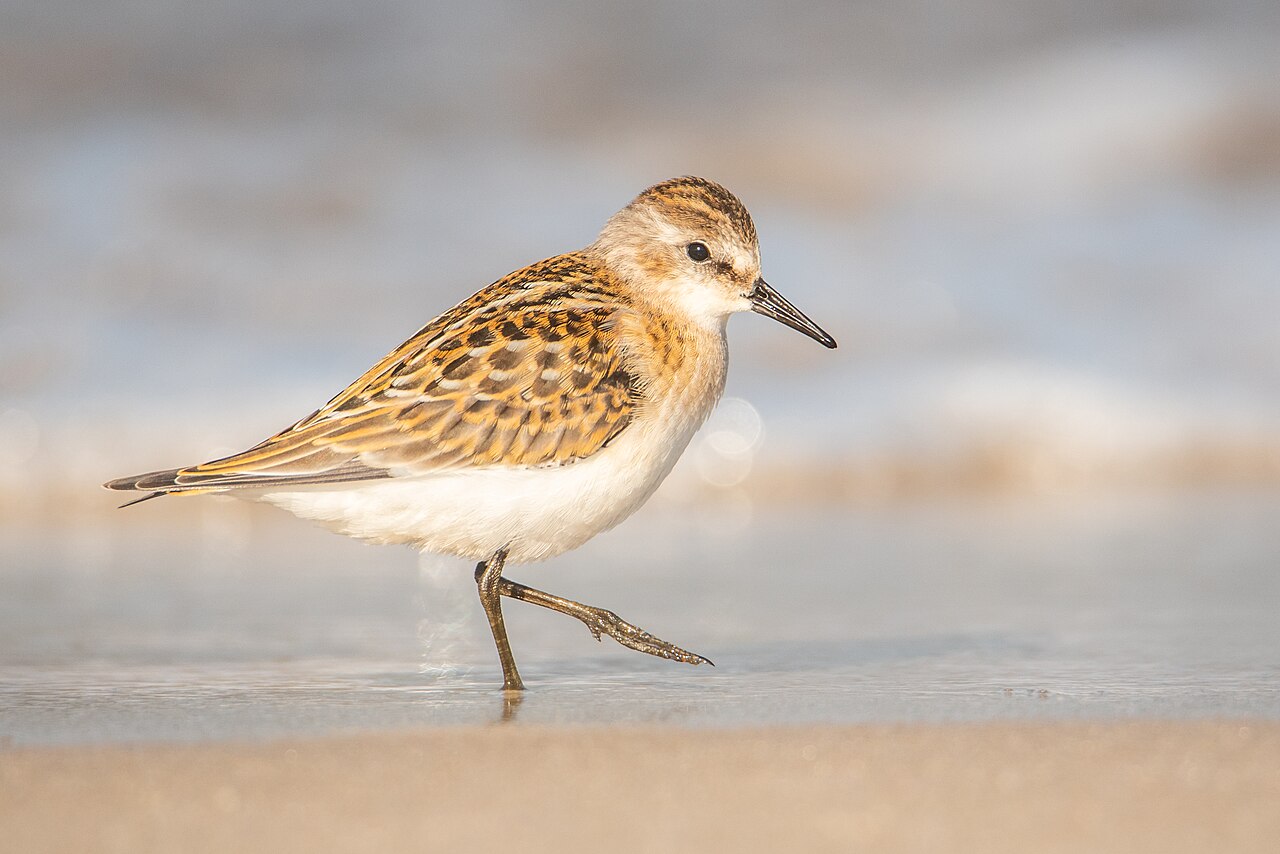
One of the smallest shorebirds in the world, with black legs and a short, fine, straight black bill with a sharp tip. In breeding plumage head, neck and sides of the breast are warm rufous with a sharply defined white throat, and mantle and scapulars carry black and rufous feathers with pale fringes forming a white V down the back. Juveniles show that white V at its clearest, along with a split supercilium — a pale stripe above the eye that divides in two towards the front — and clean white, unstreaked underparts. In nonbreeding plumage it is grey above with dark shaft streaks and white below, with a grey wash at the sides of the breast. In flight it shows a narrow white wingbar and a dark central stripe down the rump.
Confusion species
Least Sandpiper (Calidris minutilla) is the first species to rule out: it has yellow-green legs, a browner ground colour, a fully streaked breast band and shorter wings. Semipalmated Sandpiper (Calidris pusilla) has a blunter, deeper-based bill, half-webbed toes, and lacks both the bright rufous and the crisp white mantle V. Western Sandpiper (Calidris mauri) has a longer bill drooping at the tip, rufous confined to crown, ear patch and scapulars, and arrowhead marks along the flanks. In western Alaska Red-necked Stint (Calidris ruficollis) is also possible: in breeding plumage it has an unstreaked brick-red throat, and as a juvenile plainer grey scapulars and a far weaker mantle V.
Habitat
On the breeding grounds it chooses dry to damp mossy tundra and sedge flats, often near the coast and frequently alongside Temminck's Stint. On migration and in winter it is a bird of shallow water without vegetation: mudflats, salt pans, flooded fields, settling ponds and the bare margins of inland lakes. In North America it almost always turns up among other small sandpipers, on tidal mud or on a coastal pool behind the dunes. It avoids dense vegetation, rocky shores and deep water.
Where the bird is most often found, arranged by the USNVC — the vegetation classification of the United States and Canada — and CMECS for sea and coast.





Range and movements
The breeding range runs from northern Scandinavia eastward through northern Russia to the New Siberian Islands; the winter is spent on mudflats and marshes from southern Europe and Africa to southern Asia. It reaches North America as a vagrant, with well over two dozen accepted records by now, split roughly evenly between the Northeast, the Pacific coast and Alaska. It is most regular in western Alaska — St. Lawrence Island and the Pribilofs — where birds drift across from the Siberian side in late spring and in autumn. Breeding numbers swing widely from year to year with the lemming population on the tundra, because in poor lemming years predators turn to shorebird nests.
Where and when to look
The best chance is in the first half of June at Gambell on St. Lawrence Island, and in August and September on a coastal pool on either seaboard. Work through a flock of juvenile peeps systematically and check three things in turn: black legs, a short and dead-straight bill, and a crisp white V on the mantle. If all three fit, look at the supercilium: if it splits in two above the base of the bill, you have it.
Conservation
The species is listed as Least Concern (LC): the breeding range is vast and the world population large. Numbers do swing sharply from year to year, in step with the lemming cycle on the tundra. The main pressure comes not from the breeding grounds but from the flyway: the loss and drying out of mudflats and inland lakes in southern Europe, the Middle East and Africa, where the birds must refuel in a short time.
Scientific name
Calidris minuta | (Leisler, 1812)
Leisler described the species in 1812 as Tringa minuta; because it was later placed in the genus Calidris, author and year stand in parentheses. Calidris goes back to Greek kalidris, a word Aristotle used for grey birds of the waterside. The epithet minuta is Latin for 'small' and says exactly what it needs to: few shorebirds are smaller. The specimen described came from Hanau am Main in Germany — a migrant, then, far from the tundra where the species breeds.