All species › Passerines › Finches, euphonias and allies › Purple Finch
Purple Finch | Haemorhous purpureus
Amerikaanse roodmus | Camachuelo purpúreo
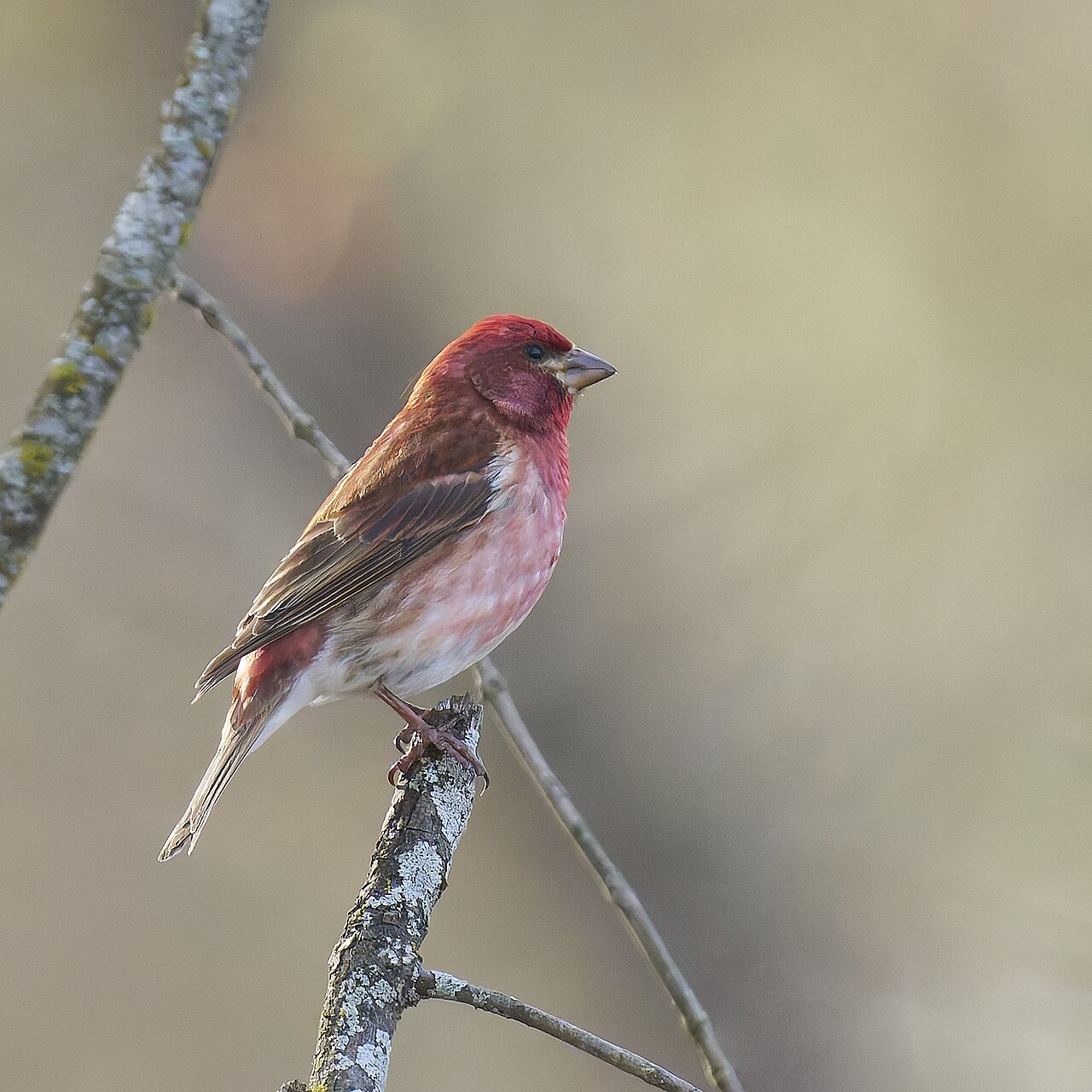
The Purple Finch is the finch of the conifer forest of Canada and the northeastern United States, moving south to winter in numbers that vary from year to year. Along the Pacific coast lives a separate, largely resident subspecies. The male is raspberry red onto the back and flanks, without the brown streaking of House Finch.
Voice
The song is a continuous, fast warble of two to three seconds, without the scratchy undertone and hoarse ending of House Finch, and often with short imitations worked in. The flight call is a sharp, dry pik or tik, a single hard tick quite unlike the bright cheep of House Finch; in flight it is usually the first thing heard. Perched flocks also give a soft weet.
Recording: Ed Pandolfino — CC BY-NC-SA 4.0 · Ice House Aspen Grove, El Dorado County, California, United States · xeno-canto
Identification
A stocky finch with a large conical bill with nearly straight cutting edges, a short, clearly notched tail and a somewhat triangular head profile. The male is washed raspberry to wine red over head, breast, back and rump, with a white belly; the red blends into the brown of the upperparts rather than sitting on top of it. Female and young birds are white with coarse, sharply marked dark brown streaks on breast and flanks, and show a distinct head pattern: a broad white eyebrow, a dark cheek patch and a dark stripe down the side of the throat.
Confusion species
House Finch has a short, curved upper mandible, evenly brown-streaked back and flanks on the male, and a female without head pattern — the crisp eyebrow and jaw stripe are the quickest mark here. Cassin's Finch, with which it overlaps in the west, has a longer bill, a more peaked crown with sharply bounded red, finer and narrower streaking and streaked undertail coverts, where those of Purple Finch are plain white. Pine Siskin is much smaller, with a thin pointed bill and yellow wing panels.
Habitat
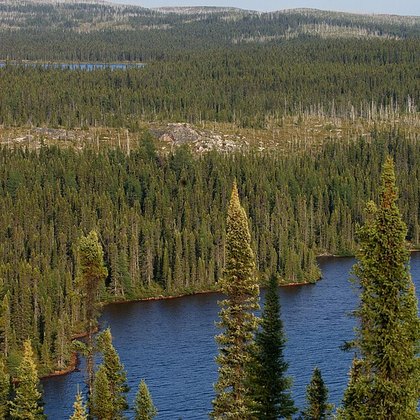
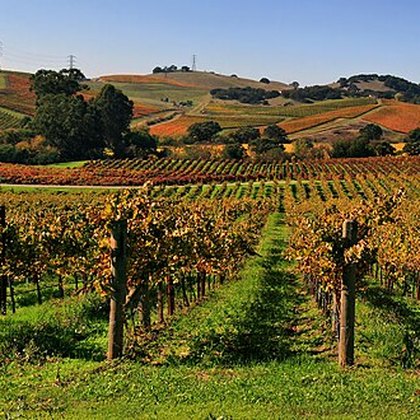
Breeds in coniferous and mixed forest of spruce, pine and hemlock, often along clearings, forest edges and stream valleys, and on the Pacific coast also in mixed oak and Douglas-fir woodland and lowland coastal forest. Outside the breeding season in deciduous woodland, hedgerows, weedy fields with seeding herbs, orchards and gardens with feeders. It often forages high in the canopy, at buds and seed cones.
Where the bird is most often found, arranged by the USNVC — the vegetation classification of the United States and Canada — and CMECS for sea and coast.




Range and movements
The eastern subspecies breeds from Newfoundland and the Maritimes through southern Quebec, Ontario and the prairie provinces to British Columbia, and south in the United States to the Great Lakes and New England, with outliers in the Appalachians. It winters in the eastern and southeastern United States, in some winters as far as Texas and Florida. The scale of that movement differs strongly from year to year and tracks the conifer seed crop. The western subspecies californicus stays year-round along the Pacific coast from British Columbia to southern California.
- Resident
- Breeding (summer)
- Winter
- Passage
- dark = core range, pale = thinly spread
Where and when to look
At an eastern feeder in November and December the chances are best, and it pays then to watch the head of the streaked birds rather than the red males: the broad white eyebrow and the dark jaw stripe show in any light. The sharp pik flight call separates it before the plumage is visible at all.
Conservation
The species is not threatened (LC), but numbers in the east have been falling steadily for several decades. The spread of House Finch after 1940 coincides with that decline: where the two meet, House Finch nearly always wins the direct contest at a feeder. Logging of conifer forest and damage to hemlock by the adelgid Adelges tsugae also play a part. The species has been the state bird of New Hampshire since 1957.
Scientific name
Haemorhous purpureus | (Gmelin, 1789)
Johann Friedrich Gmelin described the species in 1789 as Fringilla purpurea, from a specimen from Carolina; because it later moved to another genus, author and year stand in parentheses. The genus Haemorhous was introduced in 1837 by William Swainson, from Greek haima 'blood' and orrhos 'rump'. The species name purpureus is Latin for 'purple', which in classical use meant a deep red to red-violet colour rather than present-day purple; the English and Spanish names go back to that word.