All species › Waders, gulls and terns › Sandpipers and allies › Purple Sandpiper
Purple Sandpiper | Calidris maritima
Paarse strandloper | Correlimos oscuro
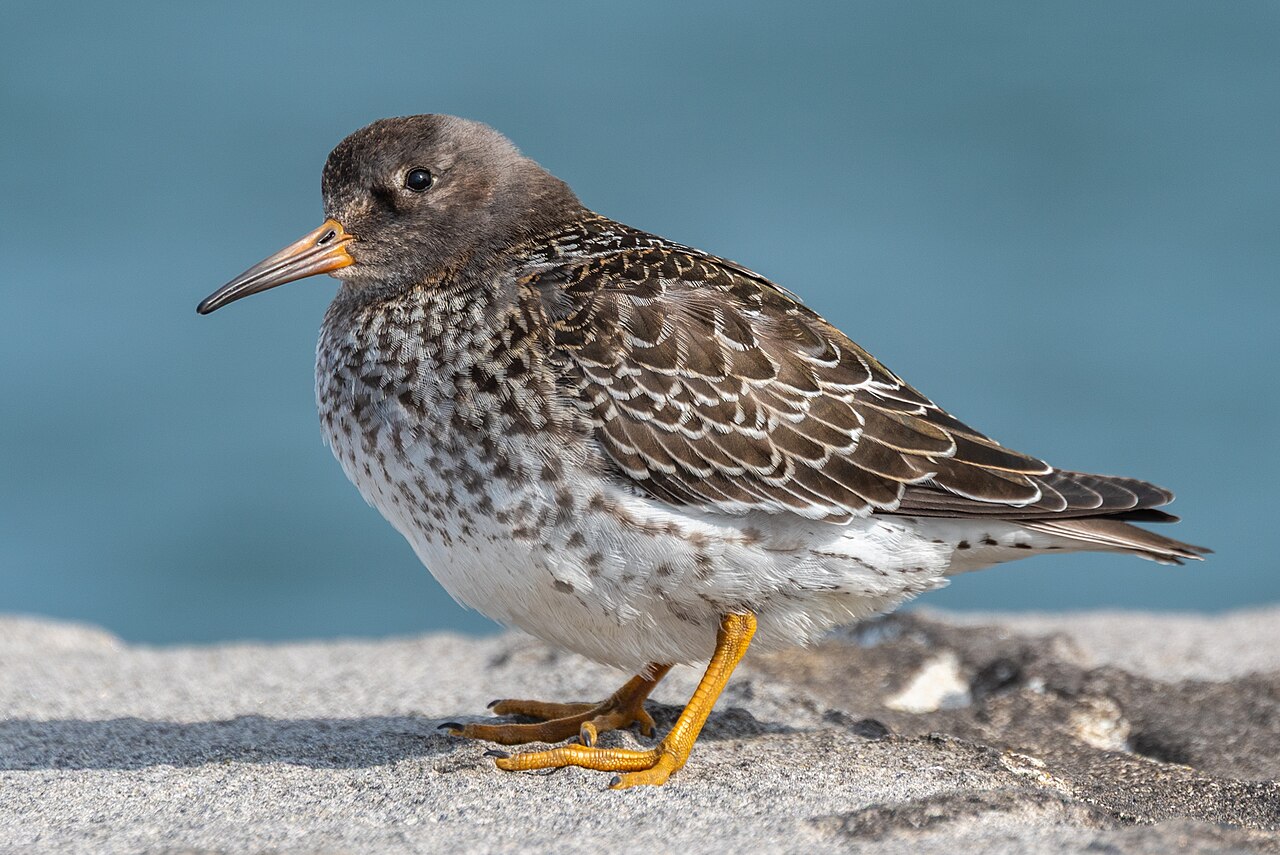
The Purple Sandpiper winters farther north than any other wader in the world: dark slate grey, with orange legs and bill base, on rock that the surf keeps hammering. It is so wedded to hard shore that it is almost never seen on sand or mud.
Voice
Displaying males have a rolling, chuckling song of repeated phrases, delivered in a flight that alternates fluttering with gliding over the tundra. On the winter rocks it is close to silent: what carries is a squeaky, coarse kee or keer as a party lifts, and a low kip in flight. Disturbance brings a descending, chattering rattle. On a breakwater in December you usually hear it only once the flock has passed.
Recording: Stanislas Wroza — CC BY-NC-SA 4.0 · Île-de-Sein, Finistère, Bretagne, France · xeno-canto
Identification
A dumpy, short-legged sandpiper with a fairly long, slightly drooping bill, orange at the base and dark at the tip. In winter plumage evenly slate grey over head, breast and back, with a white belly and finely streaked flanks; in good light a violet sheen lies on the wing feathers and gives the bird its name. The dull orange-yellow legs are the best mark at a distance. Breeding birds are warmer, with rust-coloured feather fringes and heavy dark spotting on breast and flanks; juveniles have pale feather edges that make the back look scaled. In flight it shows a narrow white wingbar and a dark centre to the tail.
Confusion species
The Rock Sandpiper (Calidris ptilocnemis) of the Pacific is its counterpart, but the two ranges nowhere meet: that bird has a black belly patch and a brown ear patch when breeding. Dunlin (C. alpina) shares the same winter coasts but is browner, longer-legged, and has a longer, more strongly curved black bill with no orange base. Ruddy Turnstone often stands in the same party on the same rock, but is far more strongly patterned and shorter-billed. With a dark sandpiper on a jetty, then, look first at the legs and the base of the bill.
Compare sandpipers, snipes and allies: bill, legs, wing bar and rump
Habitat
In winter, hard substrate only: rocky shores, cliffs, piers, breakwaters and weed-grown riprap, in the band the tide has just uncovered. It avoids sand and mud, and visits an estuary only in passing. It breeds on bare tundra rich in moss and lichen along arctic and upland coasts, often on stony ridges. What makes a breakwater attractive is not the stone but the mussel: where barnacles, periwinkles and mussels grow, the bird stands.
Where the bird is most often found, arranged by the USNVC — the vegetation classification of the United States and Canada — and CMECS for sea and coast.



Range and movements
Breeds on the arctic islands of Canada from Banks to southern Ellesmere and Baffin and in Greenland, and eastward through arctic Europe and Russia to the Taymyr Peninsula. In North America it winters on rocky coasts from Labrador and the Gulf of St. Lawrence south to North Carolina — farther north than any other wader. On the Great Lakes it appears annually in small numbers in late autumn, on piers and harbour walls. The numbers reaching the Atlantic coast appear to have fallen over recent decades.
- Resident
- Breeding (summer)
- Winter
- Passage
- dark = core range, pale = thinly spread
Where and when to look
Look for it between November and March on a breakwater, jetty or rocky point along the Atlantic coast, ideally around low water when the weed line is exposed. Keep your eyes low and close to the foam: the birds work between the breaking waves and vanish behind a stone every few seconds. They are not shy — stay in one place and they will often go on feeding a few metres away.
Conservation
Least Concern (LC) globally and numerous in the north, but hard to count: the North American population is put at roughly 25,000 birds and the world population at a few hundred thousand. The trend appears to be downward and the species is on the Partners in Flight Yellow Watch List. Oil on the rocky shore, pollution and shrub creeping over the breeding tundra are the heaviest threats; rising sea level narrows the strip in which it feeds still further.
Scientific name
Calidris maritima | (Brünnich, 1764)
Brünnich described the species in 1764 as Tringa maritima; because it was later moved to another genus, author and year stand in parentheses. The genus Calidris goes back to Greek kalidris, in Aristotle the name of a grey bird of the waterside. maritima is Latin for 'of the sea' and refers to the coast on which it spends the winter. The type locality is Christiansø and Norway; Morten Thrane Brünnich was a Danish zoologist who described the birds of the far north.