All species › Waders, gulls and terns › Sandpipers and allies › Dunlin
Dunlin | Calidris alpina
Bonte strandloper | Correlimos común
On the tidal flats of both coasts this is often the commonest small wader of winter: a grey bird with a drooping bill tip that turns over the mud in dense flocks and flips from grey to white as the flock swings. In breeding plumage it carries a black belly patch that no other sandpiper of the continent has. It breeds on wet tundra and migrates later in autumn than most of its relatives.

Voice
The flight call is a rasping, slightly nasal kreep or cheerp, one syllable, which from a rising flock sounds like a scattered rustle. Over the tundra the displaying male hangs on shivering wings and delivers a long swelling trill — a dry errrrrrrrr that first speeds up and then falls away again. At the nest site there is also a short, hard chik when a jaeger or a fox goes by. Away from the north only the flight call is heard, and it often betrays a flock you had not yet picked up.
Recording: Stanislas Wroza — CC BY-NC-SA 4.0 · Soppavann, Finland · xeno-canto
Identification
In breeding plumage the back is rufous with black feather centres, the underside white with a large black belly patch and a finely streaked breast. In winter plumage the bird is plain grey-brown above and white below, with a grey wash across the breast and no striking feature at all except the bill. That bill is black, about as long as the head, and bends clearly downward over its last third. Juveniles in autumn have rufous-edged mantle feathers that form two pale V lines down the back, and black spots that run in rows on belly and flanks. In flight a narrow white bar crosses the wing and the rump is black down the middle with white sides; on the flats it feeds with hunched shoulders and a short neck, probing fast and without pause.
Confusion species
Sanderling (Calidris alba) is the same size but far whiter in winter, with a straight, shorter bill, a black shoulder and a broad white wingbar; it runs after the surf where Dunlin stays out on the mud and probes. Semipalmated Sandpiper (C. pusilla) is smaller and shorter-billed, with a straight tip rather than a drooping one. Red Knot (C. canutus) is clearly larger and more thickset, with a short straight bill and a pale rump. If in doubt, look at the bill tip and at the carriage: the downward kink in the last part of the bill and the slightly hunched stance are enough together.
Compare sandpipers, snipes and allies: bill, legs, wing bar and rump
Habitat
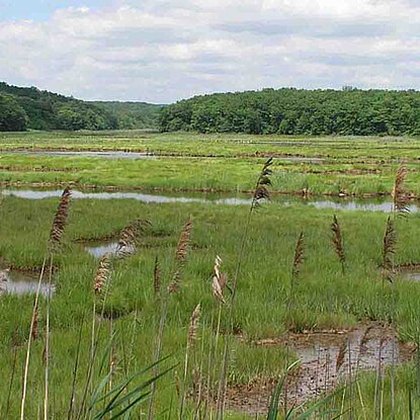
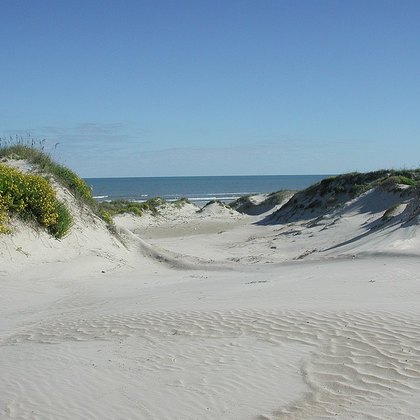
Outside the breeding season this is a bird of mud: the tidal flats of estuaries and bays, the margins of lagoons, and where the mud stops the saltmarsh, where it waits out high water in dense flocks. Sandy beaches are used, but less than by Sanderling, and a rocky coast it avoids. On passage inland it appears on flooded fields, sewage lagoons and the drying shores of reservoirs. It breeds on wet coastal tundra with sedge and moss hummocks, near small pools, the nest tucked into a tussock on a slightly drier ridge.
Where the bird is most often found, arranged by the USNVC — the vegetation classification of the United States and Canada — and CMECS for sea and coast.



Range and movements
Three forms breed in North America: one along the coasts of Alaska and the Bering Sea, one along Hudson Bay in Manitoba and Ontario and on the islands beyond, and one in Greenland. The Alaskan birds move to the Pacific: the Fraser delta, Willapa Bay and San Francisco Bay hold hundreds of thousands through the winter, and the southern limit lies in Baja California and Sinaloa. The eastern birds winter from Massachusetts along the coast to Texas. Unlike most waders it moults its flight feathers first and migrates afterwards, so it arrives late in autumn and leaves late in spring; in the Caribbean and in Central America it is accordingly rare.
- Resident
- Breeding (summer)
- Winter
- Passage
- dark = core range, pale = thinly spread
Where and when to look
Stand at the edge of a tidal flat on a rising tide in October or November and wait until the water pushes the birds towards you: in one flock you will then see the spread of bill lengths this species shows. With a turning flock, watch the flip from dark to white — that is nearly always Dunlin, and at such range it is the only usable mark. In April and May the first birds with a black belly patch can be told from a long way off.
Conservation
The Red List holds the species as Near Threatened (NT) — the step below the threatened categories. The world population runs to several million birds and is falling; in North America counts along both coasts have declined over the past half century. The vulnerability lies in the concentration: a large part of a population uses a handful of estuaries in winter and on passage, so reclamation, pollution or disturbance on a single flat reaches many birds at once. The breeding grounds are changing too: on the wet coastal tundra the vegetation is shifting and the thaw seasons are not what they were.
Scientific name
Calidris alpina | (Linnaeus, 1758)
Linnaeus described the species in 1758 as Tringa alpina; since it was placed in the genus Calidris, author and year stand in parentheses. Calidris goes back to the Greek kalidris, in Aristotle the name of a grey speckled bird of the waterside; the genus was introduced by Merrem in 1804. alpina is Latin for 'of the high mountains'. That refers not to the way of life but to the type locality: Lapland, where the described specimen came from and where the bird breeds on the bare mountain tundra.