All species › Woodpeckers and allies › Woodpeckers › Red-bellied Woodpecker
Red-bellied Woodpecker | Melanerpes carolinus
Roodbuikspecht | Carpintero de Carolina
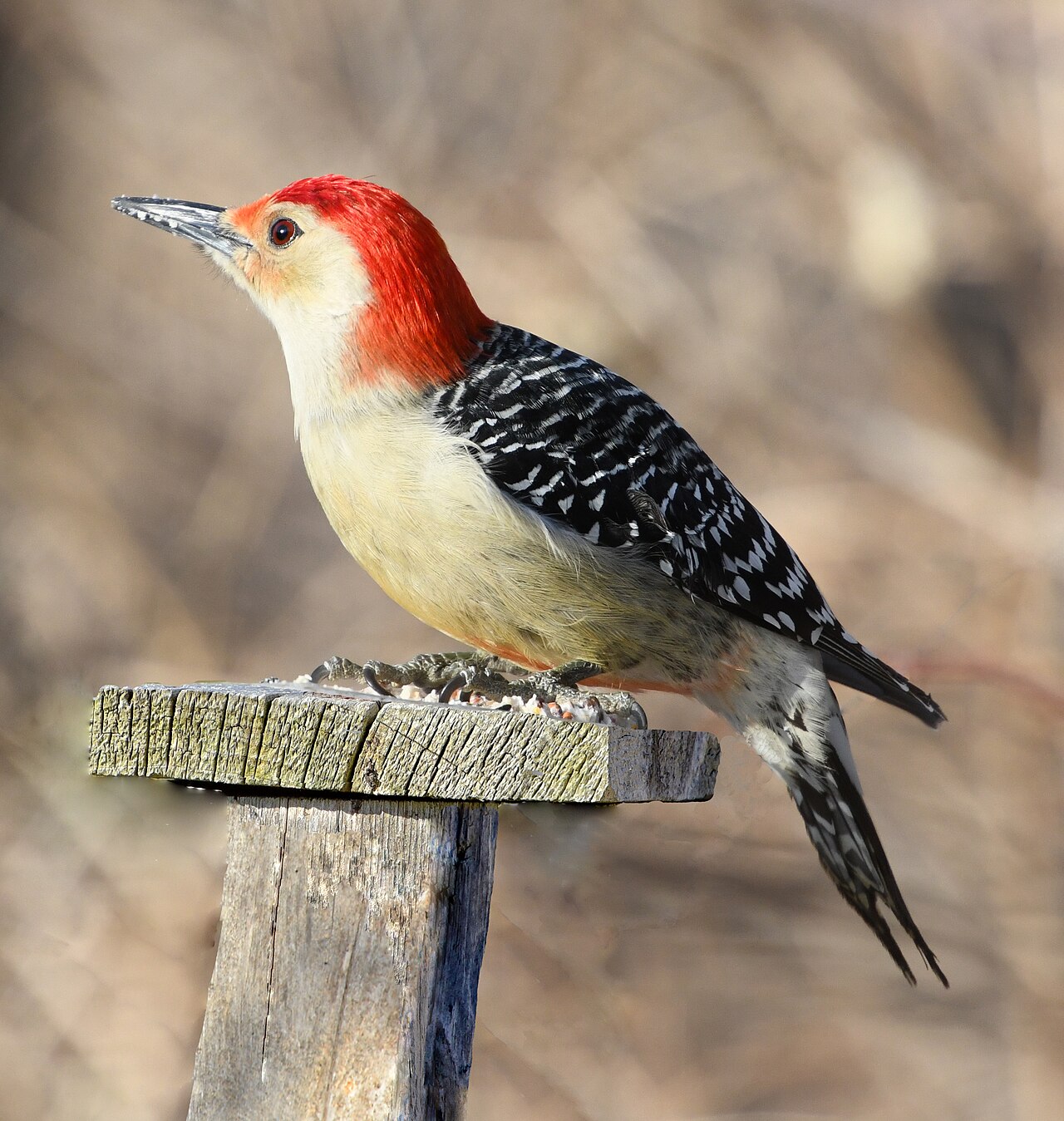
In the eastern United States the Red-bellied Woodpecker is one of the best-known woodpeckers, a regular visitor to gardens and feeders: a medium-sized, pale grey woodpecker with a finely zebra-barred black-and-white back and a bright red cap. The red belly that gives it its name is hardly visible in the field — a soft pinkish wash low on the belly. The species has been spreading north for decades and is now also an established breeder in southern Canada.
Voice
It is talkative and can be heard all year round. The best-known sound is a rolling kwirr or churr, often in series such as churr-churr-churr, that carries far through woodland; it also gives a short chiv-chiv. In conflicts with its own kind it uses a loud, repeated chee-wuck, and pairs keep in touch during courtship with a soft, growling grr, grr. Young birds beg with a high pree-pree-pree. The drum consists of short, even rolls of a handful of taps; males in particular drum regularly in spring.
Recording: Rory Nefdt — CC BY-NC-SA 4.0 · Lusby, Calvert County, Maryland, United States · xeno-canto
Identification
A medium-sized woodpecker with regularly black-and-white barred back and upperwings, a pale grey to sandy face and plain pale grey underparts. The male has a red cap running from the base of the bill over the crown to the nape; in the female the crown is grey and only the nape and a small spot above the bill are red. The pink to red wash on the lower belly is usually visible only at close range. In flight the white rump and a small white patch at the base of the primaries stand out; the central tail feathers are barred white. Young birds lack the red on the head.
Confusion species
Red-headed Woodpecker has an entirely red head and neck, a solid black back and large white wing panels; the naming often misleads beginners here. In Texas and Oklahoma it overlaps with Golden-fronted Woodpecker, which has a yellow to orange nape and a yellow spot above the bill, the male with only a small red crown patch, and plain black central tail feathers; where the two species occur together, hybrids occasionally arise. Northern Flicker is brown with a black breast band and a white rump, and forages much on the ground.
Habitat
Broadleaved and mixed woodland of many kinds: oak–hickory forest, mixed pine–hardwood forest, maple woods and above all moist forests along rivers and in swamps, generally below 600 metres. It is not fussy as long as there are dead trees or dead branches in which to excavate its nest cavity, and so also lives in parks, old orchards and leafy residential areas. Its food consists largely of insects, but in autumn and winter it eats many acorns, nuts, seeds and fruits, which it also stores in bark crevices. It occasionally takes a lizard or a nestling.
Where the bird is most often found, arranged by the USNVC — the vegetation classification of the United States and Canada — and CMECS for sea and coast.


Range and movements
It inhabits the eastern United States, from Florida and the Gulf Coast north to the Great Lakes and New England and west to the eastern edge of the Great Plains, from Texas to southern Minnesota. Over the course of the twentieth century its northern limit moved markedly; it now breeds regularly in southern Ontario. It is mainly resident; in the northernmost areas some birds move a little south in winter. It does not occur in Mexico. No subspecies are recognised.
- Resident
- Winter
- Passage
- dark = core range, pale = thinly spread
Where and when to look
It visits feeders in leafy gardens, where it comes to peanuts, sunflower seeds and suet and drives off most other birds — only Blue Jay refuses to be chased away. In autumn look for birds tucking acorns or seeds into bark crevices or the tops of fence posts. When sexing a bird, check the crown: red right to the bill means a male, a grey crown with a red nape a female.
Conservation
The IUCN rates the species as Least Concern (LC). Partners in Flight estimates the breeding population at about 16 million birds, and according to the Breeding Bird Survey numbers increased by an average of 0.8 per cent a year between 1966 and 2019, alongside the northward expansion of its range. The species benefits from feeders and from the maturing of eastern forests. It does depend on dead trees and branches for nesting, however, and often has to surrender nest cavities to the introduced European Starling.
Scientific name
Melanerpes carolinus | (Linnaeus, 1758)
Linnaeus described the species in 1758 as Picus carolinus, based on the illustration and description by Mark Catesby in his work on the natural history of Carolina; because the species has since been moved to another genus, author and year stand in parentheses. Linnaeus gave its origin only as 'North America'; the type locality was later restricted to South Carolina. Melanerpes, introduced by William Swainson in 1832, comes from the Greek melas 'black' and herpēs 'creeper'; carolinus refers to Carolina.