All species › Woodpeckers and allies › Woodpeckers › Black-backed Woodpecker
Black-backed Woodpecker | Picoides arcticus
Zwartrugspecht | Pico ártico
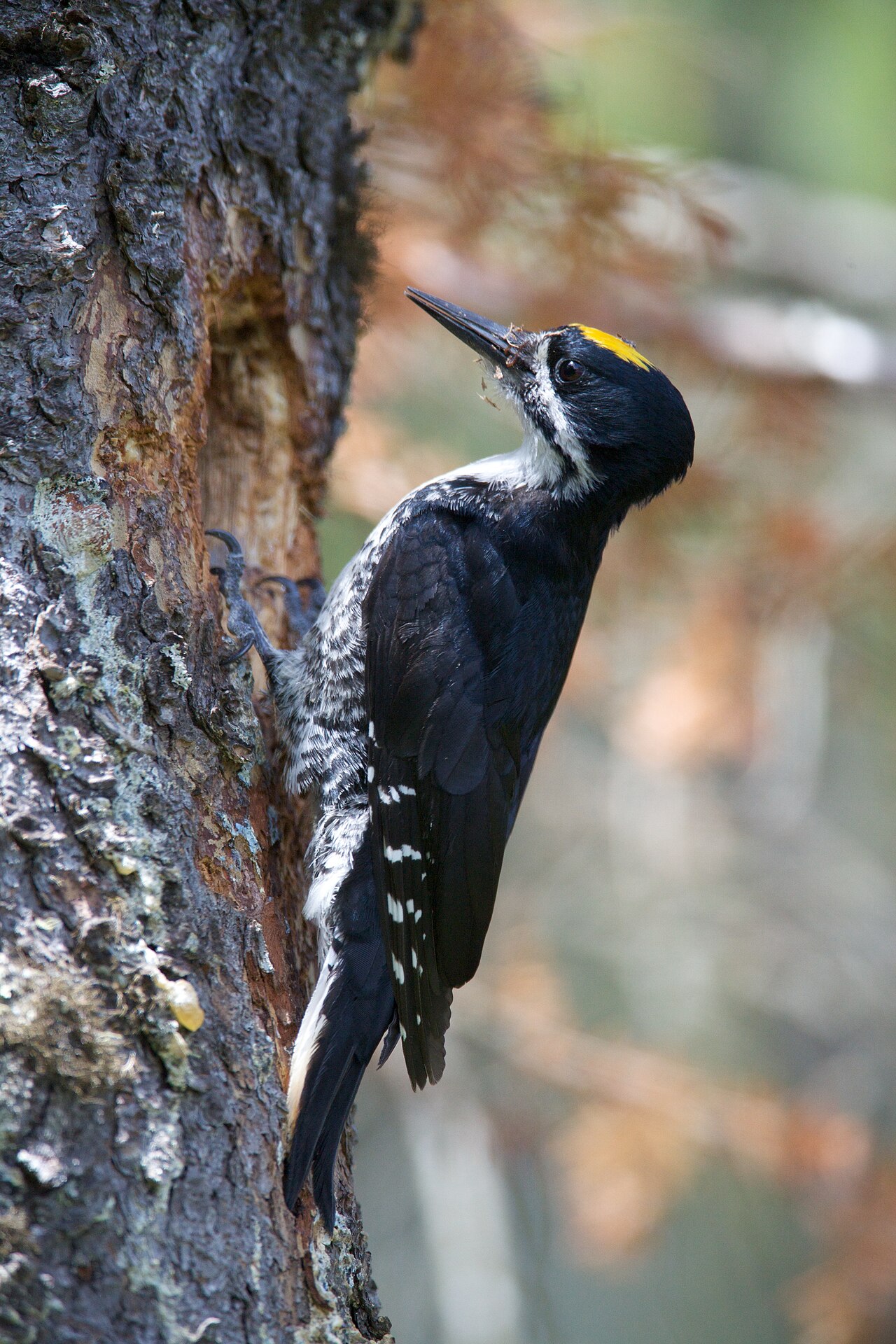
The Black-backed Woodpecker is the specialist of burned forest: a dark, sturdy woodpecker of boreal and montane conifer forests that settles in the blackened forest within weeks of a fire and lives there for years on the larvae of wood-boring beetles. Back, head and wings are glossy black, the underparts white with barred flanks, and the male has a yellow crown patch. Like American Three-toed Woodpecker, it has only three toes on each foot.
Voice
The usual call is a single, sharp and fairly low pik or kik, lower and fuller than the call of American Three-toed Woodpecker. In confrontations with its own kind it gives a characteristic sequence of a scream, a rattle and a growling, snarling sound in succession. Both sexes drum in long rolls. Even without calling it often gives itself away: the soft tapping and flaking of bark from a dead trunk can be heard from afar in a quiet, burned forest.
Recording: Stanislas Wroza — CC BY-NC-SA 4.0 · La Côte-de-Beaupré (near La Barrière-du-Maurice), Capitale-Nationale, Québec, Canada · xeno-canto
Identification
A medium-sized, sturdily built woodpecker with a relatively long bill and entirely glossy black upperparts: head, back, wings and rump without white. Across the black face runs a white stripe from the base of the bill to below the cheek; behind the eye there is at most a trace of white. The underparts are white, with dense black bars on the flanks, and the outer tail feathers are white. The male has a yellow crown patch, the female a black crown. Each foot has three toes, two pointing forward and one back.
Confusion species
American Three-toed Woodpecker also has three toes and a yellow crown in the male, but a back with white bars or a white central stripe, a white stripe behind the eye and a shorter bill. Hairy Woodpecker has a broad white stripe down the back, a white face with black stripes and, in the male, red on the nape. The male Williamson's Sapsucker also has a black back, but two white stripes across the face, a red throat, a yellow belly and a large white wing patch. Its dark colouring often makes it blend in against charred trunks in burned forest.
Habitat
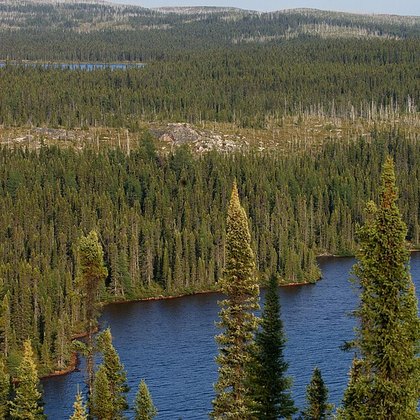
Boreal and montane conifer forest with spruces, pines and firs, in the west also Douglas-fir and ponderosa pine forest. It reaches its highest densities in recently burned forest, where it stays for up to about eight years after the fire, as long as the beetles in the dead trunks produce enough larvae. It also inhabits forests with bark-beetle outbreaks, such as the mountain pine beetle, and wooded bogs. It excavates its nest in dead or dying trees and makes a new cavity for every breeding attempt.
Where the bird is most often found, arranged by the USNVC — the vegetation classification of the United States and Canada — and CMECS for sea and coast.

Range and movements
It breeds in the boreal forest belt of Alaska and Canada, from interior Alaska to Newfoundland and Labrador and the Maritime Provinces. In the east its range reaches into northern Minnesota, Wisconsin and Michigan, the Adirondacks and northern New England; in the west through the Rocky Mountains and the Cascades into the Sierra Nevada of California. An isolated population lives in the Black Hills of South Dakota, and the birds of Oregon and California form a genetically distinct group. It is a resident that disperses south in some winters.
- Resident
- Breeding (summer)
- Winter
- Passage
- dark = core range, pale = thinly spread
Where and when to look
Search for it specifically in forest that burned one to five years ago: stand at the edge of such a burn in the early morning and listen for tapping and the low pik. It often peels large pieces of bark from dead trunks, so pale, bare patches on the black trees betray its presence. On a three-toed woodpecker, check the back first: all black is Black-backed Woodpecker, barred white or with a white stripe American Three-toed Woodpecker.
Conservation
The IUCN rates the species as Least Concern (LC). Partners in Flight estimates the breeding population at about 1.7 million birds and considers it a species of low concern; numbers appear generally stable. Its strong dependence on burned forest does, however, make it sensitive to forest management: fire suppression reduces the amount of suitable habitat, and salvage logging that removes the dead trunks soon after a fire makes a burn almost unsuitable. In the west it is therefore an indicator species for the value of unmanaged burned forest.
Scientific name
Picoides arcticus | (Swainson, 1832)
William Swainson described the species in 1832 as Picus arcticus, in the subgenus Apternus; the type locality lies near the sources of the Athabasca River, at about 57° north on the eastern slope of the Rocky Mountains in Alberta. Because the species has since been moved to another genus, author and year stand in parentheses. Picoides, introduced by Lacépède in 1799, combines the Latin picus 'woodpecker' with the Greek -oidēs 'resembling'. Arcticus is Latin for 'northern', after its boreal range.