All species › Gamebirds › Partridges, pheasants, grouse and allies › Sharp-tailed Grouse
Sharp-tailed Grouse | Tympanuchus phasianellus
Stekelstaarthoen | Gallo de las Praderas Rabudo
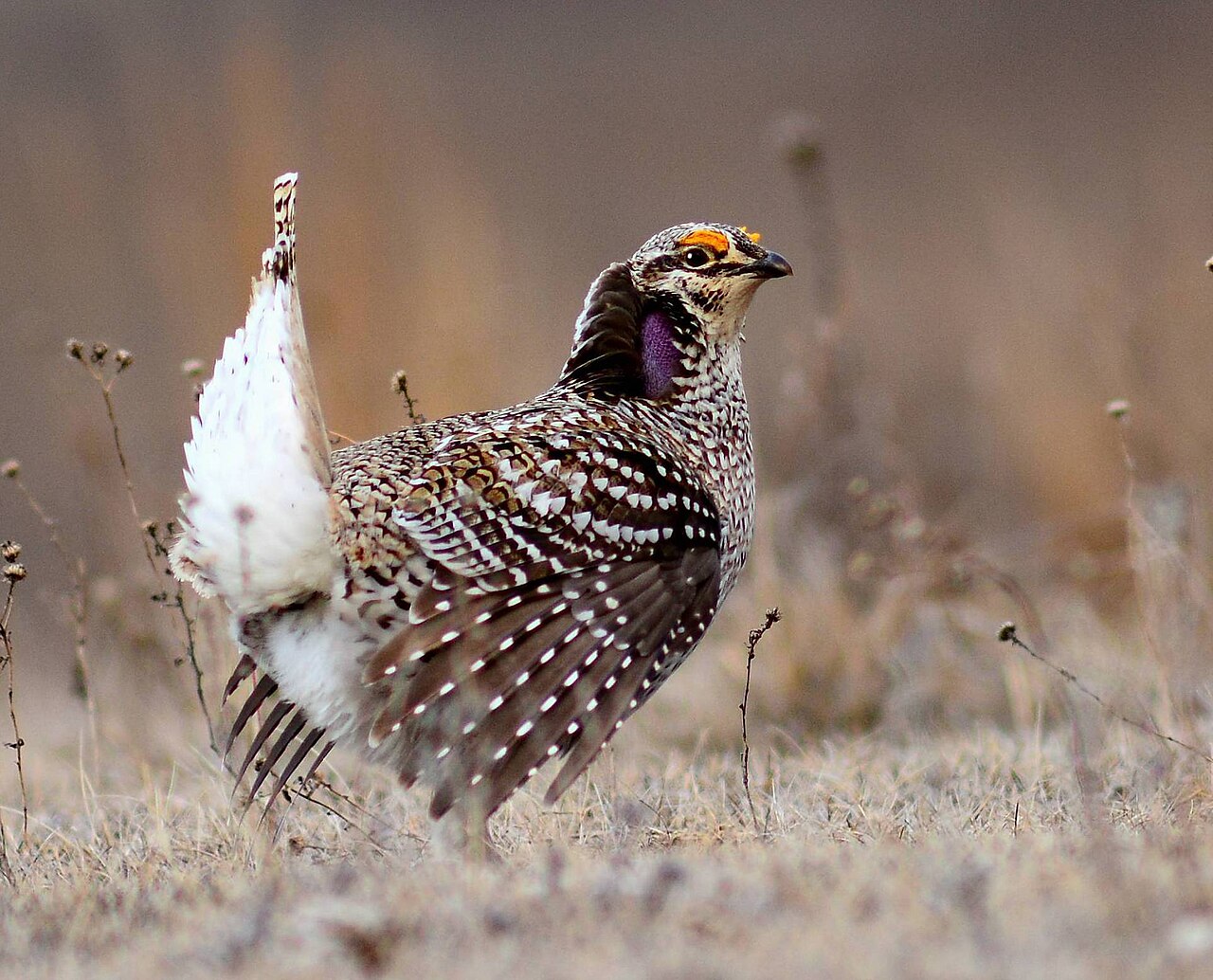
Sharp-tailed Grouse is the most widespread of North America's three prairie grouse, with a range stretching from Alaska to the Great Plains. Its pointed, elongated central tail feathers give it both its name and its silhouette, slimmer than that of its two prairie relatives. In display it stamps its feet so fast that the sound resembles a mechanical whirr more than a dance.
Voice
In display the male inflates purplish neck sacs and gives a soft, sustained cooing, backed up by clicks, barks and gobbling notes that vary from bird to bird. The sound that carries furthest, though, is not vocal: the rapid drumming of the feet reads as a soft buzz, and the tail feathers click against each other with a dry, rattling sound as the bird spins. In flight a cackling series is given, especially on take-off. Outside display the species is quiet and mostly gives itself away through the sound of its wings when flushed.
No freely licensed recording has been found for this species yet; what to listen for is described below.
Identification
A medium-sized, stocky grouse with a small head, short bill, and pointed, slightly elongated central tail feathers that clearly project beyond the rest at rest. The plumage is brown with fine, V-shaped markings below, paler and more finely marked than the two prairie-chickens. The male shows yellow eyebrow combs and purplish neck sacs in display; the female lacks these and is slightly smaller and duller. In flight the white belly stands out against the brown upperparts, and the tail shows a clear white edge in all plumages.
Confusion species
Greater Prairie-Chicken (Tympanuchus cupido) and Lesser Prairie-Chicken (Tympanuchus pallidicinctus) are more heavily built, with a short, rounded tail instead of Sharp-tailed Grouse's pointed, elongated feathers, and with coarser, horizontally barred rather than fine V-shaped underparts. The neck sacs give the species away from a distance: purple in Sharp-tailed Grouse, orange in Greater Prairie-Chicken, reddish purple in Lesser Prairie-Chicken. Where their ranges touch, in the northern Great Plains, Sharp-tailed Grouse occasionally hybridizes with Greater Prairie-Chicken. In more wooded country it is sometimes confused with Ruffed Grouse (Bonasa umbellus), which has a broader, fan-shaped tail with a wide dark terminal band instead of the pointed central feathers, and which drums with its wings rather than stamping its feet.
Habitat
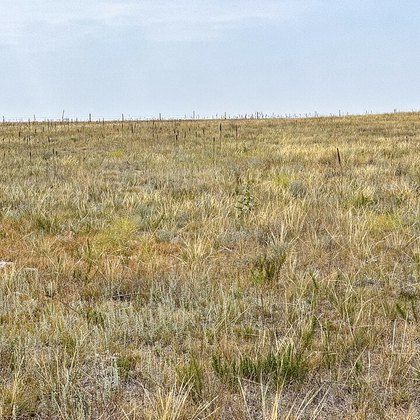
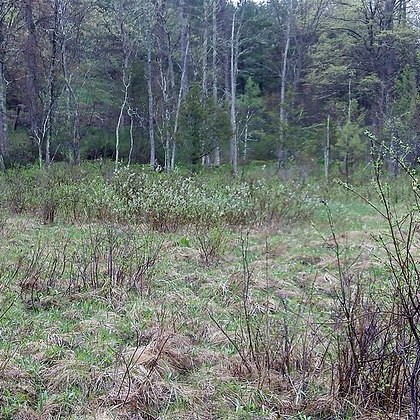
Grassland with scattered shrubs — wild rose, snowberry, hawthorn, sagebrush — forms the core of its habitat, from open prairie to the woodland edge of aspen forest in the north. Shrubs are essential: they provide cover from predators and, in winter, buds and berries for food, while open grassland supplies the display and nest site. In the north of its range it also uses peat bog and birch woodland at the edge of the boreal forest. Unbroken forest without open ground is as unsuitable as bare cropland without shrub cover.
Where the bird is most often found, arranged by the USNVC — the vegetation classification of the United States and Canada — and CMECS for sea and coast.

Range and movements
Resident across an enormous range, from Alaska through most of Canada to the northern Great Plains of the United States — Montana, the Dakotas, Nebraska, Minnesota and Wisconsin — with isolated mountain populations in Idaho, Wyoming, Utah and Colorado. In the west, in Washington state, a separate subspecies has been reduced to a handful of isolated populations. Since the nineteenth century the species has disappeared from California, Nevada, New Mexico, Kansas, Iowa and Illinois, where prairie was converted to cropland. The core range across Canada and Alaska has remained largely intact.
- Resident
- Breeding (summer)
- Winter
- Passage
- dark = core range, pale = thinly spread
Where and when to look
Look for a traditional display ground on open, short grassland at dawn in April — the same site is used year after year and is often known to local conservation groups. The rattle of the tail feathers and the drumming of the feet carry a few dozen metres and are easy to hear even before you spot the birds themselves.
Conservation
The global population is estimated at some seven hundred and fifty thousand birds, and has risen slightly since 1970. Locally, especially at the western and midwestern edges of the range, fragmentation of grassland and shrub cover by cropland remains the main threat. Partners in Flight rates the species of low conservation concern.
Scientific name
Tympanuchus phasianellus | (Linnaeus, 1758)
Linnaeus described the species in 1758 as Tetrao Phasianellus, in the genus of the capercaillies; because it has since been moved to another genus, author and year stand in parentheses. The genus Tympanuchus was introduced in 1841 by the German zoologist Gloger, formed from the Greek tympanon ('drum') and echein ('to have') — a reference to the inflatable neck sacs prairie grouse use to make their display sound. phasianellus is a diminutive of the Latin phasianus, 'pheasant', after the pointed tail that recalls a pheasant's. The type locality reads simply 'Canada', later narrowed to the area around Hudson Bay.