All species › Passerines › New World blackbirds, troupials and allies › Shiny Cowbird
Shiny Cowbird | Molothrus bonariensis
Glanskoevogel | Tordo renegrido
The Shiny Cowbird lays its eggs in the nests of other birds and builds no nest of its own; some 250 species are known to raise it. Originally a South American bird, it has colonised the Antilles since 1900 and reached Florida in 1985.
Voice
The male has a high, thin song: a series of bubbling and gurgling notes ending in a drawn-out, rising whistle, delivered with feathers raised and wings drooped. There is also a sharp chik as a contact call and a fast, descending series of rattling notes in flight. The female gives a hard, rattling churr.
Recording: Cristian Pinto Fernandez — CC BY-NC-SA 4.0 · Parque Brazil - Bosque Adriana Hoffman , Chile · xeno-canto
Identification
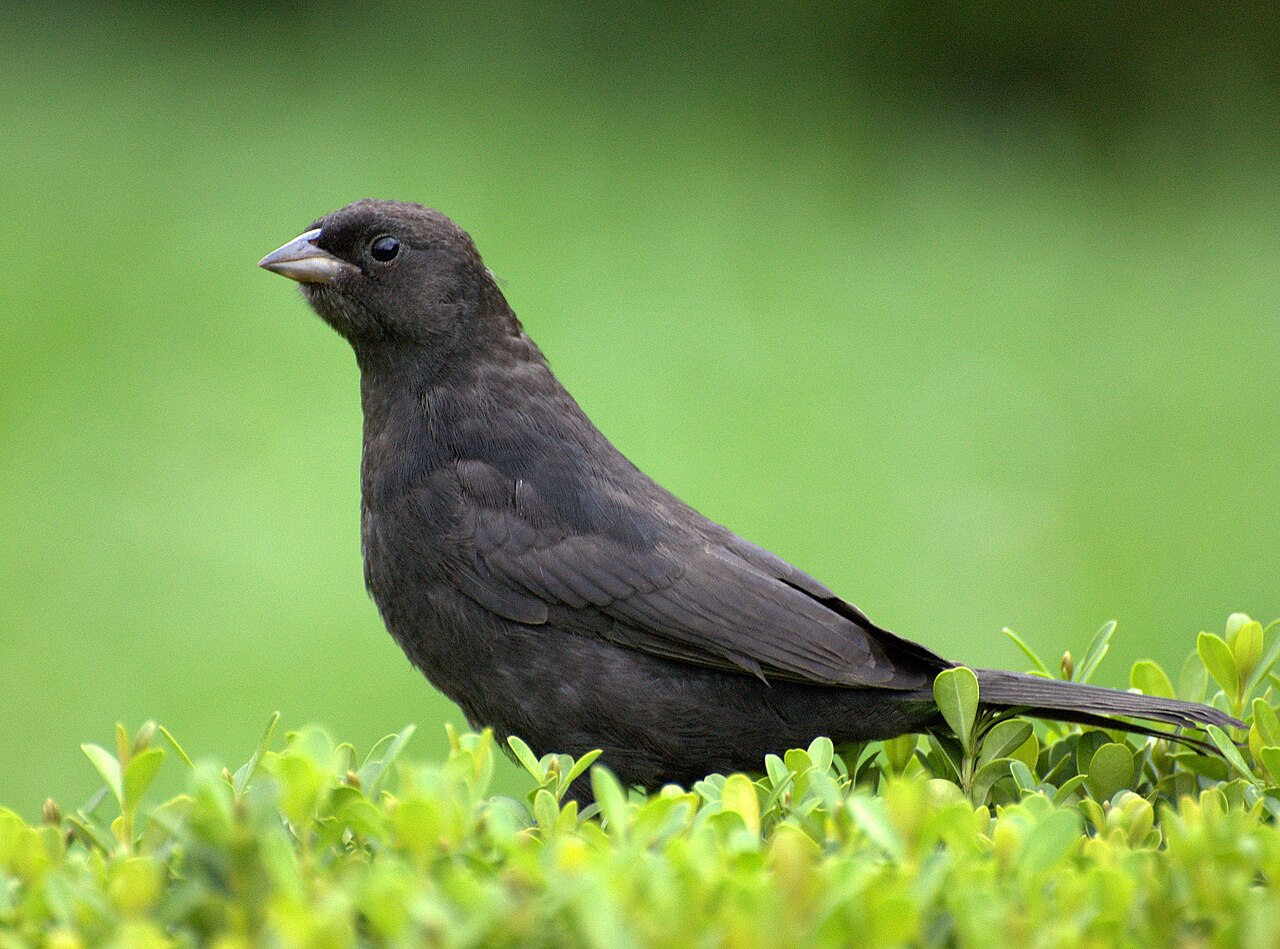
The male is entirely black with a purple-blue gloss strongest on head and breast; in dull light he looks plain black. The eye is dark. The head is small and round, without a neck ruff, and the profile runs smoothly into a pointed, conical bill. The female is plain greyish brown, slightly paler below, without clear streaking and with a faint pale eyebrow. The species is slimmer and longer-tailed than Brown-headed Cowbird.
Confusion species
Brown-headed Cowbird is the main confusion species: its male has a brown head against a black body, while the male Shiny Cowbird is black throughout. Females are more alike — the Shiny is darker and plainer, with a more pointed, longer bill and a longer tail; young birds often cannot be separated with certainty in the field. Bronzed Cowbird has a red eye and a neck ruff. Black-vented Oriole and the grackles are much larger and have a longer, wedge-shaped tail.
Habitat
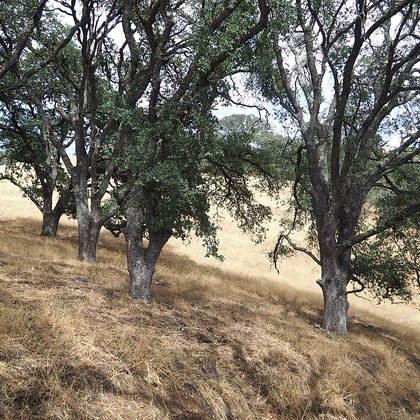
Open and semi-open ground with short vegetation: pasture, feedlots, field edges, roadsides, parks, picnic areas and village margins, often near cattle. It avoids closed forest. The spread through the Antilles and into Florida followed the conversion of forest to pasture and sugarcane; in built-up areas it uses lawns and feeding stations.
Where the bird is most often found, arranged by the USNVC — the vegetation classification of the United States and Canada — and CMECS for sea and coast.





Range and movements
The original range covers nearly all of South America. Within this guide's window it is resident in Venezuela and Colombia, and since the twentieth century also on the Leeward Antilles, Puerto Rico (from 1955), Hispaniola, Jamaica, Cuba, the Bahamas and the Turks and Caicos Islands. In 1985 a male was seen in the Florida Keys; by the 1990s the species was resident there. In Florida it has remained scarce, and no nest with confirmed eggs or young of this species has ever been found. Scattered records exist along the whole Gulf coast and as far as the northeastern states and Bermuda.
- Resident
- Breeding (summer)
- Winter
- Passage
- dark = core range, pale = thinly spread
Where and when to look
In the United States, Flamingo in Everglades National Park is the steadiest spot; look there in spring among Brown-headed Cowbirds on the ground. Watch the silhouette: smaller head, longer and more pointed bill, longer tail. A singing male gives itself away at once by the rising whistle at the end of the phrase.
Conservation
The species is listed as Least Concern (LC) and is expanding. The concern is not the cowbird itself but its hosts: on Puerto Rico its parasitism is one of the causes of the decline of the Yellow-shouldered Blackbird, and in South America the endangered Pale-headed Brushfinch has declined for the same reason. Where action is taken, it is by trapping cowbirds at colonies of threatened hosts.
Scientific name
Molothrus bonariensis | (Gmelin, 1789)
Gmelin described the species in 1789 as Tanagra bonariensis; because it was later placed in Molothrus, author and year stand in parentheses. Molothrus was introduced by Swainson in 1832; the name goes back to a Greek word for 'intruder' or 'beggar', after the brood parasitism, and probably rests on a slip of the pen. The species name bonariensis means 'from Buenos Aires', where the described specimen came from.