All species › Passerines › New World blackbirds, troupials and allies › Tricolored Blackbird
Tricolored Blackbird | Agelaius tricolor
Driekleurtroepiaal | Sargento tricolor
The Tricolored Blackbird breeds in the largest colonies of any North American landbird: a single colony may hold tens of thousands of birds. Almost the whole world population sits in California, and that population has fallen within a century from millions to a few hundred thousand.
Voice
The male's song is a harsh, nasal, strangled on-ke-kaaangh, shorter and hoarser than that of the Red-winged Blackbird. In a colony thousands of these run together into a steady low drone audible from far off. Calls are a nasal kip and a sharp check. Females give a rattling call at the nest.
Recording: Ed Pandolfino — CC BY-NC-SA 4.0 · Colusa NWR, Colusa County, California, United States · xeno-canto
Identification
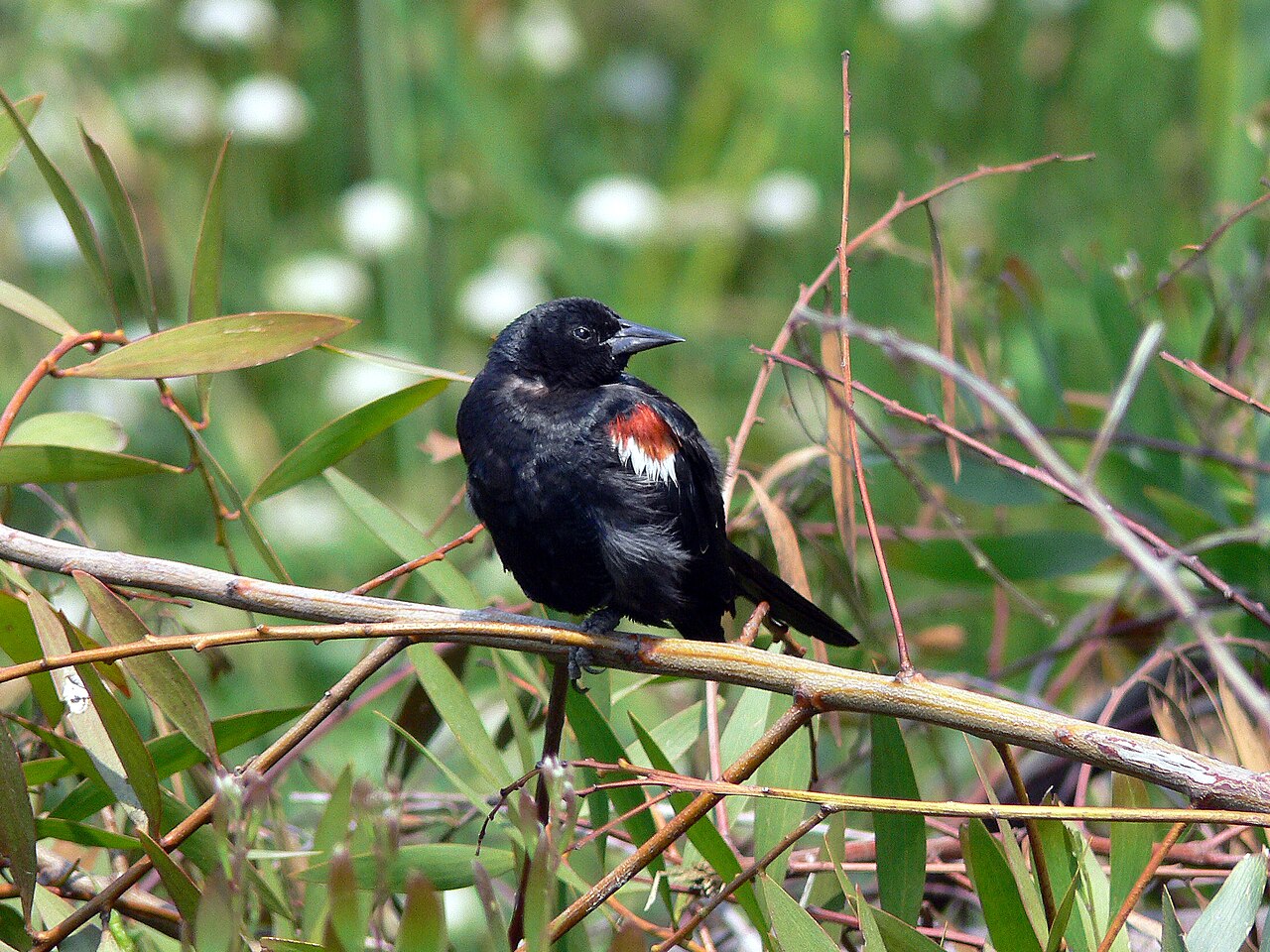
The male is entirely black with a dark red shoulder patch bordered below by a sharply defined, pure white band; that white band is the mark. The black feathers have little gloss and look matt. The female is dark brown with vague streaking, darker and colder than a female Red-winged Blackbird, with a greyish throat and usually no rusty tones. The bill is slimmer and more pointed than that of the Red-winged Blackbird.
Confusion species
Red-winged Blackbird is the only real confusion species. On that male the border below the red shoulder patch is yellow or buff and gradually bounded, not white and sharp; in fresh winter plumage that border can look pale, and then the shape of the boundary decides it. The female Red-winged is warmer brown with rusty feather edges and a more clearly streaked, often pink-washed throat. Behaviour helps too: Tricolored is almost always in dense flocks, breeding season included.
Habitat
Originally large freshwater marshes with cattail and bulrush in California's Central Valley. Most now nest in planted or naturalised vegetation: blackberry brambles, nettle, thistle fields and above all grain fields on dairy farms, harvested as silage. Foraging takes place on pasture, arable land and feedlots within a few kilometres of the colony; insect-rich grassland beside the colony is needed to raise the young.
Where the bird is most often found, arranged by the USNVC — the vegetation classification of the United States and Canada — and CMECS for sea and coast.






Range and movements
Nearly the whole range lies in California, centred on the Central Valley with smaller numbers on the central coast and in southern California. Beyond that there are small, shifting breeding groups in southern Oregon, western Nevada and southern Washington, and a small range in northern Baja California. The species is resident but moves within the state outside the breeding season towards the delta and the coast. Colonies are often not placed in the same spot in successive years.
- Resident
- Breeding (summer)
- Winter
- Passage
- dark = core range, pale = thinly spread
Where and when to look
Go to a grain field or blackberry thicket in the Central Valley in April or May and listen first: the drone of a colony carries more than a kilometre. On a flying flock the white line below the shoulder is the only reliable mark, so wait until the birds perch or pass close by.
Conservation
The species is listed as Endangered (EN). In the 1930s it numbered two to three million birds; the 2025 statewide survey arrived at about 218,000. The heaviest impact is the harvest or chopping of grain and weed fields while eggs or young are still present, which can end a whole colony in one day. Marsh drainage, the conversion of insect-rich grassland to nut orchards and vineyards, and predation by Cattle Egrets add to that. Since 2015 growers have been paid to delay harvest; in 2018 the species was listed as Threatened under the California Endangered Species Act.
Scientific name
Agelaius tricolor | (Audubon, 1837)
Audubon described the species in 1837 as Icterus tricolor; because it was later placed in Agelaius, author and year stand in parentheses. Agelaius comes from Greek agelaios 'living in herds', from agelē 'herd', after the flocking habit. The species name tricolor is Latin for 'three-coloured', after the black, red and white of the male. The type material was later assigned to Santa Barbara, California.