All species › Passerines › New World blackbirds, troupials and allies › Red-winged Blackbird
Red-winged Blackbird | Agelaius phoeniceus
Epauletspreeuw | Tordo sargento
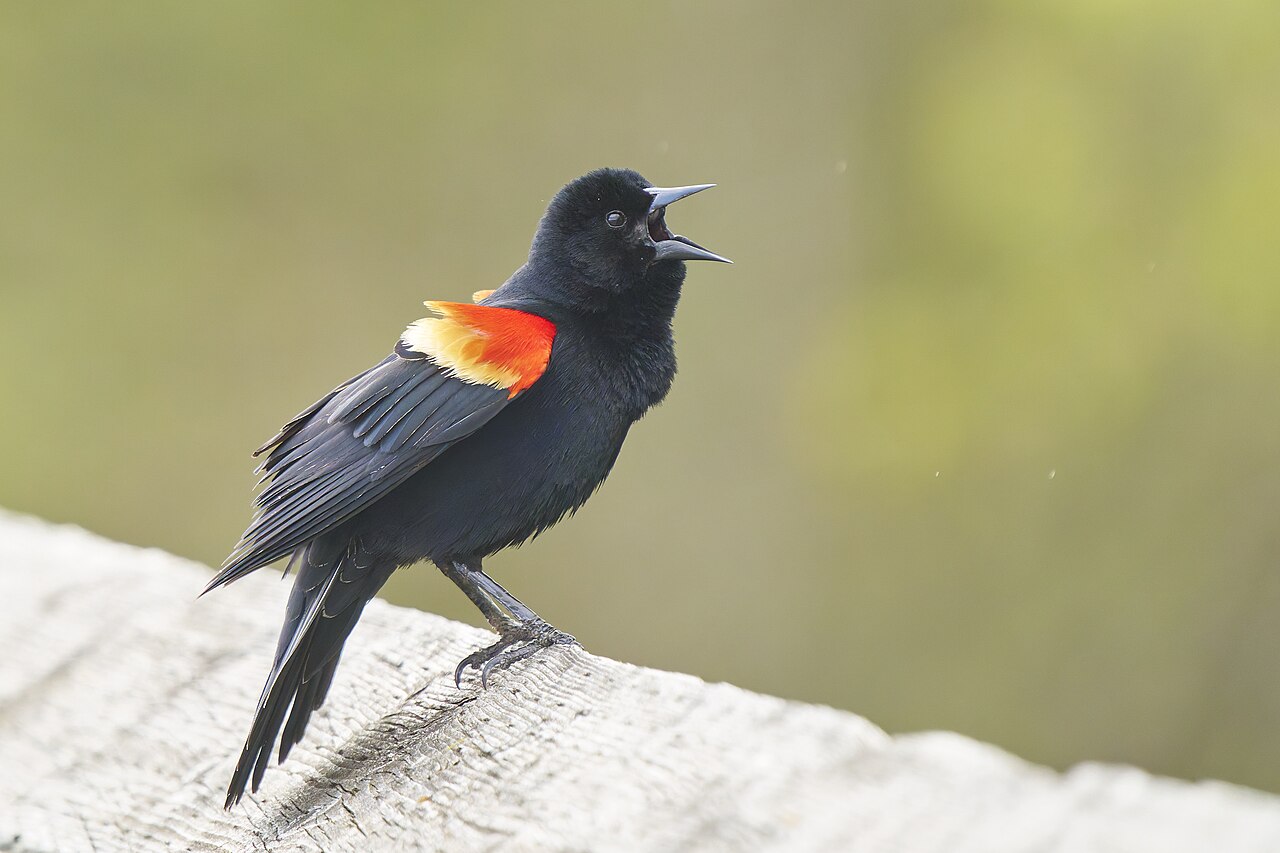
The Red-winged Blackbird is one of the most numerous birds in North America: a glossy black blackbird with bright red, yellow-edged shoulder patches that the male shows off from every reed stem in spring. In autumn the species and its relatives form the largest bird flocks on the continent, sometimes millions strong.
Voice
The song is the signature sound of every North American marsh: a hoarse, swelling konk-a-ree, delivered as the male simultaneously spreads his shoulder patches and fluffs his feathers. The call is a sharp chek, and when alarmed, a long, descending whistle. Females give their own rattling series that bears little resemblance to the male's song.
Recording: Pat Goltz — CC BY-NC-SA 4.0 · Sweetwater Wetlands Park (near Tucson), Pima County, Arizona, United States · xeno-canto
Identification
The male is almost entirely glossy black, with scarlet shoulder patches edged by a narrow yellow band, which he can conceal or display at will. The female looks entirely different: a heavily streaked brown bird more reminiscent of a large sparrow than of her own mate, sometimes with a faint pink wash on the throat. First-summer males are brown-black with rusty feather edges and still-immature shoulder patches. In flight the species shows a direct, purposeful flight and a habit of foraging in dense flocks alongside other blackbirds.
Confusion species
The female is often mistaken for a large sparrow or a thrush, but has a sharper bill and a far more crisply streaked pattern than any sparrow. Other black blackbirds — Rusty Blackbird and Common Grackle — lack the red shoulder patch entirely and have a yellow or pale eye instead of dark. In the west it occurs alongside Yellow-headed Blackbird, barely confusable thanks to its bright yellow head and breast, though the species sometimes mix in the same flocks.
Habitat
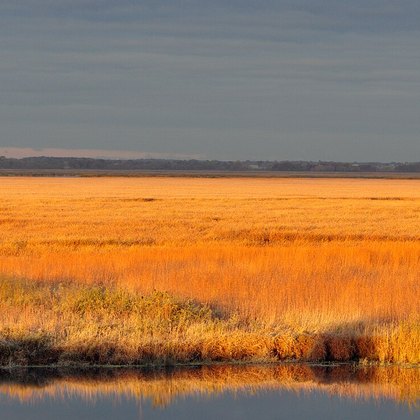
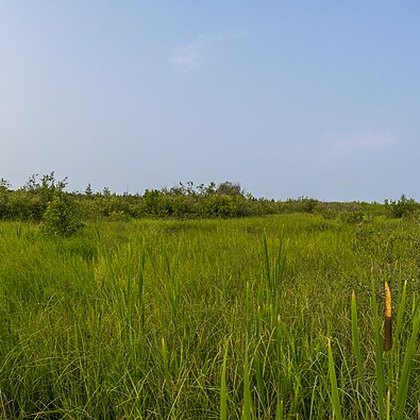
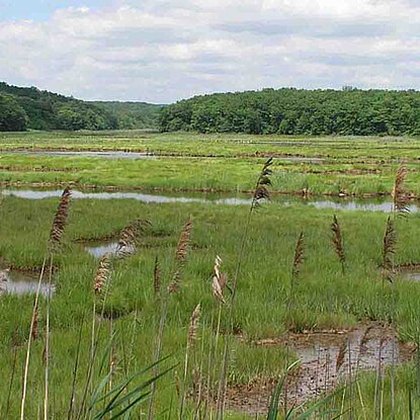
Cattail marsh, sedge meadows, lakeshores and ditch banks, and waterlogged pasture, where it stakes out its territory on sturdy stems. Outside the breeding season it trades the marsh for farmland and pasture, foraging for grain and seed in mixed flocks with other blackbirds. Almost any wet, vegetated patch of ground, from a ditch to a sprawling marsh, can hold a territory.
Where the bird is most often found, arranged by the USNVC — the vegetation classification of the United States and Canada — and CMECS for sea and coast.


Range and movements
Breeds from British Columbia and Newfoundland in the north to Costa Rica in the south, and is present year-round across almost the entire United States; only the northernmost, Canadian populations move south for winter. Outside the breeding season it gathers in large communal roosts, sometimes numbering millions of birds at once. It ranks among the most numerous birds on the continent, though numbers have declined markedly since the mid-twentieth century, partly through control as an agricultural pest and the loss of wetland.
- Resident
- Breeding (summer)
- Winter
- Passage
- dark = core range, pale = thinly spread
Where and when to look
In early spring, seek out a reedbed or willow-lined ditch and watch for males singing high on a stem with shoulder patches spread — visible from a great distance. In late summer and autumn, big, rustling flocks over farmland often reveal this species, travelling together with other blackbirds.
Conservation
One of the most numerous birds in North America, but numbers have declined steadily since the 1960s through wetland drainage and large-scale control as an agricultural pest. Where cattail marsh and wet pasture survive, the species remains common.
Scientific name
Agelaius phoeniceus | (Linnaeus, 1766)
Linnaeus described the species in 1766 as O[riolus] phoeniceus, among the orioles; it has since been moved to another genus, so author and year stand in parentheses. The genus Agelaius is Greek for 'living in flocks' and was introduced by Vieillot in 1816, for the species' strongly social behaviour. phoeniceus is Latin for 'scarlet, crimson', for the male's shoulder patches. The type locality was first given only vaguely as 'in America septentrionali', and restricted to Charleston, South Carolina, in 1928.