All species › Tubenoses › Petrels, shearwaters and diving petrels › Short-tailed Shearwater
Short-tailed Shearwater | Ardenna tenuirostris
Dunbekpijlstormvogel | Pardela de Tasmania
Short-tailed Shearwater is one of the most numerous seabirds in the world: tens of millions of pairs breed in Australia alone, in dense colonies on islands off the southern coast. Outside the breeding season almost the entire population makes a loop across the Pacific to the north, reaching as far as the waters off Alaska. From there it returns south along the North American west coast in autumn on its way back to Australia.
Voice
In the dense breeding colonies a constant, croaking and moaning chorus rises from the burrows at night, as birds underground find their partner and chick; by day the colonies are empty and silent. On migration through North American waters the species is silent; only the sound of wings and water is heard when a flock takes off. The colony call itself is never heard in this part of the world.
Recording: nick talbot — CC BY-NC-SA 4.0 · Phillip Island, Victoria, Australia · xeno-canto
Identification
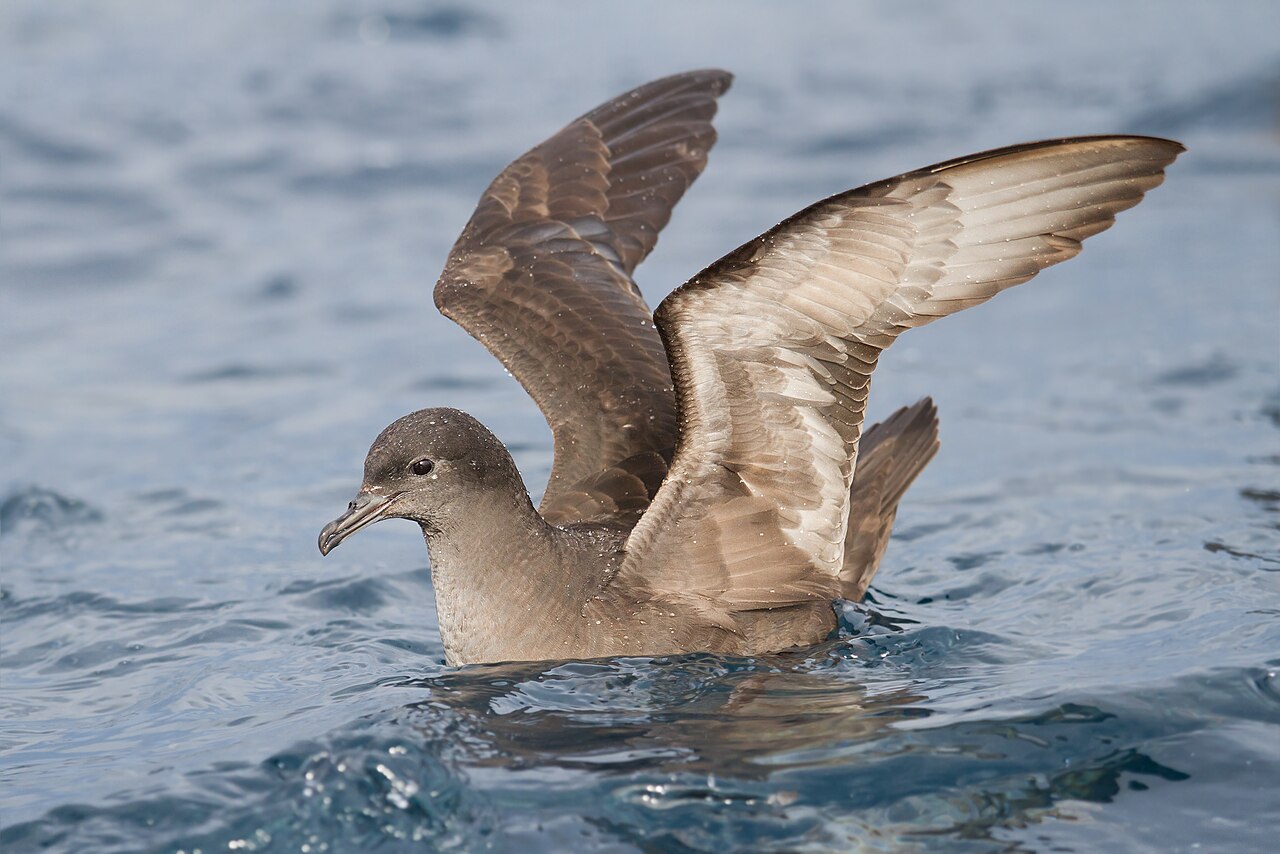
Short-tailed Shearwater is almost uniformly dark brown to blackish, slightly darker above than below, without sharp colour boundaries. The bill is short and thin, the head round with a steep forehead, and the tail short and rounded. The underwing is dull greyish-brown, at most with a faint paler band down the centre, far less pronounced than in the larger Sooty Shearwater. Sexes and juveniles look alike.
Confusion species
By far the greatest confusion is with Sooty Shearwater (Ardenna grisea), with which it often flies in the same flocks: that species is larger, with a longer, heavier bill, a more sloping forehead and a clearly silvery-white band across the centre of the underwing. Short-tailed Shearwater is smaller, rounder-headed and duller-underwinged, and these differences show best at close range. At long range most observers cannot separate the two.
Habitat
The species lives on open sea for almost the entire year, favouring cold, food-rich waters over the continental shelf. Off Alaska it often gathers in large numbers in spring and summer at narrow straits where strong currents push food to the surface, such as Unimak Pass in the Aleutians. The breeding grounds, far outside the guide area, consist of grass-covered dunes and slopes on islands off southeastern Australia and Tasmania.
Where the bird is most often found, arranged by the USNVC — the vegetation classification of the United States and Canada — and CMECS for sea and coast.

Range and movements
The entire world population breeds on islands off southeastern Australia and Tasmania. After breeding the species makes a loop north across the Pacific, with large numbers in the North American summer in the Bering Sea and around the Aleutians off Alaska. In autumn the birds head south again along the coasts of Washington, Oregon and California, before crossing the ocean once more back to Australia.
- Resident
- Breeding (summer)
- Winter
- Passage
- dark = core range, pale = thinly spread
Where and when to look
The best chance in North America is a boat trip off the Aleutians in summer, where at times hundreds of thousands of birds stream through Unimak Pass. Along the way watch for the contrast with the more numerous Sooty Shearwater: a shorter, thinner bill and a dull rather than silvery-white underwing point to Short-tailed Shearwater.
Conservation
With tens of millions of breeding pairs the species is listed as Least Concern (LC), though numbers fluctuate strongly from year to year with conditions at sea. In Tasmania, young birds have been harvested for generations, on a limited and licensed scale, as the 'muttonbird' (the local name for the bird as a food source), a practice considered sustainable. Warmer summers and food shortages in the Bering Sea have repeatedly caused mass die-offs among migrating birds in recent decades.
Scientific name
Ardenna tenuirostris | (Temminck, 1836)
Temminck described the species in 1836 as Procellaria tenuirostris, 'thin-billed', after the narrow bill that distinguishes it from related species; because it was later moved to another genus, author and year stand in parentheses. The genus Ardenna was established by Reichenbach in 1853. The type locality lies in the seas north of Japan and off the coast of Korea, far from the later-discovered breeding grounds near Australia.