All species › Tubenoses › Petrels, shearwaters and diving petrels › Sooty Shearwater
Sooty Shearwater | Ardenna grisea
Grauwe pijlstormvogel | Pardela sombría
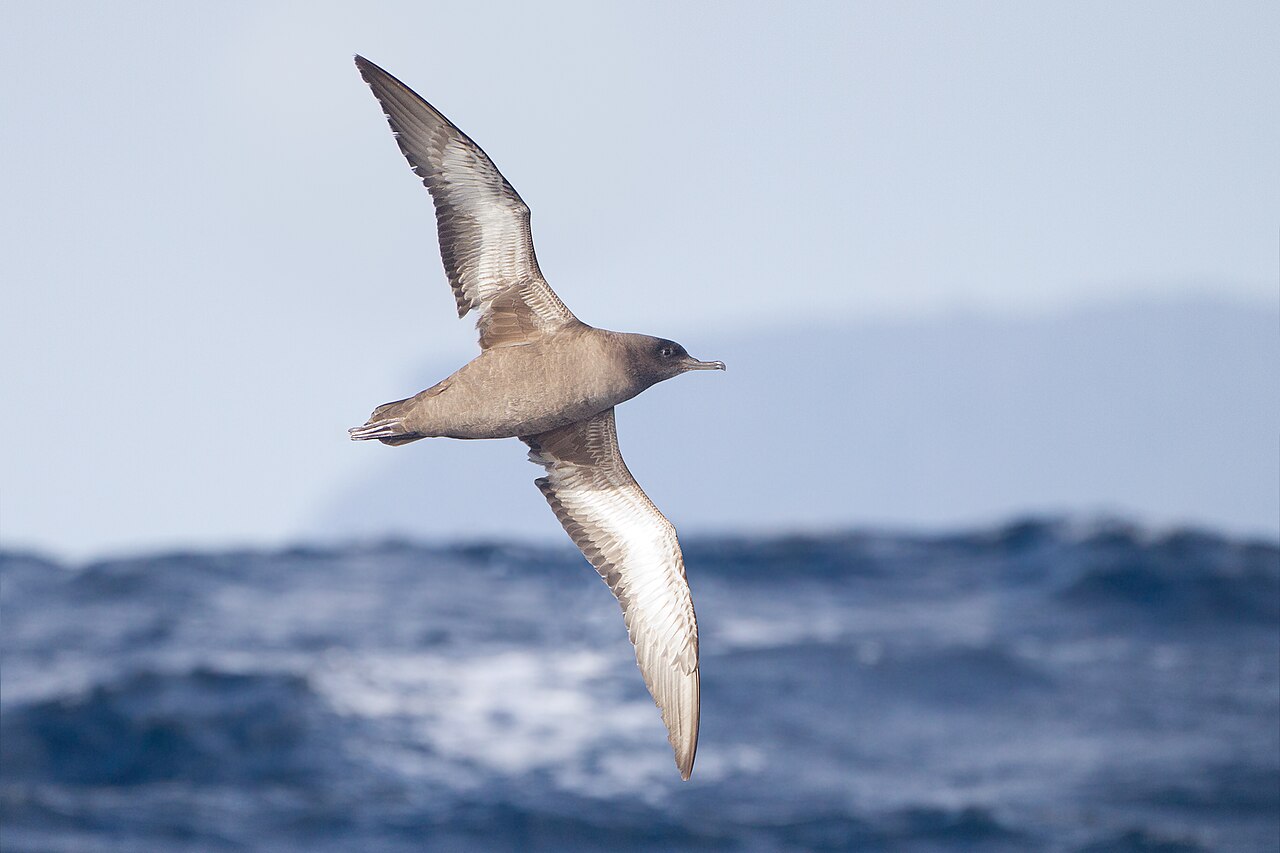
Sooty Shearwater is one of the most numerous seabirds in the world and the most common dark shearwater off both coasts of North America. It breeds in the Southern Hemisphere, from New Zealand to South America, and moves north in huge numbers outside the breeding season. Since the 1980s, numbers off the California coast have fallen sharply, a decline that has now placed the species in a category of concern.
Voice
At Southern Hemisphere breeding colonies a loud, moaning and cackling screech rises from the burrows at night; in North American waters, far from those colonies and outside the breeding season, the species is completely silent. Large flocks betray themselves only through the sound of hundreds of beating wings and splashing water as they attack a school of fish together. Anyone who 'hears' the species here is hearing a crowd, not a call.
No freely licensed recording has been found for this species yet; what to listen for is described below.
Identification
Sooty Shearwater is uniformly sooty brown to blackish-brown, with a relatively long, heavy bill and a sloping forehead. The clearest mark is the broad, silvery-white band running the full length of the underwing, visible in part on the upperwing too in bright light. Flight is powerful and stiff-winged, with rapid wingbeats alternating with low glides just above the water. Sexes and juveniles look alike.
Confusion species
The trickiest separation is from Short-tailed Shearwater (Ardenna tenuirostris), which is smaller, with a shorter, thinner bill, a rounder forehead and a duller, less silvery underwing. In the Atlantic it is also confused with Northern Fulmar, which has a thicker neck, a short, stubby bill and a flatter, less powerful flight. The broad silver band on the underwing remains the best mark for picking out Sooty Shearwater.
Habitat
Sooty Shearwater lives almost entirely on open sea, favouring cold, food-rich currents over and at the edge of the continental shelf. Along the west coast it sometimes gathers in colossal numbers in spring and summer at upwelling areas, often hunting fish and squid alongside whales. In the Atlantic it is seen mainly in spring and early autumn, in smaller numbers than in the Pacific.
Where the bird is most often found, arranged by the USNVC — the vegetation classification of the United States and Canada — and CMECS for sea and coast.
Range and movements
The species breeds on islands around New Zealand, at the southern tip of South America and on remote islands in the southern Atlantic and Pacific. Outside the breeding season it moves far north into the Pacific, occurring from spring through autumn along the entire west coast of North America, from Alaska to California; in the Atlantic it reaches the Gulf of Maine in smaller numbers. Between 1987 and 1994 the number of birds off the coast of Southern California fell by an estimated ninety percent, one of the sharpest documented declines for a seabird in these waters.
- Resident
- Breeding (summer)
- Winter
- Passage
- dark = core range, pale = thinly spread
Where and when to look
Look for the species from shore or on a boat trip at upwelling areas such as Monterey Bay, where in autumn thousands of birds sometimes stream low over the water at once. In bright backlight, watch for the broad silvery-white band under the wing: it identifies the species at considerable range among other dark seabirds.
Conservation
The world population remains large, but the species has been considered near threatened for some decades, mainly because of the sharp decline documented off California in the 1980s and 1990s. Bycatch in longlines and gillnets, changes in fish stocks linked to ocean warming, and historical chick harvest at New Zealand breeding islands are seen as the main causes.
Scientific name
Ardenna grisea | (Gmelin, 1789)
Gmelin described the species in 1789 as Procellaria grisea, 'grey', after its sooty-toned plumage; because it was later moved to another genus, author and year stand in parentheses. The genus Ardenna was established by Reichenbach in 1853. The type locality lies between 35 and 50 degrees south latitude, near New Zealand.