All species › Tubenoses › Petrels, shearwaters and diving petrels › Great Shearwater
Great Shearwater | Ardenna gravis
Grote pijlstormvogel | Pardela capirotada
Great Shearwater is one of the largest shearwaters in this guide: a heavily built seabird with a sharply defined dark cap and a white band at the base of the tail. It breeds almost entirely on a handful of islands in the far South Atlantic and, after breeding, moves north to spend the summer over the continental waters of North America. It is also the type species of the genus Ardenna.
Voice
At the breeding islands a loud, moaning and cackling chorus rises at night from the densely packed colonies, as birds find each other and their chick in the dark. In the North American summer, far from those colonies, the species is completely silent. Large feeding flocks at sea betray themselves only through the sound of beating wings and splashing water.
Recording: Sven Normant — CC BY-NC-SA 4.0 · Haut Fond d'Ar Men (north Sein Island), France · xeno-canto
Identification
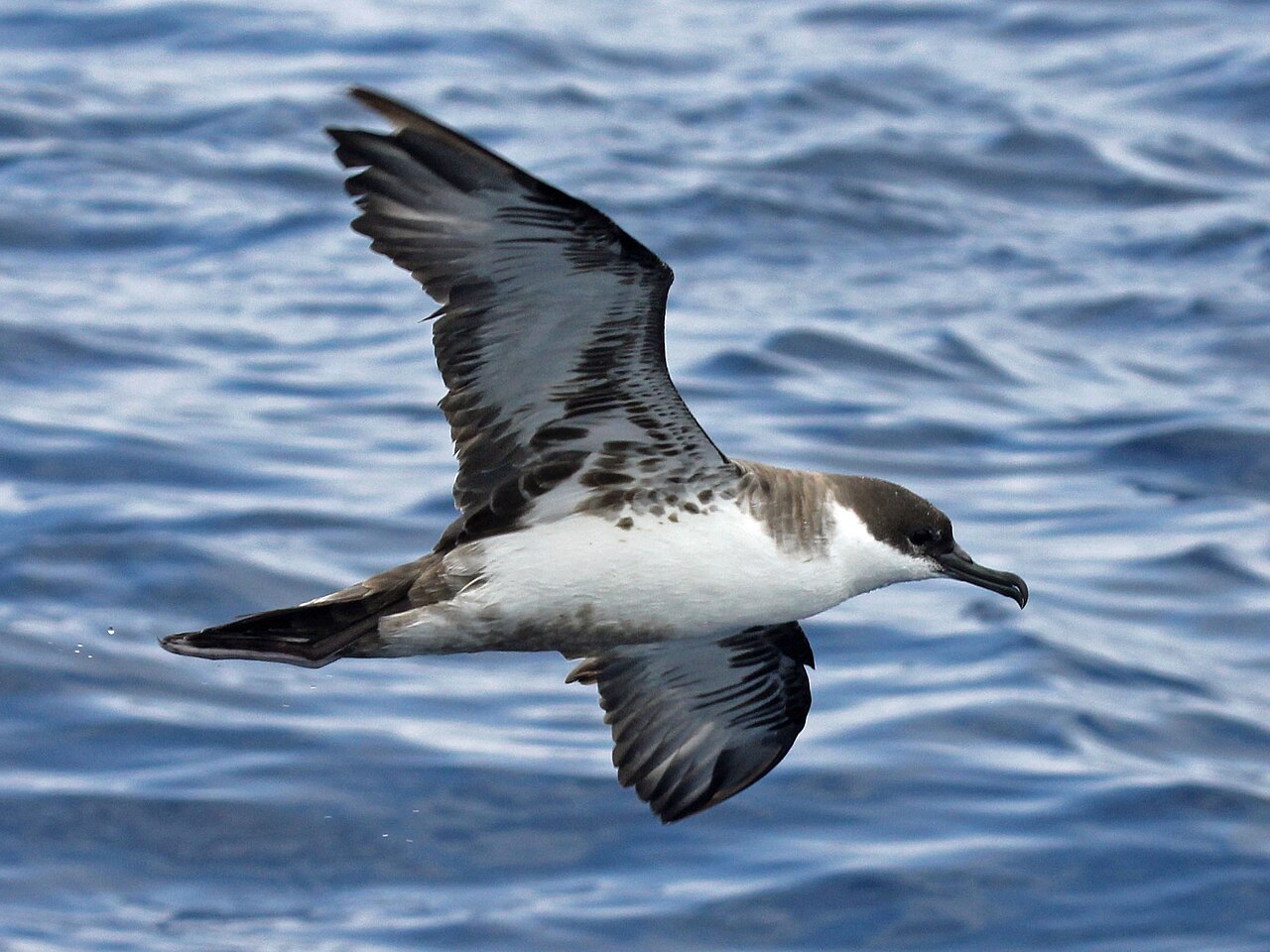
Great Shearwater has a sharply defined dark brown cap meeting a white neck and underparts, with a blotchy, variably dark patch on the belly. The upperparts are greyish-brown with paler fringes to the covert feathers, giving a scaly pattern, and a narrow white band stands out at the base of the tail. The bill is dark and heavy, flight powerful with stiff, rapid wingbeats alternating with long glides high above the water. Sexes and juveniles look alike.
Confusion species
The trickiest separation is from Cory's Shearwater, which shares the same waters and season but has a more evenly brown head without a sharp cap, a yellowish rather than dark bill and usually no dark belly patch. The white tail base and the sharply defined dark cap remain the most reliable marks for Great Shearwater in good light. At greater range the heavy build can also suggest an immature jaeger, but the straight, stiff glide of the shearwater differs clearly from a jaeger's agile flight.
Habitat
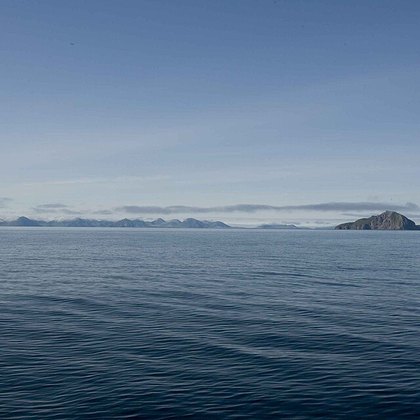
Outside the breeding season Great Shearwater lives on open ocean water, with a marked preference for the edge of the continental shelf and the Gulf Stream, where warm and cold water meet. It rarely comes close to shore except after severe autumn storms, and is normally seen from a boat, well out of sight of the beach. At the breeding islands the habitat is grassy, wind-battered slopes into which the birds dig their burrows.
Where the bird is most often found, arranged by the USNVC — the vegetation classification of the United States and Canada — and CMECS for sea and coast.
Range and movements
The species breeds in large colonies on islands of the Tristan da Cunha group and on Kidney Island in the Falkland Islands, in the far South Atlantic. After breeding, almost the entire population moves north into the North Atlantic, where the birds occur from June into November along the US and Canadian east coast, with a peak from late July through August off North Carolina and large concentrations in the Gulf of Maine and the Bay of Fundy. In September they begin the return journey to the breeding islands.
- Resident
- Breeding (summer)
- Passage
- dark = core range, pale = thinly spread
Where and when to look
Watch from shore near Cape Hatteras from late July through August, or join a boat trip out onto the Gulf Stream: that is usually the best time and place for large numbers. Look for the sharply defined dark cap and the white tail base to separate it from the similar Cory's Shearwater.
Conservation
The world population is large, with millions of breeding pairs on Tristan da Cunha and its surrounding islands alone, and the species is listed as Least Concern (LC). Introduced rodents on a few breeding islands pose a risk to eggs and chicks, and like other shearwaters the species suffers from fisheries bycatch along its long migration route.
Scientific name
Ardenna gravis | (O'Reilly, 1818)
O'Reilly described the species in 1818 as Procellaria Gravis, 'heavy', after its stout build compared with other shearwaters; the description appeared in a travel account of a voyage to Greenland, not in a scientific journal. Because the species was later moved to another genus, author and year stand in parentheses. The genus Ardenna was established by Reichenbach in 1853, with this species as its type. The type locality covers the sea route between Cape Farewell and Newfoundland, as followed by O'Reilly on his voyage.