All species › Waders, gulls and terns › Plovers and lapwings › Siberian Sand-Plover
Siberian Sand-Plover | Anarhynchus mongolus
Mongoolse plevier | Chorlitejo Mongol Chico
The Siberian Sand-Plover breeds on the bare, stony tundra of north-eastern Siberia and winters on the coasts of South-East Asia and Australia. In North America it is a scarce but almost annual visitor to the far west of Alaska, where it makes landfall on the Aleutians and the Bering Sea islands in late spring and has bred on a few occasions. In the breeding season the male carries a broad rust-red breast band that can be picked out from a long way off on a gravel beach.
Voice
The flight call is a short, hard trill, a rolling drrt that stays dry and clipped and never sounds like a whistle. On take-off, and among small parties on the beach, there is also a sharp two-syllable chi-tik. Over the breeding ground the male repeats a series of the same rolling notes in a slow display flight, strung together into a purring whole. In Alaska most birds are found silent, among other waders on the flat.
No recording with a suitable Creative Commons licence has been found for this species yet; what to listen for is described below.
Identification
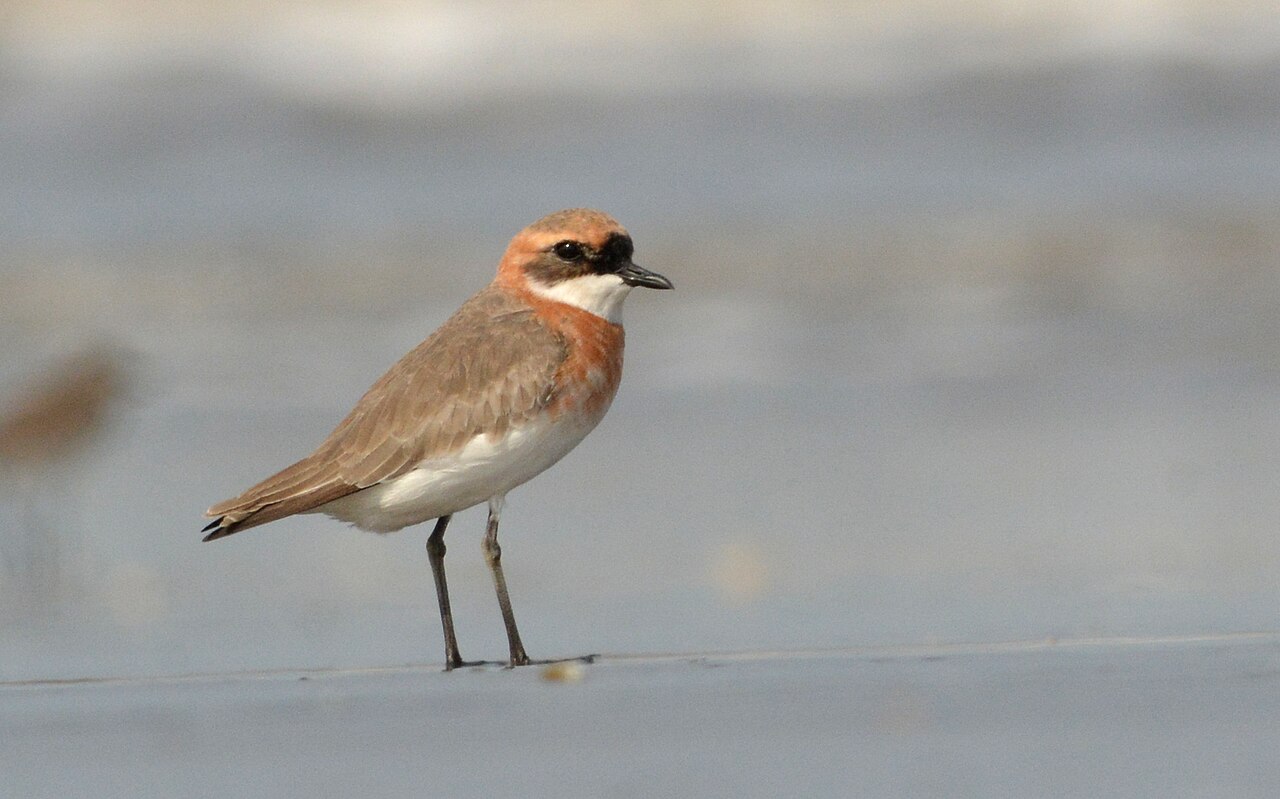
A medium-sized plover with fairly long, dark grey-green to black legs and a straight black bill somewhat heavier than that of the small plovers around it. The breeding male is grey-brown above and white below, with a broad rust-red band across the breast that continues onto the nape and forehead, and with a black mask and a black frontal bar. The female carries the same pattern in duller colours, with brown instead of black on the face. In winter plumage and in juveniles all the red goes: the bird is then plain grey-brown with a white forehead, a pale supercilium and a grey-brown patch at the side of the breast that often does not meet across it. In flight a narrow white bar runs along the wing and the white sides of the tail show against the dark centre.
Confusion species
In winter plumage this closely resembles other plovers in the guide area. Snowy Plover (Anarhynchus nivosus) is smaller and far paler, with a thin bill and a dark ear patch, and has two separate breast patches rather than a continuous band. Mountain Plover (A. montanus) is larger and sandier, has pale legs and stands on dry steppe, not on the beach. Semipalmated Plover is smaller and rounder, with orange legs and a short orange bill tipped black. The closely related Greater Sand-Plover (A. leschenaultii), also recorded in Alaska on only a few occasions, is larger and longer-legged, with a clearly longer and heavier bill and a narrower breast band.
Habitat
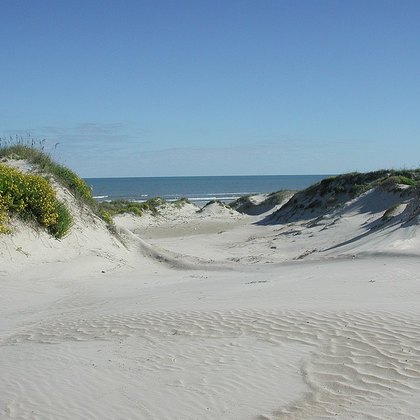
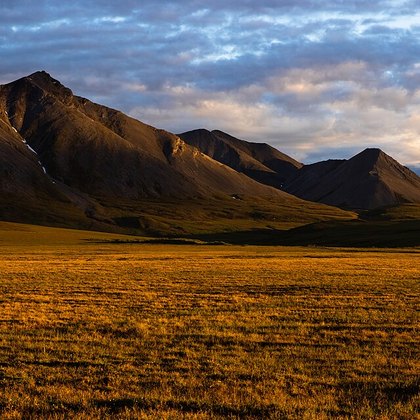
Breeds on dry, stony tundra and gravel ridges above the treeline, often on old river terraces and on bare slopes with nothing but moss and lichen between the stones. Outside the breeding season it stands on sandy beaches, tidal flats and the margins of estuaries and lagoons, hunting worms, small crabs and insects by sight. It avoids vegetated banks and freshwater marsh. In Alaska the birds are found almost always on gravel and sand beaches along the coast, and sometimes on the bare tundra behind them.
Where the bird is most often found, arranged by the USNVC — the vegetation classification of the United States and Canada — and CMECS for sea and coast.



Range and movements
The breeding range lies in north-eastern Siberia, from Chukotka and Kamchatka to the Commander Islands, in scattered patches on the uplands and the coastal plains. The birds migrate along the East Asian coast to winter quarters reaching from Japan and China to Indonesia and Australia. In North America it appears mainly between late May and early July on the western Aleutians, the Pribilofs, St. Lawrence Island and the Seward Peninsula; a few breeding records come from near Nome. Further south and east there are only scattered records, among them British Columbia, Oregon, California, Alberta, Ontario, New Jersey and Louisiana.
Where and when to look
The best chance falls in the last week of May and in June on the western Aleutians and around Nome, when Siberian waders make landfall. Work the gravel beaches and the river mouths and check every party of small plovers: a male in breeding plumage gives itself away by the broad rust-red band, even in grey weather and at distance. A bird in winter plumage takes more work — then watch the dark legs, the straight black bill and the incomplete breast band.
Conservation
Since the species was separated from the Tibetan Sand-Plover in 2023 the Red List has rated it Endangered (EN). The decline comes from the flyway and the winter quarters: along the Yellow Sea a large share of the tidal flats has been reclaimed or embanked, and it is precisely there that the birds must refuel between Siberia and Australia. Disturbance and hunting at roosts add to that in parts of the range. The Alaskan occurrence is far too small to matter for the world population.
Scientific name
Anarhynchus mongolus | (Pallas, 1776)
Peter Simon Pallas described the species in 1776 as Charadrius mongolus, in the third volume of his travel account Reise durch verschiedene Provinzen des Russischen Reichs; because it has since been placed in another genus, author and year stand in parentheses. The genus Anarhynchus is formed from Greek ana-, 'backwards', and rhynkhos, 'bill', after the sideways-bent bill of the New Zealand species for which it was set up; on the strength of genetic work published in 2022 this plover and its relatives were brought into it, and older sources still carry it under Charadrius. mongolus means 'of Mongolia'. Pallas gave the locality as the salt lakes towards the Mongolian border, probably Kulussutai on the Onon in Siberia.