All species › Waders, gulls and terns › Plovers and lapwings › Wilson's Plover
Wilson's Plover | Anarhynchus wilsonia
Dikbekplevier | Chorlitejo Piquigrueso
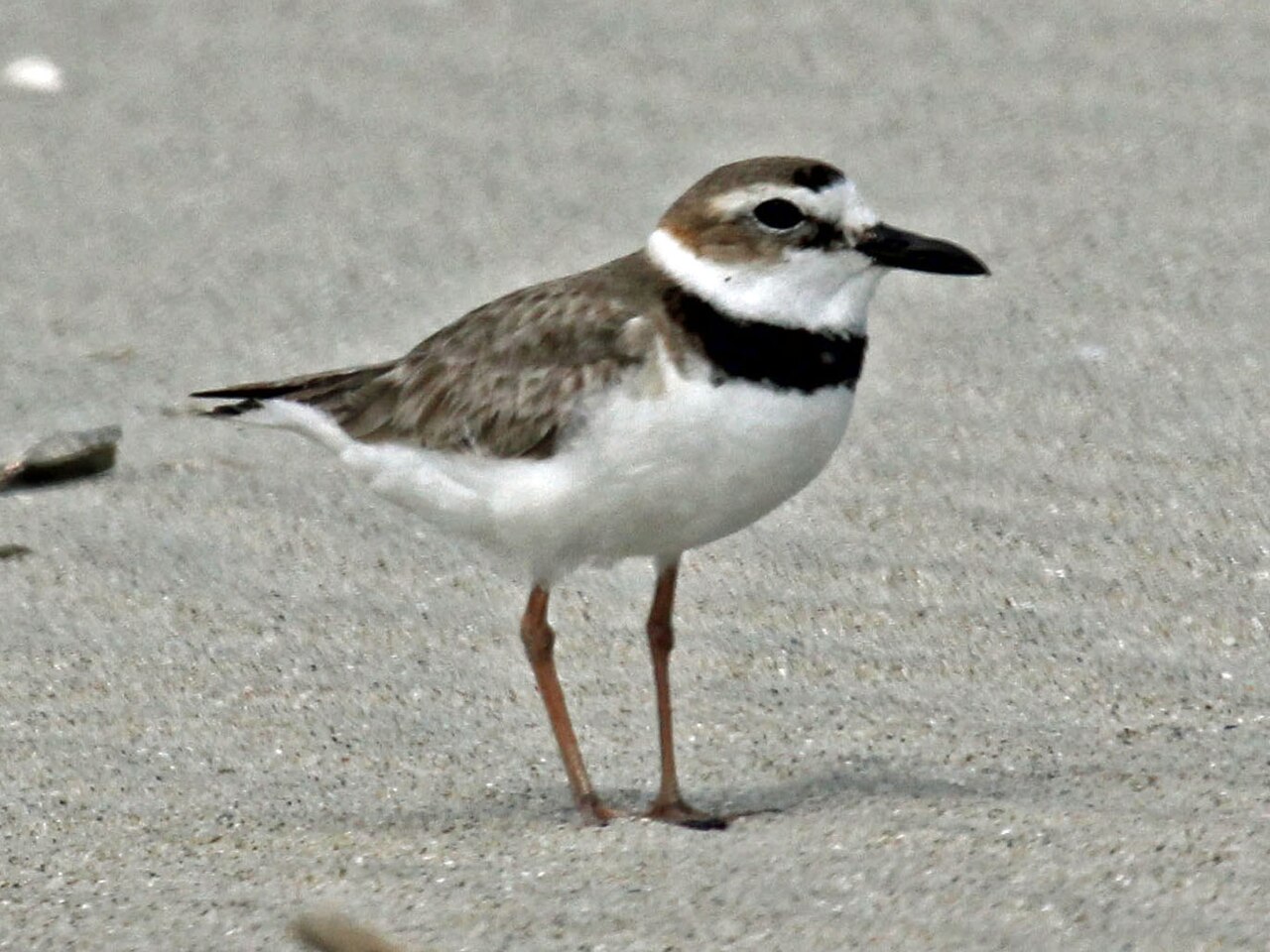
Wilson's Plover carries the heaviest bill of all the small plovers: straight, wholly black and almost too big for its head. It lives largely on fiddler crabs, which it takes from their burrows on open sand and mud flats, and it breeds along the coasts from Virginia to Brazil. Its colour and its habit of standing motionless mean it is often overlooked on a wide beach.
Voice
The call is a short, sharp whistled wheet or peet, high and thin for a bird with so heavy a bill, and usually heard only as it flies up. In boundary disputes and in courtship this becomes a fast rattling series, wit-wit-wit-wit, that carries well along the beach. At the nest there is a sustained plaintive piping with which the pair draws attention away from the chicks. Outside the breeding season it is largely silent, and then the heavy bill rather than the voice gives the first clue.
No recording with a suitable Creative Commons licence has been found for this species yet; what to listen for is described below.
Identification
Larger and longer-legged than Semipalmated Plover, with a big head, a steep forehead and a long, thick, all-black bill; the legs are dull flesh to grey-pink. The breeding male is warm grey-brown above and white below, with a single broad black breast band, a white forehead, a black frontal bar and often a cinnamon wash on crown and ear coverts. On the female, and on the male in winter, that band is brown to rufous instead of black. Juveniles are paler, with fine pale feather edges that make the back look scaled, and a narrower, sometimes broken band. In flight it shows a narrow white wingbar and white tail sides, and it goes off low and straight over the water.
Confusion species
Semipalmated Plover (Charadrius semipalmatus) is clearly smaller and rounder, with a short orange bill tipped black and orange legs; the heavy black bill and flesh-coloured legs of Wilson's Plover carry the difference even at distance. Piping Plover (C. melodus) is far paler, with orange legs and, in the breeding season, an orange bill. Snowy Plover is smaller and paler and has a thin bill and two separate breast patches. Killdeer is a good deal larger, long-tailed, with two black bands and an orange rump that shows at once as it flushes.
Habitat
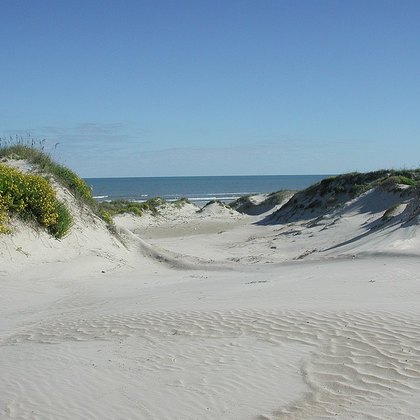
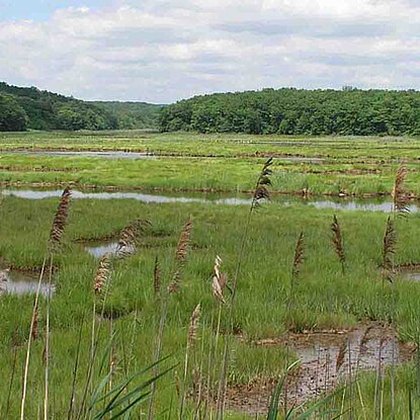
Wide, flat sandy beaches, dry salt flats behind the dunes, dredge-spoil islands, shell rakes and the muddy margins of lagoons and mangrove creeks — anywhere fiddler crabs occur in numbers. The nest is a scrape above the tideline, among shell grit or sparse beach grass. It avoids narrow, steep beaches and busy shorelines, and withdraws to islands and closed-off stretches as soon as a beach comes into use. It feeds best on a falling tide, and at night as well.
Where the bird is most often found, arranged by the USNVC — the vegetation classification of the United States and Canada — and CMECS for sea and coast.



Range and movements
It breeds along the Atlantic coast from Virginia south through the Carolinas, Georgia and Florida, along the whole Gulf coast to Texas, on both coasts of Mexico, in Central America and in the Greater and Lesser Antilles, and on south to Brazil and Peru. The northern breeders and part of the Gulf coast birds withdraw in winter to Florida, south Texas, Mexico and the Caribbean; in the south of the range it stays all year. The northern limit has drawn back over the twentieth century: into the nineteenth century it bred north to New Jersey, where it now turns up only as a vagrant. Inland it is rarely seen at all.
- Breeding (summer)
- Winter
- dark = core range, pale = thinly spread
Where and when to look
Go to a wide, quiet beach or the salt flat behind a barrier island early in the morning on a falling tide, between April and July. Look not for movement but for a standing, upright plover with an oversized black bill: it will often stay motionless for minutes before taking three steps. Where fiddler crabs are coming out of their burrows the chances are best. Keep out of the dune edge — the nests lie above the tideline and cannot be seen until you are on top of them.
Conservation
Partners in Flight puts the world population at about twenty-two thousand breeding birds, some eight thousand six hundred of them in the United States; the Red List rates the species Least Concern (LC). North American numbers have fallen by more than half in fifty years, which places it in the highest alert class of the State of the Birds reports. The causes are coastal building, beach recreation and driving on beaches during the nesting season, and in the longer term rising sea level, which takes away the dry strip above the tideline.
Scientific name
Anarhynchus wilsonia | (Ord, 1814)
George Ord described the species in 1814 as Charadrius wilsonia, in the ninth volume of Alexander Wilson's American Ornithology, which he completed after Wilson's death; because it has since been placed in another genus, author and year stand in parentheses. The genus Anarhynchus is formed from Greek ana-, 'backwards', and rhynkhos, 'bill', after the sideways-bent bill of the New Zealand species for which it was set up; this plover was brought into it on the strength of genetic work published in 2022 and still stands as Charadrius wilsonia in older sources. The species name honours Wilson himself, who collected and figured the described specimen at Cape May, New Jersey. Cape May is therefore also the type locality.